https://www.youtube.com/watch?v=eI9WJa9Q8dA
Many large urban areas around the world have more than 1 or 2 skylines or tower clusters.
UTL is about exploring past, present and future urban technologies in science and fiction, etc...
https://www.youtube.com/watch?v=eI9WJa9Q8dA
Many large urban areas around the world have more than 1 or 2 skylines or tower clusters.
https://www.youtube.com/watch?v=_D2CXdZ_4Ro
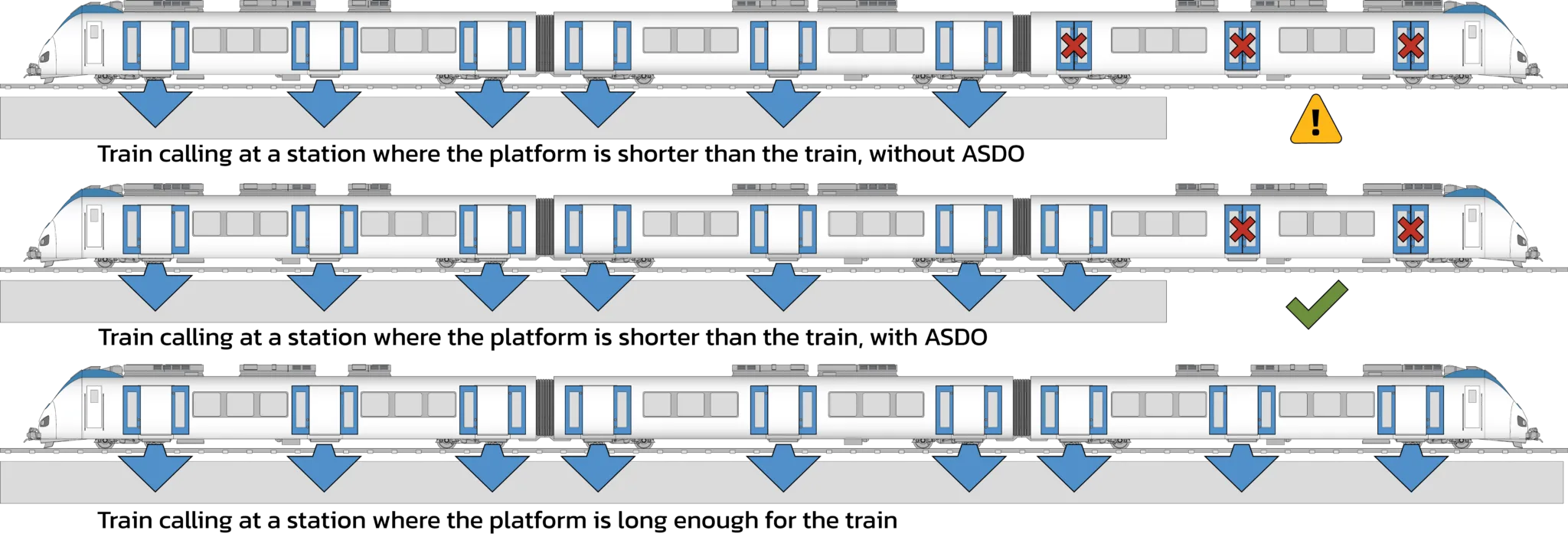
Unfortunatly, the first 2 Skytrain lines were designed to only have 80m stations and trains. The 3rd line to YVR and Richmond was only designed to have 50m stations. In contrast, the Montreal Metro has stations long enough to accomodate 152.4m long trains. Thus, the greatest mistake was to not enable the Skytrain to eventually become a very high capacity train system. Combine that with mostly narrow bridges and roads in Greater Vancouver and you have the epitome of congestive urban planning.
At least by late 2025 some of the new 5 car trains were out, along with some of the old 6 car little box trains on the 1st line. The 2nd and 3rd lines are still running 2 car joke trains, but that symbolically fits right in with the, KEEP BC SMALL AND BACKWARDS mentality.
A proper big city long-term plan would have been to allow for 10 car trains, with at least 5-6 car trains at the start when each line opened.
Victoria has been a provincial backwater for most of its history. Despite being in a mild winter setting, it's so small when compared to Edmonton, Winnipeg, Quebec City and Halifax.
https://www.onevictoriaplace.ca
https://skyscraperpage.com/diagrams/?cityID=37&status=15
While Edmonton was eventually allowed to have a tall building, even by Toronto, Calgary and Montreal standards, Victoria was always supposed to have shorter buildings than Winnipeg, Quebec City and Halifax. That's part of the KEEP THINGS SMALL mentality on V. Island.
Victoria should have had its first LRT line by now, but that might improve urban mobility. Eventually, Victoria and Nanaimo will merge into one linear urban area. Eventually, the Comox_Valley_Regional_District will have over 100,000 people, the Regional_District_of_Nanaimo will have over 200,000 people, the Cowichan_Valley_Regional_District will exceed 100,000 people and the Capital_Regional_District will have over 450,000 people.
Of course there doesn't seem to be any big regional scale planning from Sooke to Courtenay. Perhaps the island's urban planners will wait until there is 800,000 and over a million residents on the island.
https://en.wikipedia.org/wiki/Vancouver_Island#Demographics
So, as more people discover that Victoria and Vancouver are the mildest winter cities in Canada, more people just might want to move there. Especially, when Canadian Snowbirds don't feel as comfortable with Florida, Texas & California.
https://globalnews.ca/news/11602959/london-drugs-closing-woodwards-location-safety-issues/
While Kelowna is gradually fitting into its role as the 3rd largest urban area in BC, Greater Vancouver and Greater Victoria need to function more like properly growing metropolitan areas.
https://globalnews.ca/news/11602086/victoria-store-owner-frustrated-911-services-hung-up-on/
Giving up and letting crime take over is foolish. An effective effort needs to go towards dealing with the various urban social issues.
https://dailyhive.com/vancouver/vancouver-fireworks-2026-new-years-eve-nye
While Vancouver hasn't been able to get most other cities across Canada and around the world to stop, ban or cancel their NY Eve fireworks, strange Vancouver will retain this part of its NO FUN CITY mentality and agenda.
https://www.vancouverisawesome.com/local-news/fireworks-banned-halloween-vancouver-fire-department-9726922 Why just ban them in October and January, when you can ban them throughout the year?
https://www.ehnewspaper.ca/articles/third-year-of-vancouvers-fireworks-ban
For some strange reason, backwards Vancouver hasn't been able to get other cities around the world to adopt the same bizarre idiosyncrasies.
Officially, there isn't supposed to be a Vancouver+Mind+Virus, but the backwards city is so stunted and strange. Other cities in a scenic setting such as Sydney, Auckland, San_Francisco and Seattle are able to have wider bridges in or close to their city centers.
Despite warm and scenic Honolulu having some very short bridges, they are still wider than what extremely restrictive Vancouver allows. These two short bridges in Honolulu provide 4 lanes each way. Thus, they form an 8 lane crossing and they aren't even part of a freeway.
There is also a very short 6 lane bridge in Honolulu. In addition to its 6 lanes, there is a turning lane and a one lane wide median, which makes it equivalent to being 8 lanes wide. Plus, there are 2 wide sidewalks, which are wider than the original sidewalks on the Granville Bridge in Vancouver. In other words, no bridge in Vancouver is allowed to be as wide as it. Despite regional population growth, the Granville Bridge was reduced from 8 lanes to 6 lanes.
Considering how Vancouver has such a narrow road system, one would think that a regional network of bus and bike bridges would be essential. Of course the backwards city and greater urban region is too cheap to fund such infrastructure and rather opted for a congestive transportation approach.
In contrast, The+Helix+Bridge in Singapore is fine example of what backwards Vancouver refuses to build. No lanes had to be removed from the 6 lane Bayfront+Bridge or the 10 lane Benjamin+Sheares+Bridge. Stubborn Vancouver could really benefit from something like the Helix Bridge.
While Vancouver went backwards after Expo 86, Brisbane really took of after Expo 88. The Kangaroo_Point_Green_Bridge, Goodwill_Bridge, Kurilpa_Bridge, Jack_Pesch_Bridge and the Go_Between_Bridge are all great examples of what strange Vancouver refuses to build. What's really amazing from a backwater Vancouver perspective is that those bike and foot bridges in Brisbane never required any lanes to be removed from the cities road bridges.
In comparison, Vancouver removed 2 lanes from the Burrard Bridge, 1 lane from the Cambie Bridge and 2 lanes from the Granville Bridge. If urban planning in Vancouver was wise and the city never got rid of its trams or streetcars, perhaps something like the Tilikum_Crossing could have been built across False_Creek.
https://en.wikipedia.org/wiki/North_Shore_(Greater_Vancouver)
As of 2026, no bus, car, truck and commuter train tunnel was ever built near the extremely inadequate 3 lane Lions+Gate+Bridge. For if there had then, the LGB could have become a nice bike and foot crossing.
Of course no bus, truck and commuter train bridge was built next to the Iron+Bridge. The inadequate Iron Bridge is so narrow that there isn't any room for emergency lanes and especially no proper express or rapid bus lanes.
By now, there should be a SeaBus crossing of at least every 5 minutes in both directions.
Its extremely difficult to bring the Greater Vancouver Region up to a proper urban transportation standard. Partly because this is part of backwards BC and partly because there is just such a lack of a normal big city vision.
For some reason, congestive transportation planning just isn't that popular outside of backwards Vancouver, BC.
https://dailyhive.com/vancouver/riverview-bridge-opening-official-christmas-pattullo-replacement
They should have had a horse and waggon going over the bridge to symbolize the desire by some urban planners to have roads and bridges that aren't much wider than a wagon road.
https://www.youtube.com/watch?v=r4aYxObfjJ8
https://en.wikipedia.org/wiki/Port_Mann_Bridge#Original_bridge The original PMB had only 2 lanes each way with no emergency lanes or wide shoulders. It was designed to be a classic BC bottleneck-chokepoint right from the start. Eventually, a 5th lane was squeezed in.
https://en.wikipedia.org/wiki/Port_Mann_Bridge#Opposition_to_twinning_plan While bridge duplication isn't that big of a problem in Australia or the US, it is in the BC part of Canada. Australia is allowed to have 3 proper big cities on the Pacific. Thus, the urban scale of infrastructure in Melbourne, Sydney and Brisbane are much larger than what's allowed in the Greater Vancouver Region.
https://en.wikipedia.org/wiki/Port_Mann_Bridge#New_bridge Given that this is supposed to be part of the main East-West highway in Canada, a significantly wider bridge was eventually approved. While it was designed with a provision for a potential future rail line, there should have also been a provision for a lower deck.
https://dailyhive.com/vancouver/pattullo-bridge-closures-replacement-opening
No matter how much NW wants to be one of the smallest cities in backwards BC, it can't stop Surrey from eventually being the biggest city in what should be bustling BC. The SkyBridge was deliberately designed to not have any HOV or truck lanes. The narrow SkyBridge wasn't even designed to eventually become a bus and bike bridge. Just a train bridge without even any sidewalks. It really should have been given an award for one of the worlds best examples of inept urban infrastructure.
It's like the SkyBridge (1990) was designed to be the first part of the new inadequate crossings between NW and Surry.
Indeed, just like its 1937 predecessor, the Pattullo_Bridge_replacement will open with only for lanes, but at least it will have 2 bike lanes and 2 sidewalks. The Pattullo_Bridge_replacement should have opened with 6 lanes and 2 wide shoulders or emergency lanes, but that would go against funneling everything into just 2 lanes each way. No emergency lanes or wide shoulders helps to reduce emergency vehicle inefficiency. No bus & HOV lanes helps to increase transportation congestion. Despite being a seaport region, there aren't any truck lanes. Perhaps the best feature of all is than the bridge wasn't designed to eventually have a lower deck for trains and trucks.
Multibillion dollar bridges can be designed with future widening capabilities, or at least having a provision for a lower deck. Unfortunatly, it's very difficult for BC to design prober big city size transportation infrastructure.
https://macleans.ca/society/montreals-new-rail-line-is-the-future/
https://en.wikipedia.org/wiki/Grand_Paris_Express , https://www.youtube.com/watch?v=88nkbjsLbI8
| Formation |
|
|---|---|
| Capacity | 932 per train (8 cars set) |
https://en.wikipedia.org/wiki/MP_14_(Paris_Metro)
| Train length |
|
|---|---|
| Car length | 15.04 m (49 ft 4 in) |
https://www.youtube.com/watch?v=CipNVHhOER8
Why is the Purple Line in L.A. so Short? https://www.youtube.com/watch?v=f4F0hB2nEcE
Why fixing LA’s transit crisis feels impossible https://www.youtube.com/watch?v=UIlLC0KNCYc
Why Traffic Is So Bad In Los Angeles https://www.youtube.com/watch?v=S76lKWeU_xc
Why LA Destroyed Its World-Class Transit System https://www.youtube.com/watch?v=AwKv3_WwD4o There was such a drive to have nice, wide highways, but no one seemed to realize that eventually just having an extensive highway system will become overloaded.
Why is LA traffic so bad? https://www.youtube.com/watch?v=DbiI9ainetY
The real cost of freeways in LA https://www.youtube.com/watch?v=HS6WrJZKbjs Wide highways can certainly accommodate a large volume of traffic, but if there isn't an efficient bus and rail system, it all gets overloaded.
Did GM really kill the streetcar in Los Angeles? https://www.youtube.com/watch?v=RnFVBfhpprU
LA's $40 Billion Plan to Transform for the 2028 Olympics https://www.youtube.com/watch?v=AkKsiIaycU8
https://dailyhive.com/vancouver/vancouver-olympic-line-streetcar-demonstration-revival-proposal
The city and greater urban region should have never gotten rid of the streetcars and interurban tram-trains. Now, its extremely difficult to bring them back. Fortunately, backwards Vancouver was unable to get Toronto, Melbourne and SF to get rid of their street railways. Those cities and many others just never had anything like a Vancouver Mind Virus or BCMV to thwart them.
Of course Seattle & Portland would bring back some of their streetcar lines long before slow-moving Vancouver can.
https://dailyhive.com/vancouver/canada-public-transit-fund-building-communities-strong-fund
https://www.cbc.ca/news/canada/british-columbia/metro-vancouver-transit-funding-1.7490218
https://housing-infrastructure.canada.ca/cptf-ftcc/mra-erm/index-eng.html
https://housing-infrastructure.canada.ca/cptf-ftcc/index-eng.html
https://www.railwaypro.com/wp/canada-creates-transit-fund-to-support-public-transport/
https://globalnews.ca/news/10702607/canada-public-transit-funding-shortfall/
How Two U.S. cities will KICK OFF their rail transit revolution https://www.youtube.com/watch?v=eRLMtmWwAsE Dallas is part of a much larger urban area.
https://www.mylifeelsewhere.com/city-size-comparison/phoenix-c3944/dallas-c3890
https://www.chase.com/personal/mortgage/cityvscity/phoenix-dallas
https://www.mylifeelsewhere.com/city-size-comparison/dallas-c3890/phoenix-c3944
https://globalnews.ca/news/11528001/burnaby-apology-discrimination-against-chinese-community
Asia is the most populated part of the world and until recently, China had the biggest population. Thus, people from China or people who are of Chinese descent, live all over the world. There was a strong, KEEP CANADA WHITE agenda, right into the mid 20th century. Of course this mentality wasn't just directed towards Asians, but towards anyone who was nonwhite.
https://en.wikipedia.org/wiki/Chinese_head_tax
It took until the 1970s for Multiculturalism to challenge the, KEEP CANADA AS A WHITE MAN'S PARADISE.
https://pier21.ca/research/immigration-history/canadian-multiculturalism-policy-1971
https://thecanadianencyclopedia.ca/en/article/multiculturalism
While Canada hardly has that much of a Pacific Coast, when compared to the US and Australia, the BC part of Canada should have had at least one major city on the scale of Montreal or Seattle, Brisbane or SF. Unfortunatly, Vancouver has retained several of its overlapping restrictions, which prevent it from being on a scale similar to that of Montreal, Seattle, Calgary, Brisbane & SF...
Despite Burnaby & Grater Vancouver being multicultural for several decades, so much of the restrictive BC mentality remains like an old disruptive computer program that hasn't been deleted. Unfortunatly, after the WW2 era, Greater Vancouver and BC continued with a backwater mentality. Just look at how much bigger things are allowed to be in Australia's 4 largest cities. Look at the scale of Seattle & Calgary & see how much of Greater Vancouver is still held back. Look at how big Edmonton as a capital is, while Victoria remains as a small provincial backwater.
Unlike Melbourne, SF and Toronto, backwards Vancouver made sure that it was one of the first cities to get rid if its streetcar and tram-train (interurban) network before the 1960s. To make matters worse, the Greater Vancouver Region had and still does, have a system of mostly narrow bridges.
There was such a push to have a tracks to tires agenda, no one seemed to realize that all the bridges should be wide enough to accomodate 2 bus lanes, or at least build a bus bridge or tunnel next to an existing bridge.
Just because Multiculturalism in Canada started to officially get going in the 1970s, the city & municipal councils and planning departments were still predominantly managed by people of European descent. For most of the Colonial and postcolonial history of BC, the main municipalities were Vancouver, Burnaby, NW & Victoria. It was that way right into the 1970s.
Since the predominantly White civic structure was firmly in place well into the 1980s, there was plenty of time to implement and maintain a social engineering agenda. An unofficial (White) Urban Livability Plan was cleverly devised by scaling almost everything down. Since BC can't control non-white immigration, "Livability" had to be symbolically quite visible. Livability was an ingenious way to impose various overlapping restrictions throughout the decades. How does the Livability agenda work? Suppose that there was a mostly subconscious mentality to refuse building up proper big city infrastructure for non-white people. Thus, by symbolically constructing inadequate transportation infrastructure, it becomes a way demonstrating that you are not properly building for the future, despite most of the world being non-white. Now, Burnaby & the Greater Vancouver region are so far behind now, its difficult to catch up to other proper metropolitan areas around the world.
Despite Canada being the 2nd largest country in overall size, it has such a small area on the Pacific_Rim and Asia is the most populated part of the world. By keeping most of the bridges narrow and the trains short compared to most cities, that fits right in with the symbolism of antigrowth towards a predominantly non-white world. Canada is nowhere near close to having 1% of the worlds population, but most of the world is non-white. Its been that way since the beginning.
https://jfdatalinks.blogspot.com/search?q=Burnaby+apologizes
https://www.youtube.com/watch?v=2i8DynYuNgY
Once again urban infrastructure hasn't been properly keeping pace.
Since BC started out as a British Colonial outpost, people of European descent were at the orchestrated top of the human hierarchy. Chinese and Asians & nonwhites in general were a concern to the White majority of early BC.
https://www.veterans.gc.ca/en/remembrance/people-and-stories/chinese-canadians
South Asians were also a concern to the colonial power structure.
https://thecanadianencyclopedia.ca/en/article/komagata-maru
https://www.canada.ca/en/parks-canada/news/2016/08/the-komagata-maru-incident-of-1914.html
Of course Indigenous and Black People were part of being categorized as a lesser class of human.
It took a very long time for the British_Empire to respect the people of a multicultural world.
https://en.wikipedia.org/wiki/Territorial_evolution_of_the_British_Empire
https://en.wikipedia.org/wiki/Historiography_of_the_British_Empire#Decline_and_decolonization
Multicultural Canada has less than 1% of the world's population. Yet, so many smaller countries are able to have a higher density and larger population than Canada.
Burnaby in Greater Vancouver is part of Canada's largest urban area on the Pacific_Rim. There are still many people who would like to thwart the scale of growth in Greater_Vancouver. They don't want the region to become as big and dynamic as Montreal, Toronto, Calgary, Seattle, SFBA, Melbourne, Sydney & Brisbane.
A big & dynamic urban region means more Asians and more nonwhite people in general. Unfortunatly, some people are still too uncomfortable with that notion.
https://jfdatalinks.blogspot.com/search?q=Burnaby+apologizes