https://en.wikipedia.org/wiki/King_George_Square_busway_station
Showing posts sorted by date for query Brisbane. Sort by relevance Show all posts
Showing posts sorted by date for query Brisbane. Sort by relevance Show all posts
Saturday, July 11, 2026
First Nation files court challenge against Burrard Inlet dredging project for oil tankers
Decades ago, there should have already been a North Boundary Road bus and bike bridge beside the Iron-Bridge. Since the Iron Bridge wasn't widened to accommodate 2 express bus or 2 rapid bus lanes, a North Boundary Road bus and bike bridge would have been a huge improvement.

Canada is on the same planet as Australia, but seems to be on a different world. Asia, Europe and the US just don't seem to have the same overlapping restrictions as Canada and especially, BC.
Greater Vancouver should be on a similar city and port level as Brisbane, but the provincial backwater BC mindset keeps holding things back.
If Burrard Inlet isn't a suitable location for the tankers, then another location must be found. BC remains as a provincial backwater on the Pacific Rim and Canada has less than 1% of the worlds population. If it were possible, there are those in Canada who would like to just shut out the world and even shut Canada down.
Australia hasn't been able to do so much more than Canada simply because it doesn't have half of the year stuck in cold, crappy weather.

Friday, July 10, 2026
Victoria Bus and Bike Bridge in Brisbane
https://www.google.com/maps/place/Victoria+Bridge
Of course a bus and bike bridge makes sense in Brisbane & Calgary. That's why they aren't allowed in backwards Vancouver.
https://www.reddit.com/r/brisbane/comments/1e98dkr/the_busway_victoria_bridge_living_up_to_its_name/
Vancouver is so lacking with bus and bike bridges. Its an ongoing part of the+missing+element in transportation planning in BC.
https://www.google.com/maps/place/Eleanor+Schonell+Bridge
https://www.google.com/maps/place/Kurilpa+Bridge
https://www.google.com/maps/place/The+Neville+Bonner+Bridge
https://www.google.com/maps/place/Goodwill+Bridge
While Queensland is on the same planet as backwards BC, it might as well be on a different world.
Story Bridge and Clem Jones Tunnel vs the inadequat LGB
https://en.wikipedia.org/wiki/Story_Bridge 3 lanes each way.
https://en.wikipedia.org/wiki/Clem_Jones_Tunnel (CJT) 2 lanes each way.
https://en.wikipedia.org/wiki/Clem_Jones_Tunnel#Public_transport
https://www.google.com/maps/place/Story+Bridge
The+Missing+Element in backwards BC.
In contrast, Vancouver is stuck with a 3 lane LGB, with no parallel bus, truck and train tunnels. If visiting Vancouver from Brisbane, or almost any Australian city or town, you will be shocked. While Australia is allowed to have 3 big port cities on the Pacific Rim (Mel Syd & Bris), Canada has taken a Half-A$$ED approach.
While the Port_of_Prince_Rupert has a lot of potential, most of it remains as a watered down front.
https://en.wikipedia.org/wiki/Port_of_Prince_Rupert#Conversion_to_an_intermodal_terminal
https://en.wikipedia.org/wiki/Victoria_Harbour_(British_Columbia)#Facilities
https://gvha.ca/deep-water-terminal/terminal-information/ V-BC has potential, but its also so scaled back or watered down.
Despite Victoria wanting to remain as a quaint provincial backwater, it should eventually become a proper port city like Wellington. https://www.centreport.co.nz/
https://en.wikipedia.org/wiki/CentrePort_Wellington#Containers
Port of Vancouver, BC.
The Gateway Bridges in Brisbane vs the SCB in Seattle
The Sir_Leo_Hielscher_Bridges provide a 12 lane Gateway crossing.
https://en.wikipedia.org/wiki/Sir_Leo_Hielscher_Bridges#Duplication

https://upload.wikimedia.org/wikipedia/commons/6/6e/Gateway_Bridge_aerial4.JPG No problem in Queensland.
https://www.google.com/maps/place/Gateway+Bridge Its tough enough just to get a 6 lane bridge built in BC, let alone a 12 lane crossing.
https://en.wikipedia.org/wiki/Ship_Canal_Bridge (SCB) Its a 12 lane crossing.
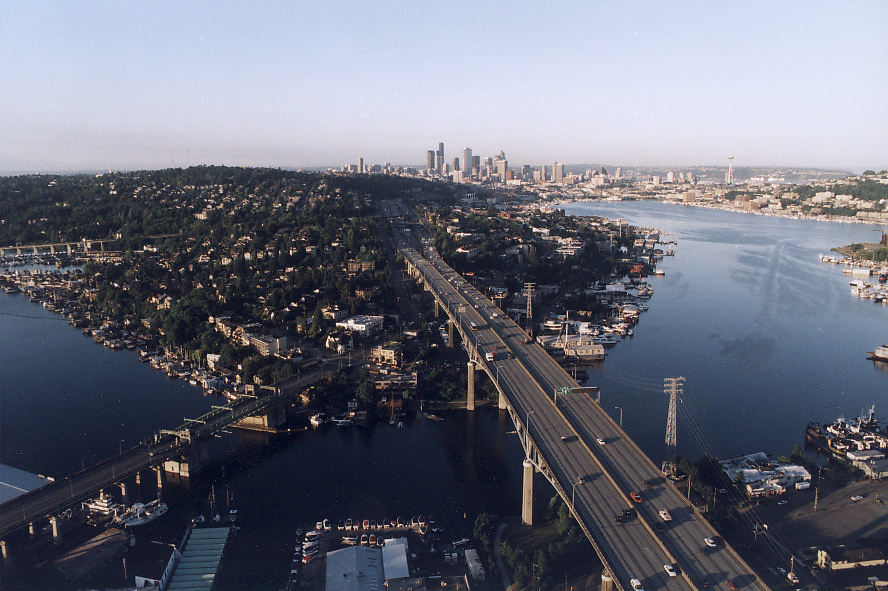

While Brisbane and Seattle are both on the Pacific Rim, backwards Vancouver, BC might as well be on another world. Brisbane and Seattle are allowed to function like proper big port cities, because they aren't hindered by anything like the VMV, or the Backwards BC Mentality.
If such a 12 lane crossing was allowed in Greater Vancouver it would mean that there could be 2 BRT lanes, 2 HOV lanes, 2 truck lanes and at least 6 general traffic lanes. However, the backwards BC approach is to funnel everything into just 2 or 3 lanes each way.
6 lanes, plus 2 train tracks
https://www.google.com/maps/place/18B+Howard+Smith+Dr,+Port+Of+Brisbane
A 6 lane bridge and a rail-bridge with 2 tracks.
Brisbane got it right and Vancouver got it wrong. Both are major Pacific port cities, but the Vancouver version is watered down.
https://www.google.com/maps/place/Iron+Workers+Memorial+Bridge 6 lanes, but should have been 8-10 lanes by now.
https://www.google.com/maps/place/Thornton+Tunnel+North+Entrance Its only a single track tunnel and freight train bridge. Any major seaport region should have double track bridges and tunnels.
https://www.google.com/maps/place/Riverview+Bridge Its only 4 lanes, but has a potential to become a 6 lane crossing. https://www.pilingcanada.ca/bridging-the-past-into-the-future/
The New_Westminster (rail)_Bridge should have opened with 2 tracks and had enough future width for a 3rd track.
The Brisbane International Cruise Terminal
https://en.wikipedia.org/wiki/Brisbane_International_Cruise_Terminal
https://www.portbris.com.au/cruise
https://www.arkhefield.com.au/projects/brisbane-international-cruise-terminal
https://en.wikipedia.org/wiki/Brisbane_International_Cruise_Terminal#Usage
https://www.cruisecritic.com/articles/port-of-brisbane-cruise-terminal-parking-address-amenity-info
The Port of Brisbane’s future capacity
https://www.portbris.com.au/major-projects/fpe
https://www.portbris.com.au/property/land-use-planning
https://www.portbris.com.au/portbris-2060
https://www.google.com/maps/place/Port+Of+Brisbane+QLD+4178,+Australia
The Sir_Leo_Hielscher_Bridges provides a 12 lane crossing and provides great access to the airport and seaport.
https://en.wikipedia.org/wiki/Sir_Leo_Hielscher_Bridges#Duplication
Saturday, June 27, 2026
How much will Vancouver change by 2036?
https://www.youtube.com/watch?v=OJtotvMq2ls
The Lion+Bridge will likely still not have an express bus and LRT tunnel near it. The+Iron+Bridge still might not have a proper BRT and LRT bridge next to it. The OSB and the KSB will likely not have a bus and bike bridge built beside them. There will still likely be no new Fraser Street Bridge for bikes and buses. No Boundary Road bridges to provide a direct link between the North Shore and Richmond for buses, trucks and bikes.
While the first 2 Skytrain lines will have 5 car trains, the stunted YVR-Canada Line will only have 2.5 car trains. Vancouver still might not permit any office tower to have a 40th floor, but might allow some residential towers to be on a Melbourne, Sydney, Brisbane & Toronto scale.
However, BIG city thinking and planning in Vancouver has always been so difficult. Boston, SF and the City of Paris are ridiculously small cities like Vancouver with all 3 having a land area of less than 50 sq. mi. or 129.5 sq. km. Yet, Boston, SF and especially the City of Paris, have all been able to fit so much more into the same general space. That's because they aren't bound by anything like the inept and extreme Vancouver type restrictions.
Thursday, June 25, 2026
Burrard Inlet dredging approved to boost Vancouver port's oil tanker capacity
https://dailyhive.com/vancouver/burrard-inlet-second-narrows-dredging-vancouver-oil-tanker
Its so difficult for Canada to even have even one proper major port city on the Pacific Rim when Australia has Brisbane, Sydney & Melbourne.
Most of the Greater Vancouver bridges are only 2 lanes each way & single track freight train bridges, when they should have been doubletracked by now.
https://gvha.ca/deep-water-terminal/shore-power-project Small town.
https://www.rupertport.com/cargo-volumes Very small town.
Tuesday, June 2, 2026
Seoul's Subway System Is Decades Ahead of many others
https://www.youtube.com/watch?v=PPlGQDpx4xg
While there could be a reasonable argument that if a subway or elevated line isn't expected to be that busy in its first few years, then just build half-size stations and run half-length trains. However, in the case of backwards Vancouver, what should have been stations that were designed to accommodate at least 5 car trains, were only designed for an eventual 2.5 car train. Thus, it will be challenging enough just to modify the incredibly short Canada Line stations to gradually accommodate 3 full-size 20 m cars, not just some 2.5 car joke of a train for a 50 m station.
Fortunately the Skyline_(Honolulu) stations can accommodate a 4 car train right from the start. Someday, with SDO a 4 car train could become a 6 car train.
If Selective+Door+Operation (SDO) can ever be implemented on the YVR-Canada Line then it can go from being a 2 car joke of a train to a 3 car attempt of a train. Then, once people got used to 3 car trains, an extra car could be added at both ends, thus allowing for a 5 car train.
Ultimately, the YVR-Canada+Line should have been designed as a proper big-city size train with 8-10 cars. There seems to be such a lack of proper long-term transportation infrastructure planning in BC. To just build a small-scale line as a symbolic demonstration of reluctance towards the Pacific Rim is so absurd.
Fortunately, Melbourne, Sydney and Brisbane never opted for such a short train.
There Is a Hidden City Under Seoul Nobody Talks About. https://www.youtube.com/watch?v=pIewf8sOZ0I
Sunday, May 31, 2026
Vancouver 450 ft and Fahrenheit 451
Was a 450 foot height restriction just by chance, or was it intentionally made to be very close to 451 Fahrenheit? Despite being around the same size as Paris, Boston & SF, Vancouver remains as a very restrictive city.
Any tall building in SL City is under 450 feet. Honolulu is still stuck around the 450 foot maximum, while San Diego is stuck at 500 feet. Even Rio DeGennaro still has shorter buildings than Vancouver, BC. Washington, DC has strict height limitations like Paris. However, W,DC could eventually set up their own equivalent of La_Defense. Its a fine example of allowing tall buildings just beyond the city limits.
https://en.wikipedia.org/wiki/Fahrenheit_451 (1953) By the 1950s, so many things were already banned, watered down or scaled back in provincial backwater Vancouver. Generations later, there was the No Fun City mind virus that further tried to cancel out things in such a small city with so much red tape and other ridiculous obstacles.
https://en.wikipedia.org/wiki/Fahrenheit_451_(1966_film) By the mid and late1960s, the city made sure that its first office tower to have more than 29 floors wouldn't be until the 1970s. Its highly doubtful that Vancouver will have an office tower at, or over 40 stories by 2030. However, Burnaby and Surrey could, because they aren't under the extreme restrictions of the Vancouver Mind Virus (VMV).
It wasn't until 1973 when Vancouver allowed its first building to be taller than the Los_Angeles_City_Hall. https://en.wikipedia.org/wiki/Los_Angeles_City_Hall

The Scotia_Tower (stump) is a good reference point to visualize the small scale of backwater Vancouver, as its about the same height as the Los_Angeles_City_Hall at 453'.

https://www.skyscrapercenter.com/building/scotia-tower/4396 453'
https://skyscraperpage.com/b65/vancouver/the-scotia-tower 452'
https://en.wikipedia.org/wiki/One_Wall_Centre It opened in 2001 at 157.8 m (518 ft). Its 49 feet shorter than the Philadelphia_City_Hall.

https://en.wikipedia.org/wiki/Philadelphia_City_Hall Opened in 1901 at 548 ft (167 m).
https://en.wikipedia.org/wiki/Fahrenheit_451_(2018_film) By 2018 it was quite apparent that Vancouver was in the process of allowing for more buildings over 450 feet. However, nothing has been permitted to reach 700 feet, so far. A tower over 1000 feet would help to water down its provincial mindset.
_(cropped).jpg/3840px-Vancouver_panorama_(49988799796)_(cropped).jpg)

SF, Sydney & Auckland are just as scenic as Vancouver & warmer throughout the year. They all have taller building than what Vancouver currently permits. Seattle is just as scenic as Vancouver, but its allowed to function like a proper big city, because it doesn't have the imposed restrictions like Vancouver has. While its cold, damp & depressing like Vancouver during the fall & winter, Seattle usually gets noticeably hotter summers than Vancouver, BC. The tallest building in Seattle is the 76 story B of A office tower.

Everything is so small or scaled back in Vancouver. Even the Greater Vancouver mountains aren't allowed to be as tall as the ones in L.A. While the San_Francisco_Bay & Port_Phillip Bay by Melbourne are big next to their cities, English_Bay in_Vancouver is so much smaller. Its even smaller than Elliott_Bay by Seattle.
Vancouver really needs to have bus and HOV bridges built next to its mostly narrow & congested bridges. Only a 5 car Skytrain is the max on the first 2 lines and ultimately, just a 2.5 car joke of a train on the YVR-Canada Line.
Selective+Door+Operation can allow a short train to have an extra car at each end, despite a shorter platform.
.jpg/3840px-Vancouver_sunset_(J).jpg)


Australia like the USA, has some big & tall cities on the Pacific Rim. However, Vancouver symbolically kept watering down its size, because that's how you demonstrate a reluctance towards proper urban planning & growth.
Oddly enough, the imposed small scale Vancouver mentality & agenda wasn't adopted by most cities around the world. Officially, there is no Vancouver Mind Virus (VMV), but somehow something like it keeps manifesting, just like the BCMV.
Despite its size, Canada has less than 1% of the worlds population. Its been difficult enough just for Canada to even have half of 1% of the worlds population.
One expects Melbourne and Sydney to be proper big cities. However, Australia has big stuff at both ends of the country.
https://en.wikipedia.org/wiki/Sir_Leo_Hielscher_Bridges#Design Its a 12 lane crossing in Brisbane.
https://en.wikipedia.org/wiki/Narrows_Bridge_(Perth) 10 lanes with 2 commuter train tracks in the middle.
https://en.wikipedia.org/wiki/Brisbane_Skytower It has 90 floors. https://en.wikipedia.org/wiki/Q1_(building) Almost has 80 floors.
Perth Central_Park_(skyscraper) at 51 floors and 108_St_Georges_Terrace at 50. Very restrictive Vancouver still won't permit any office tower to have a 40th floor. Calgary and Seattle each have a few over 50 stories.
So far, provincial Halifax hasn't been allowed to be on a similar scale as Boston and Montreal.
https://en.wikipedia.org/wiki/Angus_L._Macdonald_Bridge 3 lanes.
https://en.wikipedia.org/wiki/A._Murray_MacKay_Bridge 4 lanes.
The scale of Vancouver is kept below that of Calgary & Seattle or even Auckland, in some ways.
https://en.wikipedia.org/wiki/Lions_Gate_Bridge A classic 3 lane BC bottleneck-chokepoint. No parallel bus and truck tunnels and especially, no LRT tunnel.
Provincial backwater Victoria isn't allowed to be on a similar scale of Wellington, NZ.
https://en.wikipedia.org/wiki/Johnson_Street_Bridge Another BC 3 lane wonder.
Saturday, May 9, 2026
Sydney's SEVERED Skyline vs. the stumps of Vancouver
https://www.youtube.com/watch?v=SpEoJia-4ns Fortunately, Melbourne, Brisbane and Perth don't have similar restrictions as Sydney. However, NSW still has less imposed restrictions and impediments as backwater BC.
Backwards+Vancouver B$ logic should never make it to Sydney, or any other properly functioning city. Fortunately overall, NSW never was overtaken by anything like the BC Mind Virus (BCMV). Otherwise, Sydney would also have narrow bridges, short trains and mostly short buildings.
https://en.wikipedia.org/wiki/25_Martin_Place Over 60 levels.
https://en.wikipedia.org/wiki/Scotia_Tower Not even 40 levels.
Vancouver still won't allow any office tower to have 40 floors, let alone 50 or 60.
Tuesday, May 5, 2026
The urban trifecta of backwards Vancouver
https://www.merriam-webster.com/dictionary/trifecta
https://en.wikipedia.org/wiki/Trifecta#History
Ideally, for some small thinking cities, the plan is to symbolically have mostly short buildings and short trains and mostly narrow bridges.
That seems to have been the goal of Vancouver over the past several decades. In contrast, Brisbane after its Expo 88, was able to really go into big city planning mode, because it doesn't have anything like the excessive Vancouver restrictions holding it back.
1 The+Typical+Vancouver+Size+Stump+Building No office tower has been permitted to have a 40th floor. https://jfdatalinks.blogspot.com/search?q=The+Stumpy+Post+building+in+Vancouver Never-mind 40 or 50 stories, it wasn't even allowed to have 25 floors.
2 YVR-Canada+Line A 2 car joke of a train.
3 Lions+Gate+Bridge A 3 lane joke of a bridge.
https://jfdatalinks.blogspot.com/search?q=backwards+Vancouver
Saturday, May 2, 2026
Expo 86 and Expo 88
https://en.wikipedia.org/wiki/Expo_86
https://en.wikipedia.org/wiki/Expo_86#Fair
Unlike highly restrictive Vancouver, Brisbane started to allow taller buildings, wider bridges and longer trains.
https://en.wikipedia.org/wiki/World_Expo_88
https://en.wikipedia.org/wiki/World_Expo_88#The_Fair
No office tower in Vancouver has been allowed to have a 40th floor. No Vancouver bridge is allowed to have 8 lanes. Only some of the newest Skytrains have 5 cars, but certainty not 8-10. That would go against the congestive transportation mentality of BC.
The VMV and the BC Mind Virus are so firmly entrenched.
Sunday, April 5, 2026
Road transport in Brisbane
https://en.wikipedia.org/wiki/Road_transport_in_Brisbane
https://en.wikipedia.org/wiki/Bridges_over_the_Brisbane_River#Major_bridges
https://en.wikipedia.org/wiki/Clem_Jones_Tunnel 4 lanes
https://en.wikipedia.org/wiki/Story_Bridge 6 lanes
https://www.google.com/maps/place/Story+Bridge A nice 10 lane crossing.
In comparison, the 3 lane Lions+Gate+Bridge still hasn't had a parallel relief tunnel. If a 7-8 lane tunnel is ever built, then the LGB could be for express or rapid busses.
World Expo 88 in Brisbane
https://en.wikipedia.org/wiki/World_Expo_88 This city was able to do so much after their expo, because they didn't have the same restrictions imposed upon them like what Vancouver has.
https://www.bie-paris.org/site/en/1988-brisbane
https://en.wikipedia.org/wiki/Brisbane#Tourism_and_recreation
https://en.wikipedia.org/wiki/Brisbane#Transport
It would be disastrous if Brisbane took the Vancouver approach to things.
https://en.wikipedia.org/wiki/Busways_in_Brisbane
https://en.wikipedia.org/wiki/Eleanor_Schonell_Bridge Unfortunatly, such a nice bus and bike doesn't exist in backwards Vancouver. The whole region could greatly benefit from a proper bus and bike network. Most of the bridges in Greater Vancouver are so narrow, there isn't enough room for separate bus lanes. Most of the sidewalks and bike lanes are also too narrow.
https://en.wikipedia.org/wiki/Translink_(Queensland)
https://en.wikipedia.org/wiki/Bridges_over_the_Brisbane_River#Major_bridges
https://en.wikipedia.org/wiki/List_of_tallest_buildings_in_Brisbane#Tallest_buildings
Subscribe to:
Posts (Atom)