Showing posts sorted by date for query Granville Bridge. Sort by relevance Show all posts

Friday, May 15, 2026

Granville Bridge death was preventable, advocates say

 https://vancouver.citynews.ca/2026/05/14/granville-bridge-death-was-preventable-say-advocates/ 

While the Granville+Bridge needs to have a higher fence like the Burrard+Bridge, there is another remaining pending danger. 

https://vancouversun.com/news/iio-investigates-womans-death-after-9-hour-incident-on-granville-street-bridge 

There is no central safety barrier to prevent head-on collisions. Whether a person becomes disoriented, or actually wants to crash into traffic from the opposite direction, there is no traffic divider.

https://www.ctvnews.ca/vancouver/article/barrier-needed-on-vancouver-bridge-after-another-suicide-death-advocates-say/

The sidewalks could have been made a little wider in a way that there still could have been enough space for a traffic divider. 

https://www.reddit.com/r/vancouver/comments/1td85mt/iio_investigates_womans_death_after_ninehour/

Saturday, April 25, 2026

Gateway landmark condo and hotel tower proposed beside Granville Street Bridge in Downtown Vancouver

 https://dailyhive.com/vancouver/601-beach-crescent-vancouver-condo-hotel-pinnacle-international-tower-revised-concept "The proposal now envisions a 650-ft.-tall, 67-storey tower..." 

While this would be the 2nd tallest in Vancouver, in several other cities it would just be an average tall building.

Sunday, March 29, 2026

RAPID Regional Transit in the Sea to Sky: Connecting Vancouver to Squamish, Whistler, and Pemberton

 https://www.youtube.com/watch?v=OE_W5Vj6OeQ With Greater Vancouver having so many narrow bridges, there must be a regional network of bus and bike bridges, otherwise it all just remains a sad joke.

How bike lanes has affected Vancouver's urban infrastructure https://www.youtube.com/watch?v=LvkifuIjq9I Many cities don't have to remove traffic lanes, because they build proper bike bridges. 

Bike Lanes https://www.youtube.com/watch?v=oez4TTpIQWg With Vancouver being so obsessed with removing lanes from bridges, it becomes much more difficult to have bus lanes on the narrow bridges. 

A bike bridge should be built next to the Burrard, Granville and Cambie bridges. Then there would be enough room for each of them to accommodate 2 bus lanes. Things are so mixed up in backwards Vancouver.

Wednesday, February 25, 2026

Vancouver council boosts budget for roads, sidewalks by $70M

More than 60 per cent of Vancouver’s arterial roads, local streets considered in fair to very poor condition https://www.biv.com/news/economy-law-politics/not-sexy-but-fundamental-vancouver-council-boosts-budget-for-roads-sidewalks-by-70m-11921125 

The cities roads and streets are so inadequate, but Vancouver isn't allowed to become a proper big city.

The decision to not carve up small Vancouver with freeways between the 1950s and 1970s was a wise and novel idea at the time. However, there wasn't any proper foresight over the past several generations to make sure that the cities mostly narrow bridges didn't become bottleneck-chokepoints. 

By now, every bridge should have had a bus and HOV bridge built next to it. Instead, 2 lanes were removed from the Burrard Bridge, 1 lane from the Cambie Bridge and 2 from the Granville Bridge. 

Conveniently, no bike bridges were ever built next to those bridges. Apparently, what was disguised as a cost saving measure by not building proper bike-bridges, the decision was made to remove traffic lanes from some bridges. This all seems to be part of the bottleneck planning mentality. 

It's amazing how several cities around the world are able to build bike-bridges, simply because they aren't under anything like the backwards Vancouver planning agenda. 

Saturday, January 31, 2026

Why Greater Toronto Has Several Skylines

 https://www.youtube.com/watch?v=eI9WJa9Q8dA 

Of course many large urban areas around the world have more than 1 or 2 skylines or tower clusters. 

For the longest time, no building in Vancouver or BC, was allowed to be as tall as the 1930s CIBC tower, which is now a stump.

https://www.blogto.com/city/2017/05/toronto-lost-observation-deck-commerce-court-north/

https://www.torontojourney416.com/canadian-bank-of-commerce-building/ 

https://www.25king.ca/the-history 

It wasn't until the early 1970s when stumpy, Vancouver allowed a building to be taller than the L.A. City Hall, or the Smith Tower in Seattle. 

The 1930s CIBC tower, the L.A. City Hall and the Smith Tower, would still be prominent towers in Vancouver, but stumps in their own cities. 

Despite Vancouver being divided by an inlet and a river, the city wasn't able to build a huge wall along Boundary Road. Thus, the KEEP THEM OUT agenda was a little thwarted. The various White city councils tried to do the next best thing. That was to symbolically impose various restrictions as a reluctance to think, plan and build on a BIG city scale. The time especially from 1960 to 2000 had predominantly White City Hall and its councils continually impose several overlapping restrictions. 

Since Vancouver can't control immigration or the movements of non-white people, keeping things small and backwards, means that less people will move there than to Toronto, Montreal, Calgary and Edmonton. However, with a mild winter climate, more and more people want to move to backwards BC, especially small-minded Vancouver and provincial Victoria. 

In spite of immigration and Multiculturalism, Vancouver was to perpetually promote its small scale agenda. 

While the first Skytrain line can finally run 5 car trains, the stations weren't designed to become long enough to eventually accomodate 9 car trains like the big city Montreal Metro has. 

The 2nd and 3rd Skytrain lines are still only running 2 car joke trains. Running 8-10 car trains is what a proper big city would do, but not backwards Vancouver. 

Narrow bridges provides strong symbolism of the cities narrow-mindedness. When bridges are too narrow, its difficult to have a proper express or rapid bus system. The reluctance to build parallel bus and HOV bridges helps to maintain the congestive planning approach that is vancouver and the Greater Region. 

Vancouver's refusal to build parallel bike bridges has meant that 2 lanes were removed from the Burrard Bridge, 1 lane from the Cambie Bridge and 2 lanes from the Granville Bridge. 

Keeping buildings symbolically short when compared to what scenic Sydney, Auckland, SF and Seattle allow, also helps to maintain Vancouver's reluctance to enter the big and tall urban scale. In fact, the scenic setting that Vancouver is in has been used as the main excuse to continually scale the city down. Yet, several scenic cities around the world are either able to have wider bridges, wider roads, longer trains or taller buildings. 

The world is mostly composed of non-white people. Canada has less than 1% of the world's population and stubborn Vancouver symbolically remains as a small provincial backwater on the Pacific Rim. 

https://centralparktower.com.au Unlike Perth, Vancouver forbids 50 story office towers and Brisbane, Sydney and Melbourne size residential towers. 

https://en.wikipedia.org/wiki/108_St_Georges_Terrace In fact, no office building in Vancouver has been permitted to have a 40th floor. However, since Burnaby and Surrey aren't under the restrictive controls of Vancouver, they will eventually allow office towers over 40 stories. 

Despite Australia having less people than Canada, Perth is allowed to have taller buildings, wider bridges and longer trains than Vancouver. Taller buildings, wider bridges and longer trains are even less likely in Halifax than whats in Brisbane or Queensland.

https://en.wikipedia.org/wiki/Q1_(building) To see buildings on a similar scale of what Brisbane allows, one has to get to Greater Toronto. Brisbane is allowed to have some buildings that would even be impressive in Melbourne and Sydney. 

While Montreal is allowed to have taller buildings than Vancouver, Montreal isn't allowed to have Sydney size towers. Especially not on the scale of what Melbourne and Toronto permit. 

Monday, December 29, 2025

No fireworks in downtown Vancouver for New Year's Eve or the rest of 2026

 https://dailyhive.com/vancouver/vancouver-fireworks-2026-new-years-eve-nye 

While Vancouver hasn't been able to get most other cities across Canada and around the world to stop, ban or cancel their NY Eve fireworks, strange Vancouver will retain this part of its NO FUN CITY mentality and agenda. 

https://www.vancouverisawesome.com/local-news/fireworks-banned-halloween-vancouver-fire-department-9726922 Why just ban them in October and January, when you can ban them throughout the year? 

https://www.ehnewspaper.ca/articles/third-year-of-vancouvers-fireworks-ban

For some strange reason, backwards Vancouver hasn't been able to get other cities around the world to adopt the same bizarre idiosyncrasies.  

Officially, there isn't supposed to be a Vancouver+Mind+Virus, but the backwards city is so stunted and strange. Other cities in a scenic setting such as SydneyAucklandSan_Francisco and Seattle are able to have wider bridges in or close to their city centers. 

Despite warm and scenic Honolulu having some very short bridges, they are still wider than what extremely restrictive Vancouver allows. These two short bridges in Honolulu provide 4 lanes each way. Thus, they form an 8 lane crossing and they aren't even part of a freeway.  

There is also a very short 6 lane bridge in Honolulu. In addition to its 6 lanes, there is a turning lane and a one lane wide median, which makes it equivalent to being 8 lanes wide. Plus, there are 2 wide sidewalks, which are wider than the original sidewalks on the Granville Bridge in Vancouver. In other words, no bridge in Vancouver is allowed to be as wide as it. Despite regional population growth, the Granville Bridge was reduced from 8 lanes to 6 lanes. 

Considering how Vancouver has such a narrow road system, one would think that a regional network of bus and bike bridges would be essential. Of course the backwards city and greater urban region is too cheap to fund such infrastructure and rather opted for a congestive transportation approach.

In contrast, The+Helix+Bridge in Singapore is fine example of what backwards Vancouver refuses to build. No lanes had to be removed from the 6 lane Bayfront+Bridge or the 10 lane Benjamin+Sheares+Bridge. Stubborn Vancouver could really benefit from something like the Helix Bridge. 

While Vancouver went backwards after Expo 86, Brisbane really took of after Expo 88. The Kangaroo_Point_Green_BridgeGoodwill_BridgeKurilpa_BridgeJack_Pesch_Bridge and the Go_Between_Bridge are all great examples of what strange Vancouver refuses to build. What's really amazing from a backwater Vancouver perspective is that those bike and foot bridges in Brisbane never required any lanes to be removed from the cities road bridges. 

In comparison, Vancouver removed 2 lanes from the Burrard Bridge, 1 lane from the Cambie Bridge and 2 lanes from the Granville Bridge. If urban planning in Vancouver was wise and the city never got rid of its trams or streetcars, perhaps something like the Tilikum_Crossing could have been built across False_Creek.


https://jfdatalinks.blogspot.com/search?q=fireworks

Wednesday, November 19, 2025

A Richmond encampment under the Oak Street bridge

 https://vancouver.citynews.ca/2025/11/19/growing-calls-to-clear-richmond-encampment 

Of course any neighborhood will be concerned when a bunch of people are living under a bridge and wandering around.

Living under a bridge is hardly affordable housing. There needs to be proper secure housing with plenty of security and staff to help people who are stuck living outside. 

That bridge is so narrow and inadequate. 

SW-Vancouver needs a proper transportation upgrade. Granville Street should be extended across the Fraser River on a parallel bridge to the Oak Street Bridge (OSB). Then, the 2 bridges could provide 4 general lanes each way. Plus, another 4-lane parallel bridge to accommodate 2 BRT lanes and 2 HOV lanes. 

Or, a totally built a new version of the Oak+St+Bridge that could provide 6 lanes northbound. Then, a Granville Street extension could provide 6 southbound lanes onto a new OSB. Four general lanes each way, plus a rapid bus lane each way & 1 HOV lane each way. 

For the most part, the Oak+Street-Granville+Street+Corridor has 12 lanes. A yellow paint strip designates 3 lanes each way. Instead, Oak could have 6 northbound lanes and Granville could have 6 southbound lanes. The 5th & 6th lanes could be for the Oak & Granville BRT lane & HOV lane on complete one way streets.

Unfortunately, the OSB remains as a 4 lane traffic bottleneck or chokepoint. 

The 2009 Canada (embarrassment) Line is still only using 2 car trains in 2025. A proper big city YVR-Canada Line should have been started with 5 car trains. Unfortunately, this joke of a train is only designed to ultimately run a 2.5 car train, someday. 

This stunted infrastructure approach is so absurd. Transportation planning in the most populated parts of BC is so inadequate, but its all part of backwards BC symbolism. The symbolism is all about showing a thwarted or watered down a city can be. Narrow bridges and short trains are some of the best ways to increase congestion and inefficiency in backwater BC.

Sunday, October 26, 2025

All cables and final steel girders now installed for new Pattullo Bridge

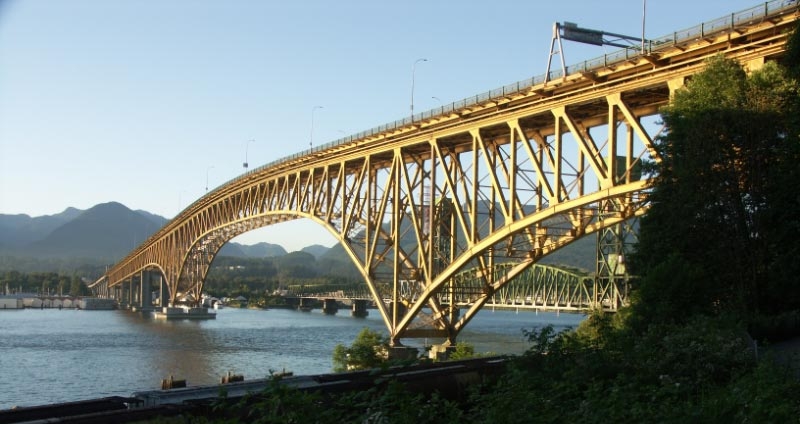
 https://dailyhive.com/vancouver/pattullo-bridge-construction-milestone-cables-deck Unlike the old, inadequate bridge, which only has 4 narrow lanes and just 1 sidewalk, this will have 2 sidewalks and 2 bike lanes. Unfortunatly, there won't be any bus or HOV lanes. Thus, all the traffic will be funneled into just 2 lanes each way. Of course there won't be any emergency lanes or breakdown lanes, so this is another quintessential BC bottleneck by design. At least a provision for a lower deck would have provided some hope. While this bridge can eventually be widened to 6 lanes, there seems to be no serious consideration for there to be bus and HOV lanes. So it will end up like the overloaded 6 lane Iron Bridge.

https://en.wikipedia.org/wiki/SkyBridge_(TransLink) No bike lanes and sidewalks and it wasn't built wide enough to eventually accomodate 3-4 tracks and 2 bus lanes. There is just something about backwards BC that makes it so obtuse and inept. 

https://upload.wikimedia.org/wikipedia/commons/thumb/1/1d/SkyBridge_from_SkyTrain_%285770458210%29.jpg/500px-SkyBridge_from_SkyTrain_%285770458210%29.jpg At the very least, this bridge should have had 3 tracks and 2 bus lanes, a bike lane and a sidewalk on a lower deck. There is only a middle service track and apparently, no provision for a bike lane and a sidewalk.

https://en.wikipedia.org/wiki/New_Westminster_Bridge Still, only a single track bridge for freight and passenger trains. 

https://upload.wikimedia.org/wikipedia/commons/thumb/1/1f/New_Westminster_Swing_Bridge.jpg/960px-New_Westminster_Swing_Bridge.jpg This old single track bridge should have been double tracked on a lower deck and have at least 4 lanes on an upper deck. Then when the first 4 lane Pattullo Bridge opened, it might not have been quite as overloaded in its later decades. 

In order for this joke of a river railway crossing to be properly upgraded and efficient is for there to be at least a new double track bridge.  

NW should have really had something like its own version of the Steel_Bridge in Portland. 

https://upload.wikimedia.org/wikipedia/commons/thumb/5/51/Amtrak_talgo_train_crossing_steel_bridge.jpg/960px-Amtrak_talgo_train_crossing_steel_bridge.jpg Fortunatly, Portland didn't have a provincial backwater mentality like NW. Thus, they could build a lot more bridges. 
https://upload.wikimedia.org/wikipedia/commons/thumb/8/80/SteelBridgePano1.jpg/960px-SteelBridgePano1.jpg MAX light rail on the upper deck and Amtrack and freight trains on the lower deck. Fortunately, Oregon is far enough away from ever catching the BC Mind Virus. 
https://upload.wikimedia.org/wikipedia/commons/thumb/e/e3/Aerial_view_of_Willamette_River_crossings_in_Portland%2C_February_2018.JPG So many nice bridges in Portland. 
 
There is such a the lack of bridges between NW and Surrey.
https://upload.wikimedia.org/wikipedia/commons/thumb/0/0a/New_Westminster_Aerial_view_2015.jpg/960px-New_Westminster_Aerial_view_2015.jpg For most of the history of NW, Surrey was just some farmland south of the river with not much going on, but its many times larger than little NW. 

There just didn't seem to be that much a big city vision for little provincial backwater NW. Back in the day, NW could have acquired what would become the Tri-Cities and perhaps, even Surrey. There just wasn't any desire to have a big river city in BC on the scale of Portland,_Oregon. So while NW is stuck as a tiny city, Surrey is on its way to becoming the biggest city in BC.

Unfortunately, the Iron Bridge and Granville Bridge were never designed to have a lower deck for trains and buses either. That's just how it is in backwards BC.  


Tuesday, October 14, 2025

Granville Bridge, Vancouver, etc.

 https://vancouver.ca/streets-transportation/granville-bridge.aspx 

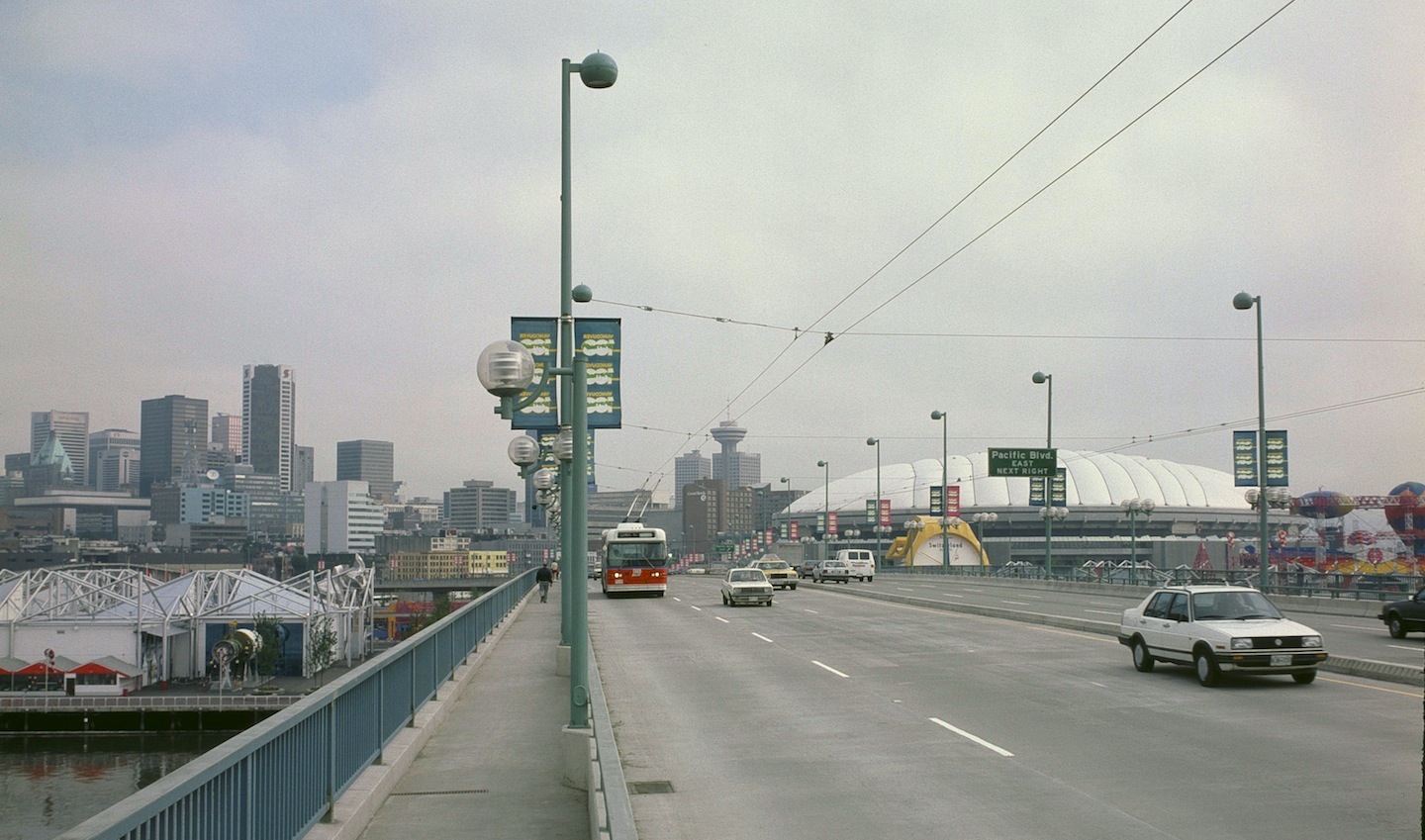
Even after 3 tries, Vancouver still couldn't quite get the Granville_Street_Bridge correct. Of course the 3rd bridge wasn't designed to have a lower deck for streetcars or tram-trains. Even though it was generally designed to be a car, truck and bus bridge, the sidewalks should have been double width and have an inner railing. If the city couldn't wait until late March, it should have had the official dedication in early March, not in crappy February 1954.

https://en.wikipedia.org/wiki/Granville_Street_Bridge#Third_bridge_(1954) "On February 4, 1954, the current Granville Street Bridge opened to traffic after five years of planning and construction; its dedication ceremony was attended by 5,000 spectators after it had been delayed a week due to heavy snow." 

https://en.wikipedia.org/wiki/Granville_Street_Bridge#21st_century Unfortunatly, new bike lanes and extra sidewalks couldn't be installed below the 8 lane deck. Thus, Vancouver went for strike 3 and removed 2 lanes from the bridge. The Burrard+Street+Bridge lost 2 lanes and the Cambie+Bridge lost 1 lane. A bike and foot bridge could have been built on the west side of the Burrard Bridge, then no lanes would have been removed. The Cambie Bridge already had a wide sidewalk on its east side. The west sidewalk should have been widened, then no lane would have been removed. 

The Granville+Bridge could have had 6 lanes and 2 bus lanes. Now, if there are ever 2 bus lanes, there will only be 2 general lanes each way.

Several cities around the world have bike & foot bridges and don't have to remove lanes from the existing bridges.

For such a congested city to have removed 5 lanes from 3 bridges, could there even be more of a reduction of lanes Well, there are some who would like to have the LGB just for bike and foot traffic.

https://globalnews.ca/news/1946543/government-says-lions-gate-bridge-will-not-close-to-cars-come-2030 

That would be OK if an 8 lane tunnel could be built near it. Such a First Narrows Tunnel could have 3 lanes each way, plus a bus lane each way. A parallel triple track commuter train tunnel should be built close to it as well.

The new & improved tunnel between Richmond and Delta won't be ready until 2030. Since things move so slow in constipated, backwards BC, perhaps a First_Narrows_Tunnel might not be completed until 2040, or even 2050.

Monday, October 6, 2025

Edmonton vs. Vancouver, etc.

Edmonton has one tower thats taller than anything in BC. However, Burnaby and Surrey will eventually rival it. Despite more people wanting to move to Vancouver, perhaps to avoid the -20C to -30C Canadian winters. However, some people are determined to make sure that Vancouver never has any building taller than what's in Edmonton & especially Calgary & Seattle.

https://en.wikipedia.org/wiki/Edmonton#Public_transit Unfortunatly, any underground train station in backwards Vancouver was designed to be shorter than the underground train stations in Edmonton & Seattle. While the trains in Vancouver can be more frequent, short stations keep the trains short and pathetic.

Despite the SkyTrain being a multibillion dollar system, the underground stations are only 80 metres on the first 2 lines. The Canada (embassament) Line only has 50 metre stations. In contrast, the Montreal Metro has 152.5 metre stations. At least the underground stations in Edmonton are in the 125 to 130 metre range and even longer in Seattle.

https://en.wikipedia.org/wiki/List_of_tallest_buildings_in_Edmonton 

https://www.flickr.com/photos/kurt-b/51118510836

https://upload.wikimedia.org/wikipedia/commons/4/41/Edmonton_Skyline_from_Blatchford.jpg 
https://upload.wikimedia.org/wikipedia/commons/thumb/2/2d/J.W._Marriott_Edmonton_Ice_District_%26_Stantec_Tower This is taller than any current building in BC. The shorter tower would be the second tallest if it was in Vancouver. 

No bridge in Vancouver is allowed to be as wide as the widest in Edmonton.

Even when the Granville+Bridge used to have 8 lanes, there were no emergency lanes and 2 narrow, uneven sidewalks. Where as the newer Quesnell+Bridge still has 8 lanes, plus 2 emergency lanes & a wide sidewalk.

Thursday, September 18, 2025

No inquiry into North Shore sewage plant overbudget problems

 https://www.nsnews.com/opinion/letter-its-a-disgrace-we-wont-get-inquiry-into-north-shore-sewage-plant-problems-11226585 

So much money has gone down the $HIT-PIPE! This has become a total $HIT-BOX nightmare. So much of this wasted money could have gone into a bus and train tunnel under the inlet near the LGB, as well as a bus and train bridge on an improved Iron Bridge crossing. 


 Vancouver council calls for reopening of container truck entrance to port https://www.nsnews.com/economy-law-politics/vancouver-council-calls-for-reopening-of-container-truck-entrance-to-port-clark-drive-11231559 

Despite Vancouver not allowing much of a 1950s-1970s freeway within its small city limits, a lower level of Knight_Street should have been constructed. This could have been a 4 lane, divided truck route between the inlet and the Fraser River and Richmond. Then, the general surface level of Knight_Street could remain as a 4-6 lane regional corridor, but still not as a freeway.  

One of the classic regional Vancouver bottleneck-chokepoints was to have only 2 lanes each way in the middle of the Knight_St_Bridge (KSB). There should have been 2 wide emergency lanes and 2 wide shoulders. That way, the KSB could have been designed to eventually have 4 lanes each way. 1 lane from and 1 lane onto Marine_Drive and the KSB.

https://en.wikipedia.org/wiki/Knight_Street_Bridge  

Marine Drive from South Granville to Boundary Road and through Burnaby, should have been a constant 6 lane eastern_section

https://en.wikipedia.org/wiki/Marine_Drive_(Greater_Vancouver)

Wednesday, August 13, 2025

The Granville Connector

 https://dailyhive.com/vancouver/granville-connector-celebration-free

It's still the Granville+Street+Bridge, but it's also the Connector. Unfortunatly, it wasn't designed to have a lower deck for streetcars and busses. Such is the irony of backwards Vancouver to be one of the first cities to get rid of its streetcars and doing its damndest to be one of the last to bring them back.


https://jfdatalinks.blogspot.com/search?q=Granville+Connector

Saturday, July 26, 2025

New pedestrian and cycling upgrade to Granville Bridge opens to public

 https://globalnews.ca/news/11304598/54m-pedestrian-and-cycling-upgrade-to-granville-bridge-opens-to-public/

Once again Vancouver gets its wrong, at least the Burrard Bridge is a better example, despite the loss of 2 lanes..

https://dailyhive.com/vancouver/granville-connector-bridge-walking-cycling-pathways-open-complete

For a bridge that was 8 lanes wide with 2 narrow sidewalks, there should have been a bike lane & a wide sidewalk on both sides. The decision was to have 2 bike lanes on the west side of the bridge with a wider, uneven sidewalk & a slightly wider sidewalk on the east side of the bridge.


Friday, July 25, 2025

Granville Bridge's new wide, safe pathways for walking and cycling now open

 https://dailyhive.com/vancouver/granville-connector-bridge-walking-cycling-pathways-open-complete

Its OK, but it could have been better.

Had there been a nice bike & foot bridge built next to it, the Granville Bridge could have had 3 general lanes each way & the 4th as a bus lane. Just like the Burrard Bridge should have had a bike & foot bridge next to it. Then, the BB could have had 2 bus lanes as well as 4 general lanes. Taking lanes away is absurd for a city that already has such a narrow road system. Yet, a proper regional bus & bike bridge system wasn't implemented.

It seems that the public wasn't properly informed decades ago that Greater Vancouver wasn't going to have a 24hr train system. All the more important for the GV Region to have a network of bus & bike bridges. Several the regional bridges are so narrow that there isn't enough room to accomodate 2 bus lanes & 2 HOV lanes.


Sunday, April 20, 2025

The Oak Street-Granville Street Corridor

 https://en.wikipedia.org/wiki/Oak_Street_(Vancouver) , https://www.youtube.com/watch?v=kXbUb7TMj6k

The Oak+Street-Granville+Street+Corridor are both 6 lanes wide for most of their lengths. Thus, this is mostly a 12 lane street corridor and is much less disruptive than if a 10-12 lane freeway had been pushed through in the 1950s or 60s.

https://en.wikipedia.org/wiki/Granville_Street , https://storeys.com/vancouver-granville-street-entertainment-district-history-renewal-planning-program

The yellow line is set for 3 lanes each way. However, if it was moved over 1 or 2 lanes, then there could be 4 or 5 main lanes one way & 1 or 2 lanes the other way. 

The Oak+Street+Bridge+and+Granville+Street+Bridge are still part of an incomplete corridor.

An improved 8 lane Granville+Street+Bridge with double-width sidewalks could have still worked, if there had also been a wide bike & foot bridge built next to it. Then, a roughly new paralel bridge next to the 4 lane Oak+Street+Bridge could have allowed for an 8 lane crossing there. Four lanes of Granville_Street southbound over the Fraser River and 4 lanes of Oak_Street northbound.

Unfortunatly 2 lanes were removed from the Burrard+Street+Bridge (BSB), 2 lanes removed from the Granville+Street+Bridge (GSB) and 1 lane from the Cambie+Street+Bridge (CSB). That didn't have to happen if a bike bridge was built next to the BSB and the GSB. While the east side of the Cambie-Street-Bridge has a nice, wide sidewalk, there wasn't enough foresight to also have a wide sidewalk on its west side. However, that narrow sidewalk could still be built out to be nice & wide so that the CSB can be restored to 6 lanes. 

When a city & metropolitan region mostly has narrow bridges, removing lanes or not having enough is utterly foolish! Case in point... https://www.pattullobridgereplacement.ca Instead of 2 bus & 2 HOV lanes, everything will be initially funneled into just 2 lanes each way. https://www.pattullobridgereplacement.ca/about/projectoverview Two nice sidewalks & 2 nice bike lanes, but no emergency lanes or bus lanes, right from the start. Its another classic BC bottleneck in the making. Since the SkyTrain doesn't run on a 24hr basis, 24hr bus lanes are essential, but that would go against the congestive planning methodology that is backwards BC.


https://jfdatalinks.blogspot.com/search?q=Oak+Street+and+Granville+Street

Saturday, April 19, 2025

The narrow bridges of Vancouver, Canada

https://montecristomagazine.com/community/forgotten-bridges-vancouver

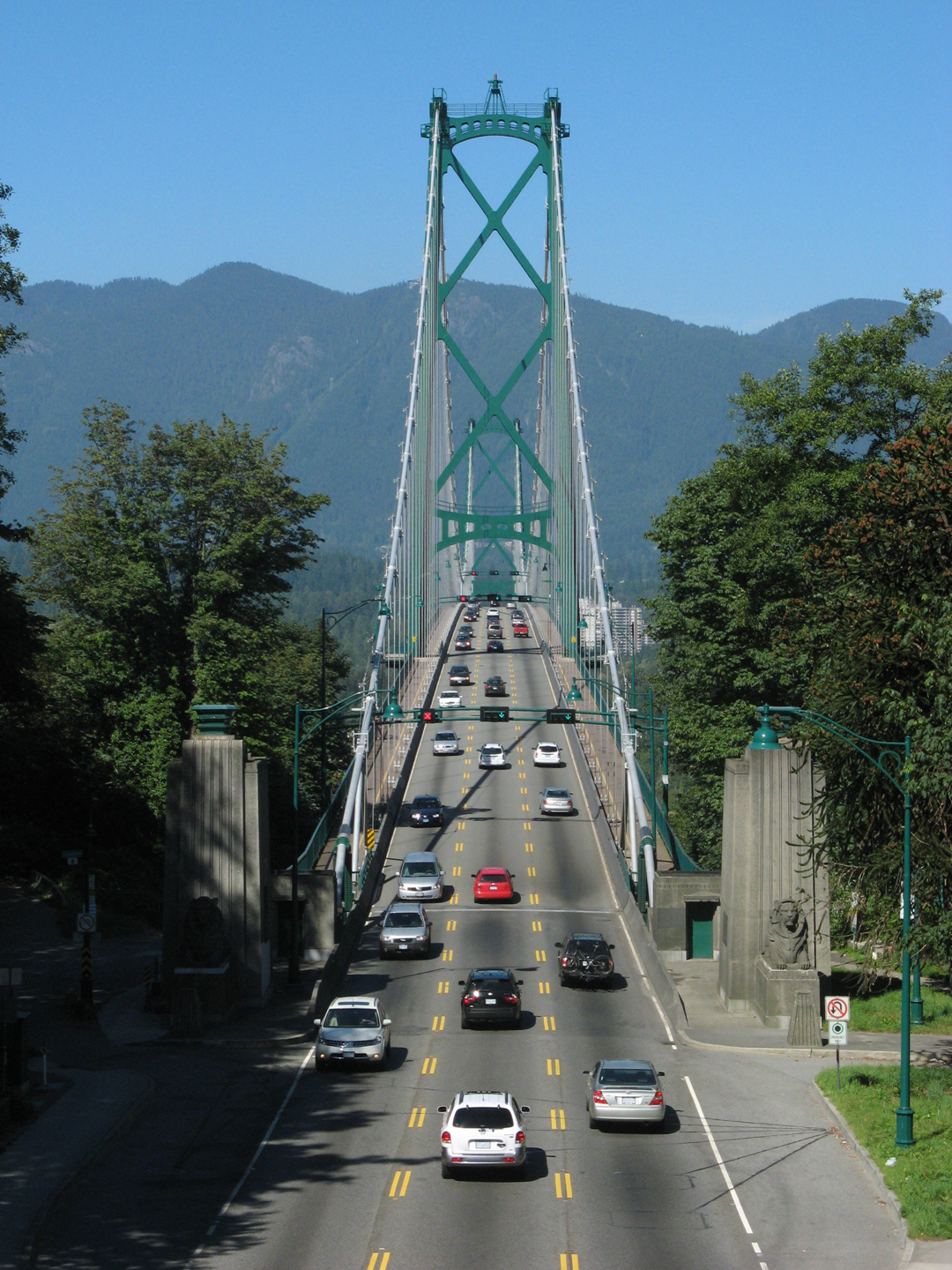
The LGB just wasn't designed with any future capacity in mind. 

History of the Lions Gate Bridge https://www.youtube.com/watch?v=JHqi7Kijedw 

https://en.wikipedia.org/wiki/Lions_Gate_Bridge#History

https://upload.wikimedia.org/wikipedia/commons/7/7e/Lions_Gate.jpg 

The inadequate 3 lane LGB is currently the most narrow road bridge in backwards & stubborn Vancouver. It's been in that category since the removal of the 2 lane Fraser Street Bridge in the 1970s. There was a refusal to twin the absurdly narrow LGB between the 1950s & 1970s. By the 1980s there should have been a subway tunnel and an 8 lane tunnel. Then two of the lanes could have been for buses. Georgia+Street is 7 lanes wide as it gets closer to Stanley Park. Thus, the main part of a tunnel through the park could have provided 3 general lanes each way & a bus lane each way. Instead, the 7 lanes of the westernmost part of Georgia Street are funneled into a 3 lane causeway & a 3 lane bridge. The LGB would be fantastic as just a bike & foot crossing, with train, bus & road tunnels well beneath & beside it.    

The Burrard_Bridge, BB or  BSB opened with 6 lanes, but now it only has 4 lanes. There are 2 bike lanes & 2 sidewalks. Had a parallel bike-bridge been built, the BB could have still had 6 lanes. While the BB has a lower level provision for streetcars or tram-trains, Vancouver did its damndest to phase out streetcars well before the 1960s. 

The Ironworkers_Memorial_Bridge has 6 lanes, but should also have had 2 wide shoulders & 2 very wide sidewalks. Unfortunatly, there was no provision for a lower deck, as is also the case with all of the other Vancouver  bridges. https://en.wikipedia.org/wiki/Ironworkers_Memorial_Second_Narrows_Crossing

Any replacement of the inadequate Ironworkers+Memorial+Bridge should be on the scale of what Perth, Seattle and Montreal have done.

https://en.wikipedia.org/wiki/Granville_Street_Bridge#Third_bridge_(1954)

https://www.youtube.com/watch?app=desktop&v=vPSdF0jRTC4 The Granville-Bridge or GSB is the widest bridge in the city limits. It opened with 8 lanes, but is being transformed into a 6 lane bridge with 2 bike lanes & 2 sidewalks. Had there been a paralel bike & foot bride, the GSB could have still been 8 lanes wide. Then there could have been 2 exclusive bus lanes.

https://vancouver.ca/streets-transportation/granville-bridge-connector.aspx

The Oak Street Bridge should have been 8 lanes wide, with 2 wide sidewalks.

The Knight+Street+Bridge should have been 8 lanes with 2 wide sidewalks. Instead, its a 4 lane chokepoint.

The Arthur+Laing+Bridge should have been at least 6 lanes with 2 proper bike lanes & 2 sidewalks.

If the Cambie_Street_Bridge had 2 very wide sidewalks, then its likely that it would still have 6 lanes instead of 5. https://en.wikipedia.org/wiki/Cambie_Bridge#The_present_bridge

Unfortunatly, bottleneck or chokepoint planning is part of the Vancouver & BC mentality.

Of course BC & the Metro+Vancouver Region just hasn't put enough funds and effort towards proper big-city planning & infrastructure development. 

If Perth+and+Seattle had to conform to the extremely restrictive Vancouver approach to things, those cities would be in a perpetual state of chaos. Fortunately, nothing like the BC Mind Virus has ever reached WA.


https://jfdatalinks.blogspot.com/search?q=Oak+Street+and+Granville+Street

Friday, February 7, 2025

Oak Street Bridge and Granville Street Bridge

While Oak+Street continues over the Fraser River as a bridge, there is no Oak+Street+Bridge (OSB) over F. Creek. The city foolishly never even allowed for future clearance for a bus & bike bridge over F. Creek. From the Fraser River to F. Creek, Oak Street should have been mostly for northbout travel.  

Right now, the Oak+Street-Granville+Street+Corridor has 12 lanes. That's because they are both 6 lane streets. Simply by moving the centerline over one lane, they each can provide 4 lanes one way & 2 lanes the other way. A reconfiguration of 4+2 lanes or even 5+1 lanes.


https://jfdatalinks.blogspot.com/search?q=Granville+Street+Bridge

https://jfdatalinks.blogspot.com/search?q=Oak+Street+Bridge

https://jfdatalinks.blogspot.com/search?q=Oak+Street+Bridge+and+Granville+Street+Bridge