https://www.youtube.com/watch?v=woN_XTPtEic
https://jfdatalinks.blogspot.com/search?q=SF+Millennium+Tower
https://www.youtube.com/watch?v=EpdZn6cxYFo
https://en.wikipedia.org/wiki/Porsche_Design_Tower_(Sunny_Isles_Beach)
https://www.dezeen.com/2024/12/19/sinking-skyscrapers-miami/
So far, the situation doesn't seem to be anywhere as concerning as the SF+Millennium+Tower predicament.

https://skyscraperpage.com/diagrams/?cityID=31&status=15
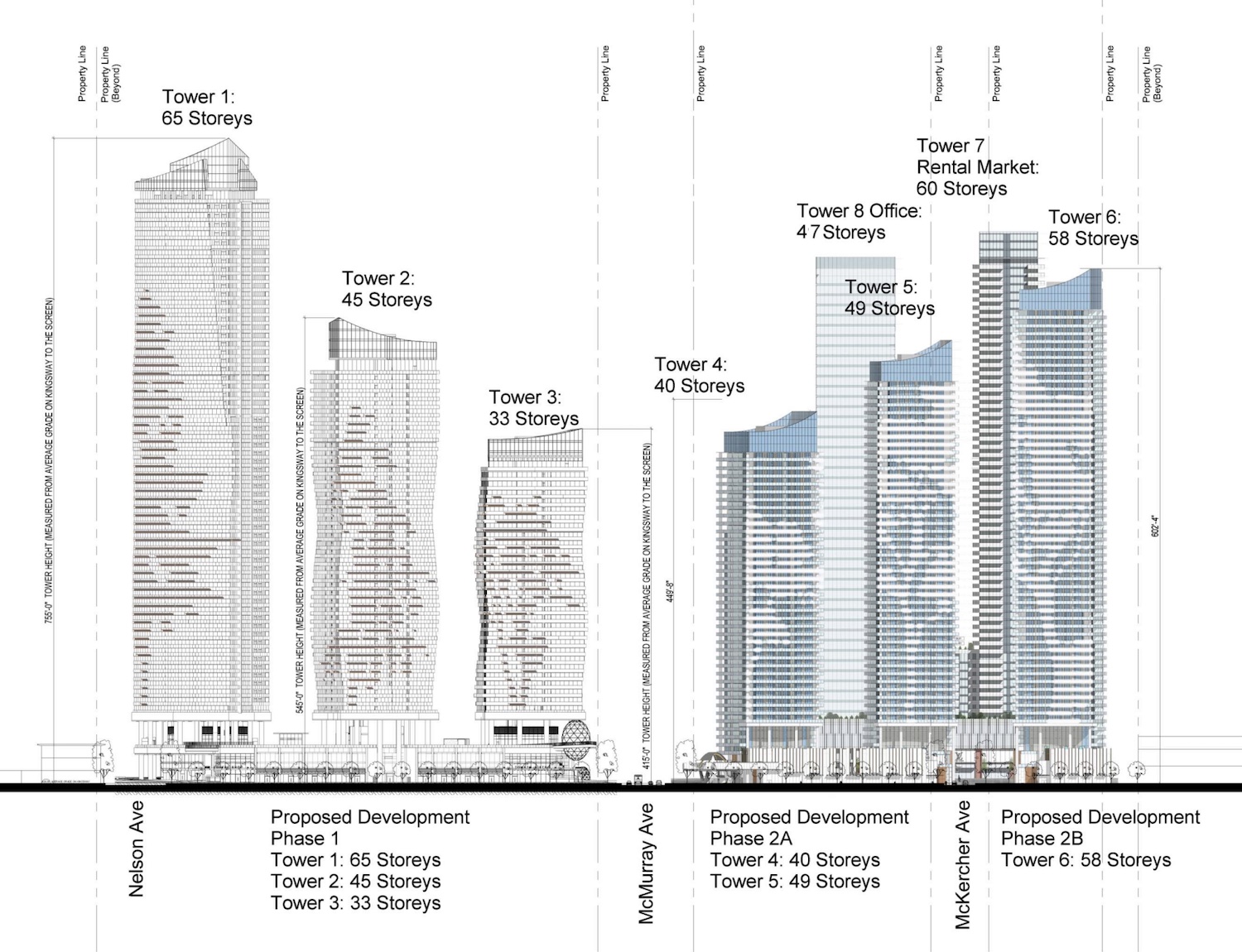
https://skyscraperpage.com/b139592/burnaby/concord-metrotown-eight 47 stories at 187.2 m
Tower 8, a 47-storey, 375,000 SF office tower at 614 ft. height, https://vancouvermarket.ca/2022/07/22/phase-2-of-concord-metrotown-to-include-5-towers-2100-units/
https://www.urbanyvr.com/wp-content/uploads/2022/08/Concord-Metrotown-phases.jpg , https://skyscraperpage.com/forum/showthread.php?t=230813&page=37
For the longest time, Vancouver has prevented BC from having a 40 story office tower, let alone a 50 or a 60 story office tower. Since Burnaby isn't directly affected by the VMV, Burnaby is on track to have the first office tower in BC that's over 45 floors. Indeed, a 47 story office tower at 614 feet would slightly rival the tallest in Bellevue,_Washington.
https://dailyhive.com/vancouver/hullo-ferries-nanaimo-vancouver-third-anniversary
Now, if only provincial, backwater Vancouver could ever have a proper big city size commuter ferry system like what Sydney and SF Bay_Area have...
https://www.vmcdn.ca/f/files/via/images/historic-images/vancouverarchives/stanley-park-100-years-1920s-entrance.jpg;w=960;h=640;bgcolor=000000 A nice wide public walkway. Unfortunately, due to a lack of a proper big city vision, no 4-6 lane wide right of way was ever established through the park.
https://stanleyparkvan.com/stanley-park-van-road-stanley-park-causeway.html
The 3 lane wide option was never followed-up with a lower 3 lane tunnel. So, instead of 3 lanes each way, everything is funneled into just 3 lanes.
https://council.vancouver.ca/000203/pe3.htm Thus, no need to have a bridge designed to be strong enough to have at least two 3 lane decks.


In Vancouver and backwards BC in general, its very difficult to build infrastructure for long-range future capacity.
https://upload.wikimedia.org/wikipedia/commons/7/76/Stanley_Park_Labeled_Aerial_Map.png
After several generations, Stanley_Park has remained as a provincial gateway to backwater Vancouver.
https://en.wikipedia.org/wiki/Stanley_Park#21st_century
https://en.wikipedia.org/wiki/British_Columbia_Highway_99#Vancouver
While no one was able to stop the Horseshoe_Bay_ferry_terminal from being built, too many people still don't want Greater_Vancouver to have a proper big city train and highway link between West_Vancouver and Downtown_Vancouver.

Fortunately, the BCMV never made it to Sydney, NSW and SF, CA. Thus, their CBD or downtown has good rail and highway links.
However, it was almost like part of the Vancouver MV made it to Auckland, NZ.
https://en.wikipedia.org/wiki/Auckland_Harbour_Bridge#Clip-ons_(1967%E2%80%931969)
https://en.wikipedia.org/wiki/Auckland_Harbour_Bridge#Alternate_proposal A parallel bus, bike and train bridge should have been built decades ago. https://en.wikipedia.org/wiki/Second_Harbour_Crossing,_Auckland#2023_Waitemat%C4%81_Harbour_Connections_proposals
https://www.nzta.govt.nz/projects/waitemata-harbour-connections
https://infrastructurepipeline.org/project/additional-waitemata-harbour-crossing
https://www.greaterauckland.org.nz/2026/05/27/build-this-brilliant-bridge
https://dailyhive.com/vancouver/vancouver-villages-plan-rejected-city-council-decision
Vancouver is a very small city in area. Indeed, Vancouver, Paris, Boston and SF, are all less than 50 square miles in city area. Despite the City of Paris being slightly smaller than the C of V, Paris has 3 times the city population. Apparently, physics is different in backwards Vancouver than it is in Paris.
Unlike provincial Vancouver, Paris is still allowed to have some wide streets and a better road system overall. Plus, with so many interconnecting train lines, its easier to get around cosmopolitan Paris.
https://en.wikipedia.org/wiki/Vancouver The city has a land area of 115.18 km2 (44.47 sq mi)
https://en.wikipedia.org/wiki/Vancouver#Geography
https://en.wikipedia.org/wiki/Queen_Elizabeth_Park,_British_Columbia It is located on top of Little Mountain approximately 125 metres (410 ft) above sea level
https://en-ca.topographic-map.com/map-vzkpm2/Little-Mountain Little Mountain, elevation 125 m (410 ft)
Of course L.Mt. is shorter than Montmartre , because everything has to be shorter and smaller in provincial Vancouver.
https://en.wikipedia.org/wiki/Metro_Vancouver_Regional_District 2,878.93 km2 (1,111.56 sq mi)
https://en.wikipedia.org/wiki/Lower_Mainland 36,303.31 km2 (14,016.79 sq mi)
https://en.wikipedia.org/wiki/Paris 105.4 km2 (40.7 sq mi)
https://en.wikipedia.org/wiki/Paris#Geography
https://en.wikipedia.org/wiki/Montmartre It is 130 m (430 ft) high
https://www.unjourdeplusaparis.com/en/paris-insolite/plus-haut-point-de-paris it is in Montmartre that the highest point of the capital is located, culminating at 130.53 meters above sea level. That's 428.25 feet, so something in-between 428 and 430 feet above sea level.
https://en.wikipedia.org/wiki/Grand_Paris 814.2 km2 (314.4 sq mi)
https://en.wikipedia.org/wiki/%C3%8Ele-de-France 12,012 km2 (4,638 sq mi)
There was a time when Vancouver wasn't allowed to have any building taller than the Great_Pyramid_of_Giza, then Ulm_Minster and then the Philadelphia_City_Hall.
The Harbour_Centre had to be less than a 3rd of the CN_Tower.
The stations on the first 2 SkyTrain lines are barely 2 thirds of the length of a Montreal_Metro station.
The Canada_Line only has 50 m stations compared to the 152.5 m Montreal_Metro stations.
For too long, anything that is symbolic of a proper big city was watered down or scaled back in provincial Vancouver. Indeed, Vancouver was supposed to perpetually be a half-sized city, or even a third of what a proper size city should be. The mostly narrow bridges still have no parallel express bus bridge, or BRT bridge built next to them.
If the project actually gets built as envisioned it will be taller than First_Canadian_Place in Toronto, Columbia_Center in Seattle, and a little taller than the Sydney_Tower and the U.S._Bank_Tower_(Los_Angeles). It still won't quite be as tall as Australia_108 in Melbourne or especially the Salesforce_Tower in SF.
https://www.youtube.com/watch?v=wvEwubAId_g
While Seattle doesn't quite get as much rain as Vancouver, BC, you still have to endure half a year of cold, damp & dreary weather. At least there usually isn't that much snow to shovel in the middle of winter.
Perhaps some people are getting fed up with 100F summers in other places.
While L.A. can easily have some 100F summer days, that's hardly the case in S.F. Indeed, SF doesn't get as hot as LA in the summer or as cold as Seattle in the winter. Honolulu just might have the best overall weather, not quite as hot during the summers in Miami and LA.
https://www.youtube.com/watch?v=OJtotvMq2ls
The Lion+Bridge will likely still not have an express bus and LRT tunnel near it. The+Iron+Bridge still might not have a proper BRT and LRT bridge next to it. The OSB and the KSB will likely not have a bus and bike bridge built beside them. There will still likely be no new Fraser Street Bridge for bikes and buses. No Boundary Road bridges to provide a direct link between the North Shore and Richmond for buses, trucks and bikes.
While the first 2 Skytrain lines will have 5 car trains, the stunted YVR-Canada Line will only have 2.5 car trains. Vancouver still might not permit any office tower to have a 40th floor, but might allow some residential towers to be on a Melbourne, Sydney, Brisbane & Toronto scale.
However, BIG city thinking and planning in Vancouver has always been so difficult. Boston, SF and the City of Paris are ridiculously small cities like Vancouver with all 3 having a land area of less than 50 sq. mi. or 129.5 sq. km. Yet, Boston, SF and especially the City of Paris, have all been able to fit so much more into the same general space. That's because they aren't bound by anything like the inept and extreme Vancouver type restrictions.
https://www.youtube.com/watch?v=ujWLEBhbdt8
If it were possible today, the KEEP VANCOUVER SMALL AND BACKWARDS people would still not permit any building to be a 3rd of the height of the CN_Tower. (CNT) https://en.wikipedia.org/wiki/CN_Tower#Height_comparisons
The Harbour_Centre opened just over a year after the CNT, and is just under a 3rd of its height. https://en.wikipedia.org/wiki/Harbour_Centre#Height
Unfortunately, The Vancouver Mind Virus (VMV) was able to ensure that the Canada_Line Stations aren't even quite a 3rd of the length of the 152.5 m Montreal Metro stations.
Even the North-Shore mountains aren't allowed to be as tall as the mountains north of L.A.
https://en.wikipedia.org/wiki/North_Shore_(Greater_Vancouver)
https://upload.wikimedia.org/wikipedia/commons/c/c0/LA_San_Gabriel_Mountains.jpg
https://en.wikipedia.org/wiki/San_Gabriel_Mountains#Gallery
Whether you are from Toronto or Chicago, LA or SF, Melbourne or Sydney, you might be shocked as to seeing how scaled down or watered down Vancouver is. Yet, the City of Paris, despite having a slightly smaller land area than Vancouver, can fit so much more inside. Boston and SF are only slightly larger in area than the City of Vancouver, yet they can also fit in so much more.
Vancouver is such an unusual and backwards city with its inefficient and congestive approach towards transportation infrastructure.
Getting rid of the streetcars and interurban trams was utterly foolish! Fortunately, such MADNE$$ wasn't adopted in Melbourne, SF, Toronto, Boston, Philadelphia and New Orleans.
Just because a no freeways mandate was chosen for Vancouver, the streets should have been kept wide enough for busses as well as other vehicles.
https://movementyvr.ca/the-case-of-vancouvers-nine-missing-bus-lanes
Despite most of the Vancouver bridges being too narrow, some bridge lanes were removed, because the city wasn't interested in building parallel bike bridges.
Since most of the bridges are so narrow, there isn't enough room for proper express bus lanes. Of course the city isn't interested in building parallel bus bridges next to the narrow bridges.
Since Vancouver is supposed to be a major, properly functioning city in Western Canada, the city should have pressed the designers of the first 2 Skytrain lines to make sure that all of the 80 m stations could gradually be extended to 152.5 m, the same as the 500 foot long Montreal Metro stations and trains.
Unlike the first 2 Skytrain lines, the Canada Line was only designed to ultimately have 50 m stations and trains. A 2 billion dollar line to YVR could have been designed in such a way that would have allowed it to look and function like a proper big-city passenger train.
A commuter train to the North Shore keeps taking a long time to be finalized.
https://northshoreconnects.ca/wp-content/uploads/2021/10/BIRT-Benefits-Assessment_Final.pdf
Think small and build backwards, or not at all.
https://www.vancouverisawesome.com/national-sports/racism-is-a-risk-when-vancouver-hosts-world-cup-but-measures-exist-bc-ag-sharma-12361474 So, this is basically the same article repeated.
https://www.britannica.com/place/British-Empire
https://en.wikipedia.org/wiki/British_Empire#Rivalry_with_other_European_empires
https://en.wikipedia.org/wiki/British_Empire#Expansion_and_colonial_conflict_(1707%E2%80%931783)
Despite its overall area, Canada has less than 1% of the worlds population. A global population that is mostly nonwhite.
https://en.wikipedia.org/wiki/British_Empire#Consolidation_and_global_dominance_(1783%E2%80%931815)
https://en.wikipedia.org/wiki/British_Empire#Britain's_imperial_century_(1815%E2%80%931914)
For its first century, Canada was supposed to be primarily for people from Europe. https://en.wikipedia.org/wiki/British_Empire#Changing_status_of_the_white_colonies
That was the British Colonial Agenda, but eventually the British_Empire had to acknowledge that most of the worlds population is nonwhite. https://en.wikipedia.org/wiki/British_Empire#Decolonisation_and_decline_(1945%E2%80%931997)
There are strong arguments that Canada should be able to gradually contain a little more of the worlds population. Since a lot of the worlds population is from warmer areas, a lot of people might not like the Canadian Winter season. SW BC just happens to be the most mild part of Canada during the winter. The Lower_Mainland of BC and SE Vancouver_Island have been very reluctant to think big and build on a grand scale.
The Lions+Gate+Bridge and the Johnson+Street+Bridge are both classic 3 lane BC bottleneck-chokepoints. They are both fine examples of not wanting to build for a growing population on a world that is composed mostly of nonwhite people.
Toronto and Southern Ontario just never had the same level of small scale thinking as in SW BC. In fact, it the backwards BC approach to things just never caught on in Toronto, Melbourne and SF. They never got rid of their streetcars and trams like Vancouver and Victoria did.
https://www.reddit.com/r/MapPorn/comments/lzvgg7/the_british_empire_at_its_territorial_peak_oc/
As Canada started to become more multicultural in the 1960s and 70s, predominantly White city councils in BC kept imposing a small-scale approach to things.
Will some people start to say that by keeping most of the world out of Canada is good for the environment? There are already some people that would like to use nonwhites as being too much of a carbon footprint and that Canada should never have 1% of the worlds population. This would be a very clever and sinister way to perpetuate the KEEP THEM OUT agenda.
The days of Canada being officially under a British Colonial, White authority management power structure are long gone. As of 2026, Canada has yet to have half of 1% of the worlds population.
Was a 450 foot height restriction just by chance, or was it intentionally made to be very close to 451 Fahrenheit? Despite being around the same size as Paris, Boston & SF, Vancouver remains as a very restrictive city.
Any tall building in SL City is under 450 feet. Honolulu is still stuck around the 450 foot maximum, while San Diego is stuck at 500 feet. Even Rio DeGennaro still has shorter buildings than Vancouver, BC. Washington, DC has strict height limitations like Paris. However, W,DC could eventually set up their own equivalent of La_Defense. Its a fine example of allowing tall buildings just beyond the city limits.
https://en.wikipedia.org/wiki/Fahrenheit_451 (1953) By the 1950s, so many things were already banned, watered down or scaled back in provincial backwater Vancouver. Generations later, there was the No Fun City mind virus that further tried to cancel out things in such a small city with so much red tape and other ridiculous obstacles.
https://en.wikipedia.org/wiki/Fahrenheit_451_(1966_film) By the mid and late1960s, the city made sure that its first office tower to have more than 29 floors wouldn't be until the 1970s. Its highly doubtful that Vancouver will have an office tower at, or over 40 stories by 2030. However, Burnaby and Surrey could, because they aren't under the extreme restrictions of the Vancouver Mind Virus (VMV).
It wasn't until 1973 when Vancouver allowed its first building to be taller than the Los_Angeles_City_Hall. https://en.wikipedia.org/wiki/Los_Angeles_City_Hall
The Scotia_Tower (stump) is a good reference point to visualize the small scale of backwater Vancouver, as its about the same height as the Los_Angeles_City_Hall at 453'.
https://www.skyscrapercenter.com/building/scotia-tower/4396 453'
https://skyscraperpage.com/b65/vancouver/the-scotia-tower 452'
https://en.wikipedia.org/wiki/One_Wall_Centre It opened in 2001 at 157.8 m (518 ft). Its 49 feet shorter than the Philadelphia_City_Hall.
https://en.wikipedia.org/wiki/Philadelphia_City_Hall Opened in 1901 at 548 ft (167 m).
https://en.wikipedia.org/wiki/Fahrenheit_451_(2018_film) By 2018 it was quite apparent that Vancouver was in the process of allowing for more buildings over 450 feet. However, nothing has been permitted to reach 700 feet, so far. A tower over 1000 feet would help to water down its provincial mindset.
_(cropped).jpg/3840px-Vancouver_panorama_(49988799796)_(cropped).jpg)
SF, Sydney & Auckland are just as scenic as Vancouver & warmer throughout the year. They all have taller building than what Vancouver currently permits. Seattle is just as scenic as Vancouver, but its allowed to function like a proper big city, because it doesn't have the imposed restrictions like Vancouver has. While its cold, damp & depressing like Vancouver during the fall & winter, Seattle usually gets noticeably hotter summers than Vancouver, BC. The tallest building in Seattle is the 76 story B of A office tower.

Everything is so small or scaled back in Vancouver. Even the Greater Vancouver mountains aren't allowed to be as tall as the ones in L.A. While the San_Francisco_Bay & Port_Phillip Bay by Melbourne are big next to their cities, English_Bay in_Vancouver is so much smaller. Its even smaller than Elliott_Bay by Seattle.
Vancouver really needs to have bus and HOV bridges built next to its mostly narrow & congested bridges. Only a 5 car Skytrain is the max on the first 2 lines and ultimately, just a 2.5 car joke of a train on the YVR-Canada Line.
Selective+Door+Operation can allow a short train to have an extra car at each end, despite a shorter platform.
.jpg/3840px-Vancouver_sunset_(J).jpg)

Australia like the USA, has some big & tall cities on the Pacific Rim. However, Vancouver symbolically kept watering down its size, because that's how you demonstrate a reluctance towards proper urban planning & growth.
Oddly enough, the imposed small scale Vancouver mentality & agenda wasn't adopted by most cities around the world. Officially, there is no Vancouver Mind Virus (VMV), but somehow something like it keeps manifesting, just like the BCMV.
Despite its size, Canada has less than 1% of the worlds population. Its been difficult enough just for Canada to even have half of 1% of the worlds population.
One expects Melbourne and Sydney to be proper big cities. However, Australia has big stuff at both ends of the country.
https://en.wikipedia.org/wiki/Sir_Leo_Hielscher_Bridges#Design Its a 12 lane crossing in Brisbane.
https://en.wikipedia.org/wiki/Narrows_Bridge_(Perth) 10 lanes with 2 commuter train tracks in the middle.
https://en.wikipedia.org/wiki/Brisbane_Skytower It has 90 floors. https://en.wikipedia.org/wiki/Q1_(building) Almost has 80 floors.
Perth Central_Park_(skyscraper) at 51 floors and 108_St_Georges_Terrace at 50. Very restrictive Vancouver still won't permit any office tower to have a 40th floor. Calgary and Seattle each have a few over 50 stories.
So far, provincial Halifax hasn't been allowed to be on a similar scale as Boston and Montreal.
https://en.wikipedia.org/wiki/Angus_L._Macdonald_Bridge 3 lanes.
https://en.wikipedia.org/wiki/A._Murray_MacKay_Bridge 4 lanes.
The scale of Vancouver is kept below that of Calgary & Seattle or even Auckland, in some ways.
https://en.wikipedia.org/wiki/Lions_Gate_Bridge A classic 3 lane BC bottleneck-chokepoint. No parallel bus and truck tunnels and especially, no LRT tunnel.
Provincial backwater Victoria isn't allowed to be on a similar scale of Wellington, NZ.
https://en.wikipedia.org/wiki/Johnson_Street_Bridge Another BC 3 lane wonder.
https://www.youtube.com/watch?v=k0JAcGSwrMk
While Vancouver has allowed a couple residential towers to have at least 60 stories, no office tower has been permitted to have a 40th floor. While buildings over 200m have been allowed in Sydney and SF, slow provincial Vancouver has been very restrictive to allow big city symbolism.
https://en.wikipedia.org/wiki/Transamerica_Pyramid
Some San Francisco Neighborhoods you should avoid in 2026 https://www.youtube.com/watch?v=bzWJA2v6EYk
https://www.youtube.com/watch?v=JnMLMp_gf1w
Unlike Toronto, SF and Melbourne, Vancouver was one of the first cities to get rid of streetcars and tram-trains or interurbans. Backwards Vancouver will likely be one of the last cities to ever bring them back.
No office tower in Vancouver was allowed to have a 30th floor before the 1970s. https://en.wikipedia.org/wiki/TD_Tower_(Vancouver) The first 30 story office tower in backwater BC opened in 1972. As of 2026, no office tower in Vancouver, or anywhere in BC has been permitted to have a 40th floor.
As of 2026, no Skytrain stations are even close to the length of the Montreal Metro, TTC subway and underground Edmonton LRT stations.
Unfortunately, almost every city around the world is expensive. Its just that you get less of things in Vancouver. Short trains, short buildings, narrow bridges and mostly narrow streets.
Thus, its no surprise that there isn't a regional network of bus-bridges. Congestive transportation planning is what Vancouver does best.
Vancouver seems to be reluctant in constructing a network of bike-bridges. The city would rather remove a total of 5 lanes from 3 bridges for bike lanes.
Broadway will eventually be reduced from 6 lanes to 4 lanes so that even some small towns will have wider major streets.
https://en.wikipedia.org/wiki/Vancouver
https://en.wikipedia.org/wiki/List_of_the_largest_municipalities_in_Canada_by_population