Showing posts sorted by date for query Urban. Sort by relevance Show all posts

Sunday, April 5, 2026

40 years after Expo 86

 https://bcanuntoldhistory.knowledge.ca/1980/expo-86 

Unlike Brisbane, Vancouver doubled down on its various restrictions. Ideally, any tall building in Vancouver had to be shorter than what Brisbane allows. The bridges kepet narrow and unduplicated than what Brisbane allows. The trains are to be shorter than what Brisbane and most cities allow. 

It was almost as if since Vancouver couldn't build a wall around the city to keep people out, a strong level of symbolism was imposed instead. This urban symbolism was all about keeping things small & backwards whenever possible.

Burnaby, Coquitlam and Surrey have all started the process to allow for taller buildings than what Vancouver permits. That's because they are bound by the same restrictions that Vancouver imposes.

Sunday, March 29, 2026

RAPID Regional Transit in the Sea to Sky: Connecting Vancouver to Squamish, Whistler, and Pemberton

 https://www.youtube.com/watch?v=OE_W5Vj6OeQ With Greater Vancouver having so many narrow bridges, there must be a regional network of bus and bike bridges, otherwise it all just remains a sad joke.

How bike lanes has affected Vancouver's urban infrastructure https://www.youtube.com/watch?v=LvkifuIjq9I Many cities don't have to remove traffic lanes, because they build proper bike bridges. 

Bike Lanes https://www.youtube.com/watch?v=oez4TTpIQWg With Vancouver being so obsessed with removing lanes from bridges, it becomes much more difficult to have bus lanes on the narrow bridges. 

A bike bridge should be built next to the Burrard, Granville and Cambie bridges. Then there would be enough room for each of them to accommodate 2 bus lanes. Things are so mixed up in backwards Vancouver.

YVR-Canada Line and REM

 https://www.youtube.com/watch?v=a1ouk0VifwM&t=42s Even if the YVR-Canada Line had to initially be built as a symbolically small city train, urban transportation infrastructure can be designed in ways that can double or even triple capacity to meet future demand. Unfortunately, its very difficult to build anything in BC with significant future capacity in mind.

Ultimately, the YVR-Canada Line should have had level station clearances to eventually be able to accommodate 10 car trains. Unfortunately, in typical backwards BC planning the stations weren't even designed with enough level clearance to accommodate 5 car trains. The joke that is the Canada Line only has a level station clearance of 50m to eventually accommodate just a 2.5 car train. 

Most other cities actually build long stations to accommodate long trains right in the first place. Or, at least allow for enough level clearance so that the stations can eventually be doubled or tripled in length. 

The YVR-Canada Line should have started with the Vancouver & Richmond segment, then the Vancouver and Horseshoe+Bay+ferry+terminal segment. Then finally, the YVR to Delta and the Tsawwassen+ferry+terminal

The SkyTrain Stations in Greater Vancouver https://www.youtube.com/watch?v=6Qg78Bmf1fk

Unfortunately, proper big city transportation planning is very difficult to achieve in backwards BC. So much is watered down in Vancouver.


Montreal’s Biggest REM Expansion Yet https://www.youtube.com/watch?v=4G1oeIAfxDU&t=106s 

The Montreal REM https://www.youtube.com/watch?v=g9O6RzsXIqQ 

While the REM was designed to help the Metro, it should have the capability to be gradually expanded. Eventually, REM trains should be lengthened from 4 car trains to 6 and even 8 car trains. 

In contrast, every Skytrain line should have been designed with enough level future station clearance to eventually accommodate a train as long as a 152.5 (500 ft.) long Montreal Metro train. The first 2 Skytrain lines have 80m stations and the joke that is the Canada Line only has 50m stations. 

While the first 2 lines can accommodate 5 car trains, the C Line wasn't designed to accommodate 5 car trains. Just 2.5 car trains, someday. 

Despite there being such a symbolic push for Vancouver to keep having short trains, narrow bridges and stumpy buildings, things are gradually changing in backwards BC. The Vancouver or BC Mind Virus should have been challenged decades ago, but too many loud people wanted to perpetuate the, KEEP THINGS SMALL AND INDEQUATE agenda.

Given how most of the bridges in Greater Vancouver are so narrow, there isn't enough room for proper bus and HOV lanes, or even wide emergency lanes. One would think that at least the trains & stations would have been designed to eventually be doubled or tripled in length. But that would go against the mutigenerational congestive planning agenda. That's why there still is only a 3 lane LGB when there should have been at least a parallel bus, HOV and train tunnel. The Pattullo+Bridge replacement didn't open with 2 bus and 2 HOV lanes, not even wide shoulders or emergency lanes. NW really likes the congestive planning approach. Of course the new tunnel between Richmond and Delta won't have an additional provision for a train tube. This will also help to perpetuate the congestive transportation mandate. 

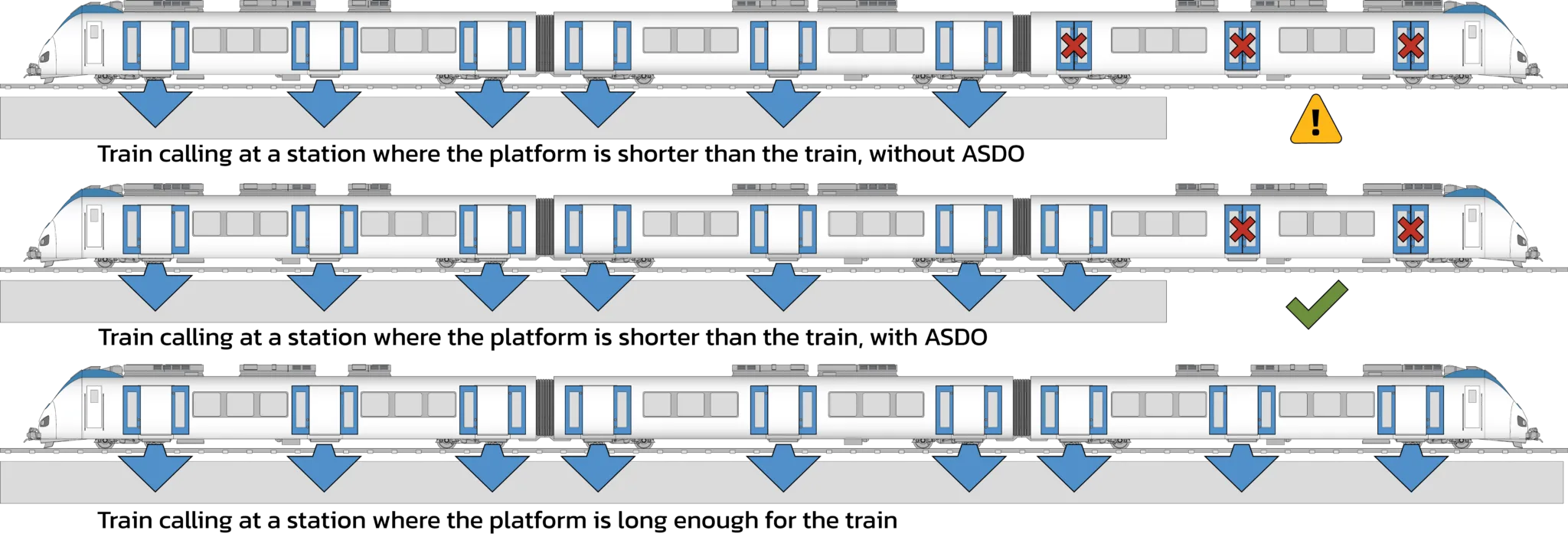
Fortunately, Selective_door_operation technology can eventually allow more sensible transportation planners to enable longer trains. 

https://en.wikipedia.org/wiki/Selective_door_operation#International_variations , https://www.youtube.com/watch?v=YdH5d1ZthmM 

This means that a 5 car Skytrain (85m) could eventually become a 7 car train, despite the 80m stations. 

https://en.wikipedia.org/wiki/SkyTrain_(Vancouver)_rolling_stock#Alstom_Mark_V Thus, an 80m train can become a 117m train.

A two car and 2.5 car (50m) train on the multibillion dollar Canada Line is so absurd and inept! With some slight station modifications, there could be a potential to eventually accommodate three, 20m cars at such short platforms. Then, once 3 car trains could become possible, its just a matter of having an extra 20m car at both ends of each train. A 5 car train of 100m is so much better than a 50m joke of a train. 

https://en.wikipedia.org/wiki/SkyTrain_(Vancouver)#Alstom_Mark_V_fleet 


https://jfdatalinks.blogspot.com/search?q=SkyTrain-Canada+Line

https://jfdatalinks.blogspot.com/search?q=REM

Saturday, March 28, 2026

The Early Spring in Cold Canada

 https://weather.gc.ca/data/wxoimages/wocanmap0_e.jpg 

In late March, most of urban Canada is still freezing overnight.

https://weather.gc.ca/canada_e.html

Monday, March 9, 2026

The narrow Pattullo Bridge Replacement

https://www.pattullobridgereplacement.ca/construction/current-works Its a nice 4 lane bottleneck choakpoint. There should have been a provision for a lower deck for bus lanes, HOV lanes and LRT, but that would help to alleviate some transportation congestion.

It wasn't designed with that much future capacity in mind, just like the absurd Canada+Line. The SkyTrain-Canada+Line is still only running 2 car trains. The New stal̕əw̓asəm Bridge is only 2 lanes each way. This is congestive urban planning in BC at its best. Narrow bridges and short trains are some of the best ways to symbolically demonstrate a reluctance to accommodate future growth capacity. 

People aren't suppose to wonder where all the money went over the past several generations, because it seems that not enough funds have gone towards proper big city infrastructure.


Thursday, March 5, 2026

Why the Widest Freeway on Earth still Made Traffic Worse in Houston

 https://www.youtube.com/watch?v=vMwKgT4ZUvQ It is utterly foolish to not have enough space for a commuter train to run above, or in the middle or underneath the widest highways. 

https://kinder.rice.edu/urbanedge/houstons-15-year-growth-three-charts Simply building wide roads like in Houston, L.A. and Toronto is just as bad as having mostly narrow bridges in Greater Vancouver.  

Whether its 10 lanes or 20 lanes wide, there should always be 2 dedicated bus lanes and 2 HOV lanes. While the highway will get clogged up during the day, at least the buses and trains can still get through quickly. 

The Pattullo+Bridge+replacement is only 2 lanes each way with narrow shoulders. It should have opened with enough space for 2 bus lanes and 2 HOV lanes, but that would go against the congestive urban planning mentality of BC.

The Samuel-De+Champlain+Bridge in Montreal is just as good as similar wide highway and train bridges in Seattle+and+Perth. All were possible, simply because they aren't limited by anything like the Vancouver and BC Mind Virus.

The narrow-minded Vancouver and BC approach is to try to funnel everything into just 2 or 3 lanes each way. Then there just isn't enough space to have 2 bus lanes and 2 HOV lanes. Greater Vancouver has certainly gone in the extreme opposite direction of Houston, L.A. and Toronto...

A wide Greater Houston highway has lots of space, but without 2 bus lanes and 2 HOV lanes, everything gets plugged up. In contrast, Greater Vancouver has most of its bridges and highways so damn narrow, there isn't enough space to accomodate a proper express bus and HOV network. 

This deliberate backwards BC bottleneck-chokepoint planning approach is totally absurd. 

There is no commuter train tunnel near the Lions+Gate+Bridge or even for the Massey+Tunnel+replacement. Thus, they are the best examples of BC choke-point urban planning. Despite having twice the lanes as the inept 3 lane LGB, the newer Iron+Bridge never had any emergency lanes. A bus and HOV bridge was never built next to it. Plus, no commuter train bridge. It's another fine example of BC choke-point, bottleneck planning. 

A north and south Boundary+Road bridge system would provide direct access between the North+ShoreRichmond+and+Delta, but that's what a proper big city would do. Backwards BC has quite a problem with thinking and building big. The 2 car Canada+Line is another example. Don't build it to at least have a 5 car train, just design it to only have 2.5 car trains, someday.

https://en.wikipedia.org/wiki/Greater_Houston#Transportation

https://en.wikipedia.org/wiki/Interstate_610_(Texas)#Lane_configurations There is a point when simply adding more lanes won't provide long-term improvement. However, when combined with dedicated bus and HOV lanes, other options become available. Especially, if there is rail rapid transit and commuter rail as well. 

https://en.wikipedia.org/wiki/METRORail While not as extentise as DART_rail, it still works like a tram-train. 

Of course longer streetcars or tram-trains are still slow on the actual surface street segments.

https://en.wikipedia.org/wiki/Trams_in_Melbourne#System_upgrades 

https://en.wikipedia.org/wiki/Toronto_streetcar_system

https://en.wikipedia.org/wiki/Muni_Metro SF

Wednesday, March 4, 2026

Major expansion of B.C. Highway 1 in Fraser Valley to begin soon

 https://dailyhive.com/vancouver/bc-highway-1-fraser-valley-expansion Ideally, the section from Horseshoe Bay to Hope shouldn't be a hopeless joke. A main highway in an urban region of over 3 million people should have at least 3 general lanes each way. Plus, a rapid bus lane and a HOV lane each way, but that would be at least 5 lanes each way. 

https://transcanadahighway.com/british-columbia/bc-highway-itinerary-horseshoe-bay-to-hope When a highway is only 2-3 lanes each way, it's too damn narrow to accomodate 2 bus lanes and 2 HOV lanes.

https://en.wikipedia.org/wiki/British_Columbia_Highway_1#Lower_Mainland_section 

BC Hwy 1 - Trans-Canada Highway, Vancouver, BC https://www.youtube.com/watch?v=uf9QTmnxkqw

Seattle, Calgary and Edmonton are all allowed to have residential floors higher above the street than what stumpy little Vancouver permits

 Seattle's Tallest Luxury Residential Tower: The Residences @ Rainier Square https://www.youtube.com/watch?v=_i2DivRATcg 

2022 OCEA Award Winner - Rainier Square Redevelopment https://www.youtube.com/watch?v=HegSZiVNQx0 

New Rainier Square Tower becomes Seattle’s second tallest building https://www.youtube.com/watch?v=l5yKXkCeAGg  


At 60-storeys, TELUS Sky is the leading example of a dynamic community of urban living and working. https://www.youtube.com/watch?v=4qWRYwK8z_E

https://www.youtube.com/shorts/sRpGYPQY3RY The 3rd tallest in Calgary  

Telus Sky top floors view https://www.youtube.com/watch?v=HirkgwyphUk

Tuesday, February 24, 2026

Delays out of North Shore continue after truck stalls for hour on Lions Gate Bridge

 https://vancouver.citynews.ca/2026/02/24/stall-on-lions-gate-bridge-causing-massive-delays-out-of-north-shore/ 

The LGB bottleneck is indicative of how some people don't want Vancouver to become a properly planned functioning big city.

https://www.reddit.com/r/vancouver/comments/1mehud6/theres_a_single_car_stopped_in_the_only/

Unfortunatly, Vancouver still isn't allowed to function like a real proper big city. For several decades, so many key people, especially urban planners don't want to have a wider structural crossing to at least match what Prince George and Kamloops have. Or, to match what Kelowna has and especially don't want to have what Ft. McMurray has. 

Indeed, most proper major cities by now would have had a 6-8 lane tunnel right under the park and close to the LGB. Georgia Street is already 7 lanes wide in the first few bloks closest to the park, so the potential for a 7-8 lane tunnel should be possible.

An 8 lane tunnel would be best in that the 3 & 4 lane counterflow on Georgia could easily feed into an 8 lane tunnel. Then once in the tunnel there world be 3 standard lanes each way, plus a bus lane each way. 

A commuter train tunnel or an extension of the YVR-Canada Line should also run close to where the LGB is. Unfortunatly, some key people for several decades don't seem to want or understand the benefits of having a train connecting YVR with both of the regional bc-ferries terminals. That's because it could actually help to relieve transportation congestion. https://www.bcferries.com/current-conditions/TSA-SWB

It's always amazing to see what other cities around the world can do, simply because they aren't trapped within the backwards Vancouver mindset or don't have a backwater BC mentality to thwart them. 

https://www.th.gov.bc.ca/atis/lgcws/index.html 

This has to be one of the worlds best examples of bottleneck-chokepoint planning around. 

https://www.translink.ca/schedules-and-maps/skytrain A rail rapid transit connection to both ferry terminals and YVR would be a huge improvement, but it's still not likely in the foreseeable future.

Saturday, January 31, 2026

Why Greater Toronto Has Several Skylines

 https://www.youtube.com/watch?v=eI9WJa9Q8dA 

Of course many large urban areas around the world have more than 1 or 2 skylines or tower clusters. 

For the longest time, no building in Vancouver or BC, was allowed to be as tall as the 1930s CIBC tower, which is now a stump.

https://www.blogto.com/city/2017/05/toronto-lost-observation-deck-commerce-court-north/

https://www.torontojourney416.com/canadian-bank-of-commerce-building/ 

https://www.25king.ca/the-history 

It wasn't until the early 1970s when stumpy, Vancouver allowed a building to be taller than the L.A. City Hall, or the Smith Tower in Seattle. 

The 1930s CIBC tower, the L.A. City Hall and the Smith Tower, would still be prominent towers in Vancouver, but stumps in their own cities. 

Despite Vancouver being divided by an inlet and a river, the city wasn't able to build a huge wall along Boundary Road. Thus, the KEEP THEM OUT agenda was a little thwarted. The various White city councils tried to do the next best thing. That was to symbolically impose various restrictions as a reluctance to think, plan and build on a BIG city scale. The time especially from 1960 to 2000 had predominantly White City Hall and its councils continually impose several overlapping restrictions. 

Since Vancouver can't control immigration or the movements of non-white people, keeping things small and backwards, means that less people will move there than to Toronto, Montreal, Calgary and Edmonton. However, with a mild winter climate, more and more people want to move to backwards BC, especially small-minded Vancouver and provincial Victoria. 

In spite of immigration and Multiculturalism, Vancouver was to perpetually promote its small scale agenda. 

While the first Skytrain line can finally run 5 car trains, the stations weren't designed to become long enough to eventually accomodate 9 car trains like the big city Montreal Metro has. 

The 2nd and 3rd Skytrain lines are still only running 2 car joke trains. Running 8-10 car trains is what a proper big city would do, but not backwards Vancouver. 

Narrow bridges provides strong symbolism of the cities narrow-mindedness. When bridges are too narrow, its difficult to have a proper express or rapid bus system. The reluctance to build parallel bus and HOV bridges helps to maintain the congestive planning approach that is vancouver and the Greater Region. 

Vancouver's refusal to build parallel bike bridges has meant that 2 lanes were removed from the Burrard Bridge, 1 lane from the Cambie Bridge and 2 lanes from the Granville Bridge. 

Keeping buildings symbolically short when compared to what scenic Sydney, Auckland, SF and Seattle allow, also helps to maintain Vancouver's reluctance to enter the big and tall urban scale. In fact, the scenic setting that Vancouver is in has been used as the main excuse to continually scale the city down. Yet, several scenic cities around the world are either able to have wider bridges, wider roads, longer trains or taller buildings. 

The world is mostly composed of non-white people. Canada has less than 1% of the world's population and stubborn Vancouver symbolically remains as a small provincial backwater on the Pacific Rim. 

https://centralparktower.com.au Unlike Perth, Vancouver forbids 50 story office towers and Brisbane, Sydney and Melbourne size residential towers. 

https://en.wikipedia.org/wiki/108_St_Georges_Terrace In fact, no office building in Vancouver has been permitted to have a 40th floor. However, since Burnaby and Surrey aren't under the restrictive controls of Vancouver, they will eventually allow office towers over 40 stories. 

Despite Australia having less people than Canada, Perth is allowed to have taller buildings, wider bridges and longer trains than Vancouver. Taller buildings, wider bridges and longer trains are even less likely in Halifax than whats in Brisbane or Queensland.

https://en.wikipedia.org/wiki/Q1_(building) To see buildings on a similar scale of what Brisbane allows, one has to get to Greater Toronto. Brisbane is allowed to have some buildings that would even be impressive in Melbourne and Sydney. 

While Montreal is allowed to have taller buildings than Vancouver, Montreal isn't allowed to have Sydney size towers. Especially not on the scale of what Melbourne and Toronto permit. 

Saturday, January 17, 2026

The Great SkyTrain upgrade (potential)

 https://www.youtube.com/watch?v=_D2CXdZ_4Ro 

Unfortunatly, the first 2 Skytrain lines were designed to only have 80m stations and trains. The 3rd line to YVR and Richmond was only designed to have 50m stations. In contrast, the Montreal Metro has stations long enough to accomodate 152.4m long trains. Thus, the greatest mistake was to not enable the Skytrain to eventually become a very high capacity train system. Combine that with mostly narrow bridges and roads in Greater Vancouver and you have the epitome of congestive urban planning. 

At least by late 2025 some of the new 5 car trains were out, along with some of the old 6 car little box trains on the 1st line. The 2nd and 3rd lines are still running 2 car joke trains, but that symbolically fits right in with the, KEEP BC SMALL AND BACKWARDS mentality. 

A proper big city long-term plan would have been to allow for 10 car trains, with at least 5-6 car trains at the start when each line opened.

Wednesday, January 14, 2026

Mild Victoria, BC

Victoria has been a provincial backwater for most of its history. Despite being in a mild winter setting, it's so small when compared to Edmonton, Winnipeg, Quebec City and Halifax. 

https://victoria.citified.ca/news/35-storey-one-victoria-place-mixed-use-tower-unveiled-blanshard-st-pandora-ave

https://www.onevictoriaplace.ca 

https://skyscraperpage.com/diagrams/?cityID=37&status=15  

While Edmonton was eventually allowed to have a tall building, even by Toronto, Calgary and Montreal standards, Victoria was always supposed to have shorter buildings than Winnipeg, Quebec City and Halifax. That's part of the KEEP THINGS SMALL mentality on V. Island. 

Victoria should have had its first LRT line by now, but that might improve urban mobility. Eventually, Victoria and Nanaimo will merge into one linear urban area. Eventually, the Comox_Valley_Regional_District will have over 100,000 people, the Regional_District_of_Nanaimo will have over 200,000 people, the Cowichan_Valley_Regional_District will exceed 100,000 people and the Capital_Regional_District will have over 450,000 people. 

Of course there doesn't seem to be any big regional scale planning from Sooke to Courtenay. Perhaps the island's urban planners will wait until there is 800,000 and over a million residents on the island.

https://en.wikipedia.org/wiki/Vancouver_Island#Demographics 

https://en.wikipedia.org/wiki/Island_Rail_Corridor#Vancouver_Island_Transportation_Corridor_Coalition

So, as more people discover that Victoria and Vancouver are the mildest winter cities in Canada, more people just might want to move there. Especially, when Canadian Snowbirds don't feel as comfortable with Florida, Texas & California.  


https://jfdatalinks.blogspot.com/search?q=population+growth

Wednesday, January 7, 2026

London Drugs closing its Woodward’s location, citing safety and operational issues

 https://globalnews.ca/news/11602959/london-drugs-closing-woodwards-location-safety-issues/ 

While Kelowna is gradually fitting into its role as the 3rd largest urban area in BC, Greater Vancouver and Greater Victoria need to function more like properly growing metropolitan areas.

https://globalnews.ca/news/11602086/victoria-store-owner-frustrated-911-services-hung-up-on/ 

Giving up and letting crime take over is foolish. An effective effort needs to go towards dealing with the various urban social issues. 

Monday, December 29, 2025

No fireworks in downtown Vancouver for New Year's Eve or the rest of 2026

 https://dailyhive.com/vancouver/vancouver-fireworks-2026-new-years-eve-nye 

While Vancouver hasn't been able to get most other cities across Canada and around the world to stop, ban or cancel their NY Eve fireworks, strange Vancouver will retain this part of its NO FUN CITY mentality and agenda. 

https://www.vancouverisawesome.com/local-news/fireworks-banned-halloween-vancouver-fire-department-9726922 Why just ban them in October and January, when you can ban them throughout the year? 

https://www.ehnewspaper.ca/articles/third-year-of-vancouvers-fireworks-ban

For some strange reason, backwards Vancouver hasn't been able to get other cities around the world to adopt the same bizarre idiosyncrasies.  

Officially, there isn't supposed to be a Vancouver+Mind+Virus, but the backwards city is so stunted and strange. Other cities in a scenic setting such as SydneyAucklandSan_Francisco and Seattle are able to have wider bridges in or close to their city centers. 

Despite warm and scenic Honolulu having some very short bridges, they are still wider than what extremely restrictive Vancouver allows. These two short bridges in Honolulu provide 4 lanes each way. Thus, they form an 8 lane crossing and they aren't even part of a freeway.  

There is also a very short 6 lane bridge in Honolulu. In addition to its 6 lanes, there is a turning lane and a one lane wide median, which makes it equivalent to being 8 lanes wide. Plus, there are 2 wide sidewalks, which are wider than the original sidewalks on the Granville Bridge in Vancouver. In other words, no bridge in Vancouver is allowed to be as wide as it. Despite regional population growth, the Granville Bridge was reduced from 8 lanes to 6 lanes. 

Considering how Vancouver has such a narrow road system, one would think that a regional network of bus and bike bridges would be essential. Of course the backwards city and greater urban region is too cheap to fund such infrastructure and rather opted for a congestive transportation approach.

In contrast, The+Helix+Bridge in Singapore is fine example of what backwards Vancouver refuses to build. No lanes had to be removed from the 6 lane Bayfront+Bridge or the 10 lane Benjamin+Sheares+Bridge. Stubborn Vancouver could really benefit from something like the Helix Bridge. 

While Vancouver went backwards after Expo 86, Brisbane really took of after Expo 88. The Kangaroo_Point_Green_BridgeGoodwill_BridgeKurilpa_BridgeJack_Pesch_Bridge and the Go_Between_Bridge are all great examples of what strange Vancouver refuses to build. What's really amazing from a backwater Vancouver perspective is that those bike and foot bridges in Brisbane never required any lanes to be removed from the cities road bridges. 

In comparison, Vancouver removed 2 lanes from the Burrard Bridge, 1 lane from the Cambie Bridge and 2 lanes from the Granville Bridge. If urban planning in Vancouver was wise and the city never got rid of its trams or streetcars, perhaps something like the Tilikum_Crossing could have been built across False_Creek.


https://jfdatalinks.blogspot.com/search?q=fireworks

Friday, December 26, 2025

Would people pay a bridge toll if it helps solve traffic woes on the North Shore?

 https://www.nsnews.com/opinion/letter-i-would-gladly-pay-a-bridge-toll-if-it-helps-solve-our-traffic-woes-11665442 

https://en.wikipedia.org/wiki/North_Shore_(Greater_Vancouver) 

As of 2026, no bus, car, truck and commuter train tunnel was ever built near the extremely inadequate 3 lane Lions+Gate+Bridge. For if there had then, the LGB could have become a nice bike and foot crossing.

Of course no bus, truck and commuter train bridge was built next to the Iron+Bridge. The inadequate Iron Bridge is so narrow that there isn't any room for emergency lanes and especially no proper express or rapid bus lanes.

By now, there should be a SeaBus crossing of at least every 5 minutes in both directions. 

Its extremely difficult to bring the Greater Vancouver Region up to a proper urban transportation standard. Partly because this is part of backwards BC and partly because there is just such a lack of a normal big city vision. 

For some reason, congestive transportation planning just isn't that popular outside of backwards Vancouver, BC.

Wednesday, December 24, 2025

Urban sprawl vs density

 https://www.youtube.com/shorts/z8L15rjmH30

One lane of new Pattullo Bridge now open to vehicle traffic

 https://dailyhive.com/vancouver/riverview-bridge-opening-official-christmas-pattullo-replacement 

They should have had a horse and waggon going over the bridge to symbolize the desire by some urban planners to have roads and bridges that aren't much wider than a wagon road.

Friday, December 12, 2025

History of the Port Mann Bridge in BC

 https://www.youtube.com/watch?v=r4aYxObfjJ8 

https://en.wikipedia.org/wiki/Port_Mann_Bridge#Original_bridge The original PMB had only 2 lanes each way with no emergency lanes or wide shoulders. It was designed to be a classic BC bottleneck-chokepoint right from the start. Eventually, a 5th lane was squeezed in.

https://en.wikipedia.org/wiki/Port_Mann_Bridge#Opposition_to_twinning_plan While bridge duplication isn't that big of a problem in Australia or the US, it is in the BC part of Canada. Australia is allowed to have 3 proper big cities on the Pacific. Thus, the urban scale of infrastructure in Melbourne, Sydney and Brisbane are much larger than what's allowed in the Greater Vancouver Region. 

https://en.wikipedia.org/wiki/Port_Mann_Bridge#New_bridge Given that this is supposed to be part of the main East-West highway in Canada, a significantly wider bridge was eventually approved. While it was designed with a provision for a potential future rail line, there should have also been a provision for a lower deck. 

https://en.wikipedia.org/wiki/List_of_crossings_of_the_Fraser_River#Main_Watercourse_(New_Westminster_to_Yellowhead_Pass)