https://dailyhive.com/canada/montreal-canada-best-big-cities-world
Showing posts sorted by date for query cities. Sort by relevance Show all posts
Showing posts sorted by date for query cities. Sort by relevance Show all posts
Tuesday, October 6, 2026
Friday, September 11, 2026
How the City Rail Link Transforms Auckland's Train Network while Vancouver is trapped by the BCMV
https://www.youtube.com/watch?v=OmtSI3N57kM Auckland, like Brisbane, Sydney, Melbourne, Perth, Seattle, Edmonton, Toronto & Montreal... are just some of the cities that get to have longer train than provincial Vancouver.
https://en.wikipedia.org/wiki/City_Rail_Link
"Although the trains are capable of having extra cars added in groups of three, the CRL station platforms, as originally specified, would not be long enough to accommodate nine-car trains. The proposed new capacity is 54,000 passengers per hour with the station platforms to be made longer so they can take the longer trains..." https://en.wikipedia.org/wiki/City_Rail_Link#Capacity_forecast_forces_platform_enlargements
9 car trains are possible for Auckland, because there isn't anything like a Vancouver Mind Virus (VMV) to thwart it.
https://www.cityraillink.co.nz/meet-your-stations
https://en.wikipedia.org/wiki/Waitemat%C4%81_railway_station#Capacity Proper big city infrastructure planning and development, unlike backwards Vancouver.
https://en.wikipedia.org/wiki/Waitemat%C4%81_railway_station#Electrification
In contrast is the joke that is the two car Canada_Line. There was a deliberate decision, (apparently to save money) to not have a future station level clearance of at lest 100 m, if not even 160 m. So instead of planning for at least 5 car trains, there is only enough space for a 2.5 car joke of a train, some day.

https://en.wikipedia.org/wiki/Canada_Line#Stations "The five busiest stations have platforms 50 metres (160 ft) long, while the rest of the stations have 40-metre (130 ft) platforms that can be easily extended to 50 metres."
Being that this is a line which could eventually link YVR to the Tsawwassen Ferry Terminal & eventually Waterfront station with Park Royal and even the Horseshoe Bay Ferry Terminal, the BC Mind Virus (BCMV) got in the way.
https://en.wikipedia.org/wiki/Canada_Line#Technology "The capacity of the trains is estimated at 334 people per pair of cars (comfortably) or 400 people at crush load."
Since each car is 20 m and the stations are designed to a maximum of 50 m, every effort should be made to try to eventually have 60 m platforms. Unfortunately, it might be difficult enough just to try to gradually have 55 m stations. Still, the initial goal should be to try to have a 3 car train of 60 m.
Then with Selective+Door+Operation, a 3 car train could become a 5 car train. Its unfortunate that there is such bad transportation planning in Greater Vancouver. Compared to backwards Vancouver, its great that nothing like a VMV has prevented Auckland from eventually having 9 car trains. The Montreal Metro and the Stockholm Subway can also have 9 car trains. Unlike Vancouver, several cities have no problem thinking big.
Auckland is so far away from the backwards mentality of Vancouver. Thus, Auckland is allowed to have longer trains than provincial Vancouver and taller buildings and even a wider harbor bridge. Of course the same can be said about Sydney and several other cities.

Wednesday, September 9, 2026
Monday, August 31, 2026
VMV and BCMV
What is the Vancouver Mind Virus and the BC Mind Virus?
Sometimes, it can be a provincial backwater approach to things. Other times, its a total Half-A$$ED attempt towards getting something done in backwards BC.
Its taken the City of Vancouver a very long time to surpass half a million residents. Its amazing that Vancouver finally surpassed having 3 quarters of a million people.
https://worldpopulationreview.com/cities/canada/vancouver 751,644
It remains to be seen if Vancouver will ever have more people than Winnipeg. Indeed, Winnipeg, like Edmonton and Calgary don't have something like a Burnaby next to them, or a Surrey & Coquitlam close by. While Vancouver barely makes it into the top 10 biggest cities in Canada, Greater Vancouver is still the 3rd largest urban region in Canada. However, so much of the urban scale and infrastructure is being heled back.
The biggest cities in Canada don't have anything like a VMV to thwart or impeded their scale. Thus, Toronto, Calgary, Montreal & Edmonton all have taller buildings than stunted Vancouver. Edmonton and Montreal, like Seattle and Perth, WA are allowed to have wider bridges. Most major cities around the world have longer trains than what's in provincial Vancouver.
Is there a Canadian Mind Virus (CMV)? Of course not officially. Fortunately, nothing like a CMV ever made it to Australia. Otherwise something absurd like provincial Trade Barriers could have really thwarted things down under.
https://www.cbc.ca/news/politics/interprovincial-trade-barriers-9.7323970
https://www.mnp.ca/en/insights/directory/what-are-the-barriers-to-interprovincial-trade-in-canada
Despite Canada being surrounded by water on 3 sides, there is no blue on the national flag. Fortunately, nothing like a CMV ever got Australia, NZ, the UK, France and even the US to remove blue from their flags.
Of course the flags of England, Switzerland and Japan have no blue in them, but blue is still a very nice color to behold.
Nothing on the scale of the 10 lane Narrows_Bridge_(Perth) is allowed in Vancouver, Victoria or Kelowna. Certainly, nothing like the Sir_Leo_Hielscher_Bridges exists in Halifax. Even Boston and Montreal don't have a 12 lane crossing like the Gateway_Bridges.

Despite Australia having fewer people than Canada, its been able to exist on a larger scale in some ways. Its like there is still a plan to have a big country down under.
Why New York City has a Two-Car Subway Train and provincial Vancouver is stuck with a 2 car airport train
https://www.youtube.com/watch?v=xH37SqlW0Ks
https://en.wikipedia.org/wiki/Franklin_Avenue_Shuttle
https://en.wikipedia.org/wiki/R68_(New_York_City_Subway_car) 75-foot (22.86 m) length for each car. So roughly, a 2 car joke of a train is almost 46 m, or 150 ft. The absurd Canada_Line-Stations with its 2 car trains are in the 40 m to 50 m range. Thus, only two car & 2.5 car trains are only possible. In contrast, a 9 car Montreal_Metro train can be up to 152.5 m, or 500 ft.

| Train length |
|
|---|
https://en.wikipedia.org/wiki/R68_(New_York_City_Subway_car)#Description So, an 8 car, 600 foot long train is 100 feet longer than a 500 foot, 9 car Montreal train.
The end of the line for the Franklin_Avenue_Shuttle is only a single track platform.
Unfortunately, the YVR and the Richmond end if the Canada_Line stations are also a single track platforms. Even if this was initially decided as a cost saving measure, a double track guideway still should have been built. Then, a proper double track station could eventually be completed. Especially if the line is ever extended to the Delta Ferry terminal.
The YVR-Airport_station was deliberately designed to be narrower and shorter than what a proper big city airport station should be. Its another example of the unofficial BCMV reducing and thwarting the scale of things.
https://en.wikipedia.org/wiki/Pearson_Airport_station Almost like REM quality for Toronto, but not for provincial Vancouver. https://www.upexpress.com/en/up-express-stations/pearson-station , https://www.torontopearson.com/en/transportation-and-parking/up-express Wow, Toronto like Perth can run 3 car big city type trains. https://en.wikipedia.org/wiki/Union_Pearson_Express#Rolling_stock Vancouver can only hope for a 2.5 car train, someday.
https://en.wikipedia.org/wiki/Union_Pearson_Express#Route Sometimes, a 2 car joke of a train might be OK to start with, but there should already be enough station clearance for at least 3-5 car trains. Then, as long as its a walk-through train, Selective_Door_Operation (SDO) can make it possible to add an extra car at both ends of a short train. SDO can be an intermediate step before having to extensively lighten each station.
Stubborn, backwards Vancouver will eventually have to seriously consider SDO in order to have longer big city type trains. Unfortunately, as long as its stuck in the BC backwater mentality or under the spell of the BCMV, things won't improve.
https://canada.constructconnect.com/dcn/news/projects/2026/05/montreals-airport-rem-station-will-have-signature-iceberg-motif , https://montrealgazette.com/news/rem-has-begun-testing-trains-on-airport-branch Of course the YUL-P.E. Trudeau_station, like the Honolulu Airport station, will be longer and wider than the one at YVR.
Perhaps the short, single track & platform at the YVR-Airport_Station would be impressive if it were in Victoria, Prince George, Kamloops or Kelowna, but its hardly impressive when compared to the SeaTac/Airport_station, Portland_Airport_station, Lelepaua_station in Honolulu, Brisbane_Airport station, Sydney_Airport stations, the future Melbourne_Airport station and Perth_Airport station. The scale of the San_Francisco_International_Airport_station, which can accommodate 10 car trains, is on a whole other scale. All major airports and their train stations in Asia & Europe are so far beyond what Canada has. There is no reason as to why Greater Vancouver and some other cities in BC, can't be upgraded to a Pacific Rim infrastructure level, instead of being stuck in a perpetual BC backwater mindset.

The VMV, under the umbrella of the larger BCMV, is such a horrible impediment and it doesn't even officially exist.
Saturday, August 22, 2026
The 14 lane George Washington bridge vs...
https://www.youtube.com/watch?v=tH6Q8yWjYpM There are wider sections of freeways in the US, but the double deck GWB has the most lanes.
Wow, in backwards Vancouver, or almost anywhere in backwater BC, just having 2 lanes each way is tough enough. A consistent 3rd lane each way could be for busses and a 4th lane for HOVs. Given that Greater Vancouver is supposed to be a major port region, several of the bridges should also have a truck lane each way. However, there is only one bridge in backwards BC that has 5 lanes each way.
https://en.wikipedia.org/wiki/Port_Mann_Bridge#New_bridge Unfortunatly, it wasn't designed to have a lower deck. Such a lower deck could have had 2 freight train tracks, 2 commuter train tracks and even a provision for 2 BRT lanes.
Essentially, in any proper big urban area, the bridges should not only provide at least 3 general lanes each way, but a bus and HOV lane each way. That's 5 lanes each way, plus on some crossings that are closer to port activity, there should even be a 6th lane each way. That's the case with the Sir_Leo_Hielscher_Bridges. Unfortunately, unlike Queensland, BC has been very reluctant towards bridge duplication or twinning.
https://www.nsnews.com/local-news/bus-hov-lanes-different-2918490
https://www.reddit.com/r/vancouver/comments/1d3fixq/hov_and_bus_lanes_how_to_deter_abuse/
While Australia has Melbourne, Sydney and Brisbane as its major Pacific Rim gateways, Canada just has provincial Vancouver, Victoria and Prince Rupert as port gateway cities.
https://en.wikipedia.org/wiki/Sir_Leo_Hielscher_Bridges#Design

https://upload.wikimedia.org/wikipedia/commons/thumb/6/6e/Gateway_Bridge_aerial4.JPG
https://en.wikipedia.org/wiki/Sir_Leo_Hielscher_Bridges#Duplication A 12 lane crossing.
The Port_of_Brisbane and the Brisbane_Airport are excellent port facilities in Queensland.
https://en.wikipedia.org/wiki/Port_of_Brisbane#Facilities
https://en.wikipedia.org/wiki/Brisbane_Airport#Rail Far away from the inept transportation planning in Greater Vancouver, Brisbane was able to do things correctly.
https://en.wikipedia.org/wiki/Airport_line,_Brisbane Unfortunatly, backwards BC just can't seem to properly plan big city type infrastructure.
The YVR-Canada_Line is a total embarrassment!
https://en.wikipedia.org/wiki/Canada_Line#Stations Not 150 m, not 100 m, only a 50 m level clarence was allowed for the stations. Even the first 2 Skytrain lines only have 80 m stations, when they should have almost been twice as long.
https://en.wikipedia.org/wiki/Canada_Line#Technology Aparently, the inept planning was due to cost saving measures. Thus, instead of designing the stations to be long enough to accommodate 5 car trains, they were only designed to ultimately have 2.5 car trains. Since 2009, the Canada_Line still only has 2 car joke trains.

The Tilikum_Crossing in Portland vs the North_Arm_Bridge between Vancouver and Richmond. The Tilikum_Crossing accommodates 2 bike lanes, 2 footpaths, 2 MAX-LRT tracks, 2 articulated_bus lanes and even streetcars can cross on it. Such a fine bridge just hasn't been allowed in BC.


https://en.wikipedia.org/wiki/North_Arm_Bridge#Details This bridge should have been wide enough to eventually accommodate 2 bike lanes, 2 footpaths and especially, 2 BRT lanes, the the Skytrain doesn't run on a 24hr schedule.
Given that most of the bridges in BC are so narrow, there needs to be proper bus, bike & HOV bridges built.
Transportation infrastructure doesn't have to be such a sad joke in backwards BC.
Saturday, August 15, 2026
Saturday, August 1, 2026
How Zürich fixed the commuter train problem
https://www.youtube.com/watch?v=6cvuthXbTDQ
This is the type of intercity train that could link some BC cities like Victoria with Nanaimo, Vancouver with Abbotsford & Chilliwack. Kelowna, Vernon & Penticton. Kamloops and Prince George. Prince Rupert & Kitimat with PG. Unfortunately, with the slow mindset and backwards approach to things in BC, it might not happen for a very long time.
Tuesday, July 28, 2026
Friday, July 24, 2026
TransLink's first European-made next-generation trolley bus to enter service in September
https://dailyhive.com/vancouver/translink-solars-trolley-bus-enters-service-september-2026
Unless there is a regional plan to build proper bus-bridges, the bus system will have too many many bottlenecks and chokepoints on the mostly narrow bridges.
The 4 lane Cushing+Bridge in Calgary was too narrow and congested for efficient east-west fast buses. So, a parallel bus-bridge was constructed.
https://en.wikipedia.org/wiki/17_Avenue_SE_(Calgary)#17_Avenue_Transitway
Stubborn, backwards Vancouver refuses to follow what Calgary and several other normal cities have done. Fortunately, the Vancouver Mind Virus never reached Calgary.
Friday, July 10, 2026
Story Bridge and Clem Jones Tunnel vs the inadequat LGB
https://en.wikipedia.org/wiki/Story_Bridge 3 lanes each way.
https://en.wikipedia.org/wiki/Clem_Jones_Tunnel (CJT) 2 lanes each way.
https://en.wikipedia.org/wiki/Clem_Jones_Tunnel#Public_transport
https://www.google.com/maps/place/Story+Bridge
The+Missing+Element in backwards BC.
In contrast, Vancouver is stuck with a 3 lane LGB, with no parallel bus, truck and train tunnels. If visiting Vancouver from Brisbane, or almost any Australian city or town, you will be shocked. While Australia is allowed to have 3 big port cities on the Pacific Rim (Mel Syd & Bris), Canada has taken a Half-A$$ED approach.
While the Port_of_Prince_Rupert has a lot of potential, most of it remains as a watered down front.
https://en.wikipedia.org/wiki/Port_of_Prince_Rupert#Conversion_to_an_intermodal_terminal
https://en.wikipedia.org/wiki/Victoria_Harbour_(British_Columbia)#Facilities
https://gvha.ca/deep-water-terminal/terminal-information/ V-BC has potential, but its also so scaled back or watered down.
Despite Victoria wanting to remain as a quaint provincial backwater, it should eventually become a proper port city like Wellington. https://www.centreport.co.nz/
https://en.wikipedia.org/wiki/CentrePort_Wellington#Containers
Port of Vancouver, BC.
The Gateway Bridges in Brisbane vs the SCB in Seattle
The Sir_Leo_Hielscher_Bridges provide a 12 lane Gateway crossing.
https://en.wikipedia.org/wiki/Sir_Leo_Hielscher_Bridges#Duplication

https://upload.wikimedia.org/wikipedia/commons/6/6e/Gateway_Bridge_aerial4.JPG No problem in Queensland.
https://www.google.com/maps/place/Gateway+Bridge Its tough enough just to get a 6 lane bridge built in BC, let alone a 12 lane crossing.
https://en.wikipedia.org/wiki/Ship_Canal_Bridge (SCB) Its a 12 lane crossing.
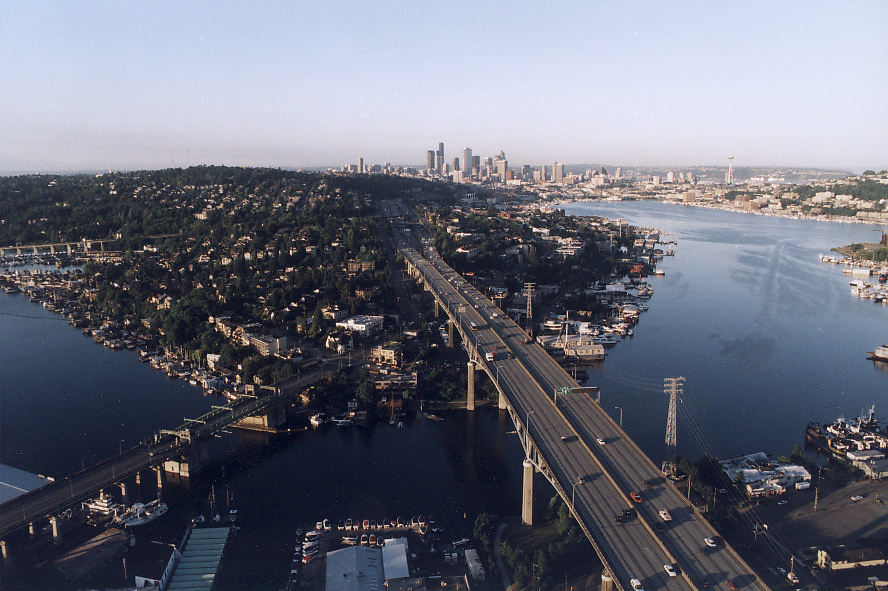

While Brisbane and Seattle are both on the Pacific Rim, backwards Vancouver, BC might as well be on another world. Brisbane and Seattle are allowed to function like proper big port cities, because they aren't hindered by anything like the VMV, or the Backwards BC Mentality.
If such a 12 lane crossing was allowed in Greater Vancouver it would mean that there could be 2 BRT lanes, 2 HOV lanes, 2 truck lanes and at least 6 general traffic lanes. However, the backwards BC approach is to funnel everything into just 2 or 3 lanes each way.
6 lanes, plus 2 train tracks
https://www.google.com/maps/place/18B+Howard+Smith+Dr,+Port+Of+Brisbane
A 6 lane bridge and a rail-bridge with 2 tracks.
Brisbane got it right and Vancouver got it wrong. Both are major Pacific port cities, but the Vancouver version is watered down.
https://www.google.com/maps/place/Iron+Workers+Memorial+Bridge 6 lanes, but should have been 8-10 lanes by now.
https://www.google.com/maps/place/Thornton+Tunnel+North+Entrance Its only a single track tunnel and freight train bridge. Any major seaport region should have double track bridges and tunnels.
https://www.google.com/maps/place/Riverview+Bridge Its only 4 lanes, but has a potential to become a 6 lane crossing. https://www.pilingcanada.ca/bridging-the-past-into-the-future/
The New_Westminster (rail)_Bridge should have opened with 2 tracks and had enough future width for a 3rd track.
Wednesday, July 8, 2026
Victoria, Q.C. and Halifax
https://victoriabuzz.com/2026/07/victoria-ranked-among-top-cities-to-live-in-canada-for-2026/
https://en.wikipedia.org/wiki/Victoria,_British_Columbia
https://en.wikipedia.org/wiki/Quebec_City
https://www.rome2rio.com/s/Victoria/Nova-Scotia
https://www.tripadvisor.ca/ShowTopic-g155025-i50-k9846192-Nova_Scotia_Vs_Quebec-Quebec.html
Saturday, July 4, 2026
Wednesday, July 1, 2026
Why do some people think that Toronto is The Next New York?
https://www.youtube.com/watch?v=-eJcCpoXx50
Its really more like becoming another Chicago. They are the 2 biggest cities on the Great Lakes.
No Canada Day Fireworks in Vancouver, yet again
"You’ll find Canada Day fireworks in Burnaby, Coquitlam, Delta, White Rock, Abbotsford, and Port Coquitlam." https://miss604.com/2026/06/canada-day-events-around-vancouver-2026
Despite not having any Canada Day fireworks for itself, Vancouver can't stop other cities in BC or Canada from having fireworks on C Day.
Tuesday, June 30, 2026
The 15-30 minute city concept
https://en.wikipedia.org/wiki/15-minute_city
https://www.sciencedirect.com/science/article/pii/S2590198222000641
Ideally, if most things are within 15 minutes, that's great.
https://unfccc.int/news/the-15-minute-city
Even in the case of urban sprawl, a lot of things can be built within 15-30 minute town centers.
https://policyoptions.irpp.org/2024/10/15-minute-cities-canada
No matter how big a city or urban region is, 15-30 minute town centers can be built, but it can require a lot of work.
https://www.planetizen.com/news/2022/07/117975-could-la-be-15-minute-city
However, sometimes people still have to get across town for various reasons.
https://medium.com/sybarite/escape-to-a-15-minute-city-ce3707baf145 While its not impossible, to even establish 30 minute urban focal points in Greater L.A. can be challenging. If a person living in L.A. is within 15 minutes of walking or biking, or a bus or train trip from the stores and other services, that's great. However, a lot of people are still a 30-60 minute drive away from work & other places to get to. Thus, a 1 hour+ city is still unavoidable in some cases.
https://www.reddit.com/r/Urbanism/comments/1gtlylo/what_city_is_californias_best_option_for_a/
Sunday, June 28, 2026
15-minute City Movement Gains Momentum in BC
https://bctimes.ca/posts/bc-15-minute-city-movement
https://ncceh.ca/resources/evidence-briefs/time-think-15-minute-cities-health-and-equity
https://www.cbc.ca/news/canada/british-columbia/vancouver-15-minute-city-1.6463022
https://open.library.ubc.ca/soa/cIRcle/collections/ubctheses/24/items/1.0412906
https://spacing.ca/vancouver/2023/05/01/your-15-minute-city-is-not-my-15-minute-city 15 to 30 minutes, but sometimes an hour+ is still required to get to where you are going.
https://policyoptions.irpp.org/2024/10/15-minute-cities-canada/
https://www.reddit.com/r/vancouver/comments/y4ax7e/thoughts_on_vancouver_ever_turning_into_a/
Subscribe to:
Posts (Atom)