https://www.youtube.com/watch?v=4-9O8UYX3FQ
Ideally, an airport line can run from the city to the airport station. Sometimes, the airport station is just a stop on a larger line.
UTL is about exploring past, present and future urban technologies in science and fiction, etc...
https://www.youtube.com/watch?v=4-9O8UYX3FQ
Ideally, an airport line can run from the city to the airport station. Sometimes, the airport station is just a stop on a larger line.
https://dailyhive.com/vancouver/skytrain-yaletown-roundhouse-station-additional-fare-gates-completed
The Canada line is such a watered down version of what should have been a proper big city airport and ferry rapid transit link. Just because this infrastructure project had to be scaled down during its first phase, the stations still could have been designed to eventually accommodate 5-6 car trains. Unfortunately, the stations were only designed to accommodate a 2.5 car train. While this perfectly fits in with the inept urban transportation mentality and especially fits in with the BC congestive transportation agenda, this is another sad result.
https://dailyhive.com/vancouver/skytrain-yaletown-roundhouse-station-fare-gate-expansion
Despite being downtown with several condominiums around, the Yaletown-Roundhouse_station is too small for an inner-city station.
https://en.wikipedia.org/wiki/Yaletown-Roundhouse_station#Station_information
There is barely enough level clarence beyond the short platform for another car. To remedy this inadequate situation, this line needs to have three full-size cars, not just some eventual 2.5 car joke of a train.
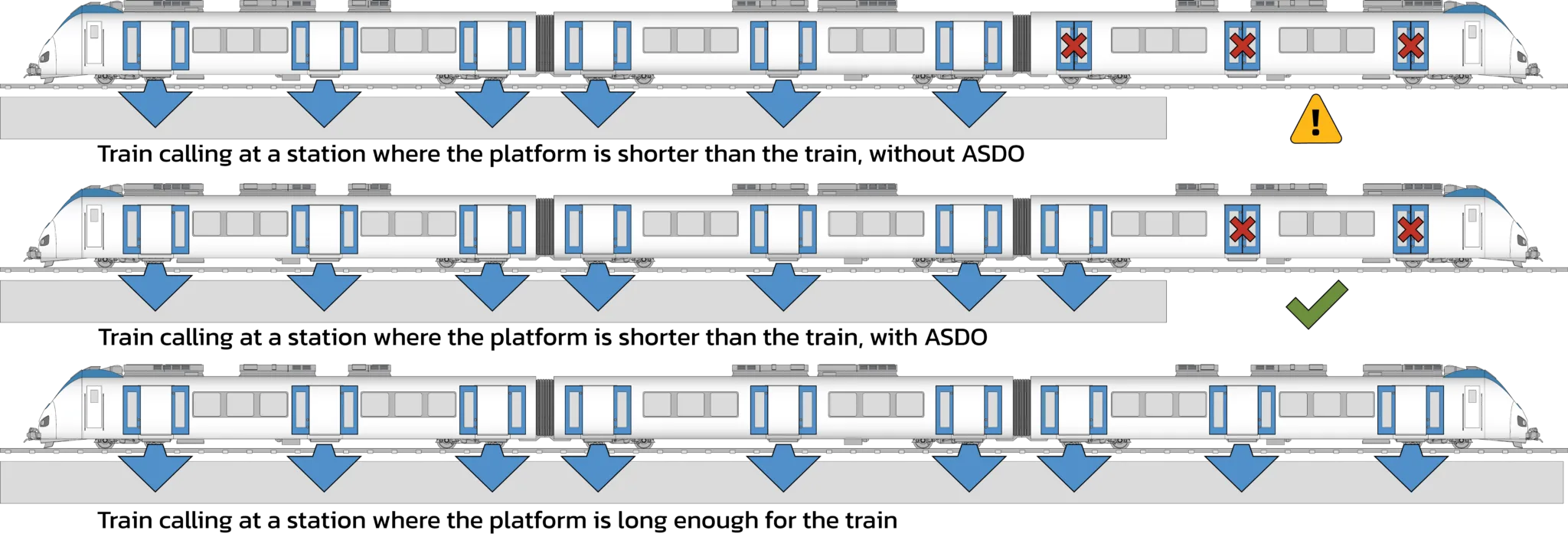
https://www.eke-electronics.com/automatic-selective-door-operation-asdo
Then eventually, once people got used to a 3 car train, an extra car could be added at each end, resulting in a 5 car train. Its a workaround that can eventually enable the 3rd line or the C Line to run 3-5 cars trains to meet demand.
Then the Exp. Line and Mil. Line, or what could become A & B lines with standard 5 car trains. However, during the busy times, a 7 car train could be possible with selective-door-operation technology.
It would have been better to have just built all of the Skytrain stations long enough for 5 car trains in the first place, with enough level track clearance for 10 car trains eventually.
Honolulu is very reluctant to allow buildings to go much higher than 450 feet. SD can't go higher than 500 feet, because of the airport being so close. However, that's not the case in Boston.
https://en.wikipedia.org/wiki/Honolulu#Economy
https://skyscraperpage.com/diagrams/?cityID=421
Will Honolulu ever have some Miami or Singapore size buildings? That remains to be seen. For now, Honolulu like San_Diego will remain free of 50 story hotels and condos and 40 story office towers.
https://en.wikipedia.org/wiki/List_of_tallest_buildings_in_San_Diego
https://skyscraperpage.com/diagrams/?cityID=120
If SD can ever relocate its airport, then it can have much taller buildings. Once Edmonton closed an airport that was too close to its downtown, the city eventually had the tallest building in Western Canada.
Honolulu got a nice airport train station long before SD.
Philly’s Airport Train is a Little Weird https://www.youtube.com/watch?v=tH1zcTLOCM0 Traveling from Terminal A at Philadelphia Airport to 30th Street, in Center City on the SEPTA Airport line takes under 30 minutes.
https://en.wikipedia.org/wiki/Airport_Line_(SEPTA)
https://www.phl.org/getting-around/public-transportation
https://www.reddit.com/r/transit/comments/1gf0pz3/why_isnt_the_septa_airport_line_rapid_transit/
https://en.wikipedia.org/wiki/Philadelphia_International_Airport#Ground_transportation
https://vancouver.citynews.ca/2026/05/14/granville-bridge-death-was-preventable-say-advocates/
While the Granville+Bridge needs to have a higher fence like the Burrard+Bridge, there is another remaining pending danger.
There is no central safety barrier to prevent head-on collisions. Whether a person becomes disoriented, or actually wants to crash into traffic from the opposite direction, there is no traffic divider.
The sidewalks could have been made a little wider in a way that there still could have been enough space for a traffic divider.
https://www.reddit.com/r/vancouver/comments/1td85mt/iio_investigates_womans_death_after_ninehour/
https://jfdatalinks.blogspot.com/search?q=Granville+Bridge Was 8 lanes, now 6, but with 2 bike lanes and wider sidewalks.
https://jfdatalinks.blogspot.com/search?q=Burrard+Bridge Was 6 lanes, now 4, but with 2 bike lanes & already good sidewalks.
Unfortunately, both bridges have no middle safety barrier to prevent head-on collisions, despite their recent modifications.
The Pattullo+Bridge was too narrow to ever have a traffic divider. Fortunately, its 4 lane replacement does have a central divider.
https://jfdatalinks.blogspot.com/search?q=Knight+Street+Bridge Only 4 lanes in the middle, but has a traffic safety barrier. The KSB really needs a bus and bike bridge next to it.
https://jfdatalinks.blogspot.com/search?q=Oak+Street+Bridge A traffic divider was eventually installed, but the narrow bridge was never designed to have 2 emergency lanes, or 2 wide shoulders. There especially was no consideration to have 2 bus lanes on the OSB. Since there is no 24 hour train service to the airport, there should be a parallel bus and bike bridge.
https://jfdatalinks.blogspot.com/search?q=Arthur+Laing+Bridge While it does have a traffic divider, there are no wide emergency lanes or wide shoulders. There isn't even enough space for 2 bus lanes. Thus, a bus and bike bridge really should be built next to it.
https://www.youtube.com/watch?v=fkhJKgNlIGc
https://www.sandag.org/projects-and-programs/featured-projects/airport-transit-connection
The airport station will likely be longer than the incredibly short, single track station at YVR.
https://www.youtube.com/watch?v=H9_GQWyo8h0
Boston and Las_Vegas allow much taller buildings than what's permitted in Richmond. Those cities don't use their airport as an excuse to have stumps. Even San_Diego has taller towers than Richmond.
Despite New_Orleans being on a delta, it has much taller buildings than Richmond as well.
Boston & LV have longer trains, while N.O. never totally got rid of their streetcars like Richmond had.
https://en.wikipedia.org/wiki/Lansdowne_station_(SkyTrain) A little 2 car joke of a train that's expected to do the job of what a big size or at least medium size city can do.
https://en.wikipedia.org/wiki/Rseau_express_metropolitain#Rolling_stock 4 cars.
https://en.wikipedia.org/wiki/Skyline_(Honolulu) 4 cars.
Fortunately, Montreal & Honolulu opted to not have something like a 2 car YVR-C Line joke of a train.
When stations can't easily be extended, Selective_door_operation can turn a 4 car rain into a 6 car train.
https://en.wikipedia.org/wiki/Selective_door_operation#International_variations
Unfortunately, the YVR-Canada_Line wasn't designed to have 4 or 5 car trains. The stations were only designed to just accommodate a 2.5 car train. However, with Selective_door_operation, a 2.5 car train could become a 4.5 car train. Perhaps, even a 5 car train with 3 full-length cars accessing the station platform. To still be running a 2 car train to Richmond and a Richmond-Delta tunnel that's still only 2 lanes each way, is a very sad joke.
So much more should have been done between 1986 and 2010. Especially, since 2010 and 2026.
https://vancouver.citynews.ca/2026/05/02/expo-86-40-years-later-the-memories-live-on
Everything is so much more difficult & costly to do in backwards BC.
https://en.wikipedia.org/wiki/North_Shore_(Greater_Vancouver)
Is North Vancouver the most livable city in Canada? https://www.youtube.com/watch?v=gX89qkSRBvg
https://www.vancouversnorthshore.com
Unfortunatly, there still isn't a commuter train from the airport to the H Bay ferry terminal.
https://en.wikipedia.org/wiki/North_Shore_(Greater_Vancouver)#Access
There isn't even a train tunnel or a bus bridge between Downtown_Vancouver and the North Shore. Inept regional planning has been very slow to build rapid rail transit, or even a proper rapid bus bridge over the Inlet. An inadequate 3 lane Lion Bridge is so narrow that some people have living rooms or swimming pools wider than it. The 6 lane Iron Bridge that's so narrow, there isn't enough room for emergency lanes and no space for HOV lanes. Any attempt of a rapid bus will still have to be funneled into the inadequate single deck crossing.
The Transit Every Airport Needs https://www.youtube.com/watch?v=4YeVZVluQWI&t=247s
https://www.upexpress.com/en/about-up/things-are-looking-up Its only a two and three car train, when it should be between 4-6 cars, depending upon the time of day. https://www.torontopearson.com/en/transportation-and-parking/up-express
At least it's not a perpetual 2 car train joke that is the YVR-Canada Line. The eventual airport REM line should consist of 4 car trains, but the entire REM should eventually have 6 car trains.
Somehow, Melbourne, Sydney, Brisbane & Perth all are able to have longer trains to the airport. The 10 car SFO-BART trains are pretty cool.
https://www.youtube.com/watch?v=4TsUH1tmmBM , https://en.wikipedia.org/wiki/LAX/Metro_Transit_Center
https://www.flylax.com , https://www.flylax.com/lax-traffic-and-ground-transportation
https://en.wikipedia.org/wiki/LAX_Consolidated_Rent-A-Car_Facility
Although not as grand as a 10 car BART train, at least LA never opted to have a 2 car joke of an airport train like YVR has.
Evolution of the Los Angeles Metro 1900-2028 https://www.youtube.com/watch?v=nH9toJw6-k8
https://www.delta-optimist.com/local-news/expect-noise-vibration-during-upcoming-massey-tunnel-replacement-11436394 This B$ should have been done a few decades ago.
A 10 lane bridge with 2 bus lanes, 2 HOV lanes & 2 wide shoulder-emergency lanes, plus at least 3 general lanes each way, could have been a nice wide crossing. Some 12 lanes, including the 2 emergency lanes. Plus, a provision for at least 2 LRT tracks.
Instead, it's a 3 lane each way tunnel with the 4th being a bus lane. No HOV lanes and no emergency lanes & especially, no train tube section.
So, just like the YVR-Canada (embarrassment) Line, this new 8 lane tunnel will eventually require some major upgrades.
Eventually, a YVR-Canada Line bridge or tunnel will have to be built so that someday, trains can go between the airport and the ferry terminal. Such a train crossing should be parallel to the new highway tunnel. A new train tunnel or bridge should have at least 3 tracks, 2 rapid bus lanes and 2 bike lanes and sidewalks. Then the bus lanes in the highway tunnel could become HOV lanes.
https://jfdatalinks.blogspot.com/search?q=Richmond-Delta+Tunnel
https://jfdatalinks.blogspot.com/search?q=Massey+Tunnel+replacement
https://jfdatalinks.blogspot.com/search?q=Richmond+and+Delta
Getting to the Airport Doesn’t Have to Suck https://www.youtube.com/watch?v=5WDCfDHQrxQ
The Missing Transit in This Fast-Growing Canadian Province https://www.youtube.com/watch?v=4LGigNBLuS0
The Transit Every Airport Needs | Airport Rail Links https://www.youtube.com/watch?v=4YeVZVluQWI
Metro Vancouver's Future Transit Plans https://www.youtube.com/watch?v=sVVfYwn7vmI
Even if the widest parts of the H-1 could be 10 or 12 lanes, it would still get plugged up. Nevertheless, being from Vancouver, it's quite impressive to see such a wide H-1 by the airport. If you visit Vancouver from Hawaii, you might think that Vancouver is a big city like Sydney, SF or Seattle. Then you discover that the roads & bridges are much narrower than what's in those cities. The real big surprise is that Vancouver not only has shorter trains than Sydney, SF & Seattle, but even Edmonton. Fortunately, the Skyline to the airport isn't a 2 car joke of a train like Vancouver's airport line is.
https://honolulutransit.org/about/route-map , https://en.wikipedia.org/wiki/Skyline_(Honolulu)#Route
https://www.honolulu.gov/dts/skyline
The Airport Segment.
https://en.wikipedia.org/wiki/Skyline_(Honolulu)#Segment_2:_Airport
https://en.wikipedia.org/wiki/Lelepaua_station If only Vancouver's line to the airport could have opened with 4 car trains, then with Selective_door_operation, eventually 6 car trains. Unfortunatly, backwards Vancouver has been stuck with a 2 car YVR train since 2009, but it has the potential to become a 2.5 car joke of a train, someday.
Downtown Honolulu.
https://en.wikipedia.org/wiki/Skyline_(Honolulu)#Segment_3:_City_Center
https://en.wikipedia.org/wiki/Skyline_(Honolulu)#Ala_Moana_extension
https://en.wikipedia.org/wiki/Skyline_(Honolulu)#Rolling_stock "The line uses 256 ft (78 m) four-car train sets, each with the capacity to carry nearly 800 passengers..." "Each car is 64 ft (20 m) long, weighs 72,000 lb (33,000 kg), and has 36 seats with a listed total capacity of 195 people, and sits on standard-gauge (1,435 mm) rails."
While the Skyline cars are similar in length to the YVR-Canada-Line cars, they are of a heavier construction. Plus, the trains are twice as long as any on the embarrassingly short Canada+Line trains.
While it took a long time to get the Skyline to the airport, at least the stations were all initially built to accommodate 4 car trains. Unfortunatly, the joke that is the SkyTrain-Canada+Line is still only running 2 car trains and wasn't designed to eventually have 5 car trains. Its difficult to understand why the joke-line stations are only designed to accommodate a 2.5 car train, someday.
Honolulu like Brisbane, are very far away from the Vancouver Mind Virus (VMV) and much warmer. Thus, they are able to have longer trains to the airport, because they can build on a proper big city scale.
https://jfdatalinks.blogspot.com/search?q=Brisbane+Airport+Railway+Line
https://www.youtube.com/watch?v=4-9O8UYX3FQ
The Amazing Transit Comeback of Los Angeles https://www.youtube.com/watch?v=Xd0Zm7T1npE
https://upload.wikimedia.org/wikipedia/commons/thumb/5/55/Canada_Line_Train_201807.jpg/960px-Canada_Line_Train_201807.jpg , https://en.wikipedia.org/wiki/Canada_Line#Route An airport+line connecting Vancouver & Richmond to YVR should have started out with at least 5-6 car trains, then eventually, 8-10 car trains after eventually connecting to the 2 main BC Ferry terminals. However that's a problem, because backwards BC can't seem to allow for proper long-range, bigcity infrastructure planning & development.
https://en.wikipedia.org/wiki/British_Rail_Class_777 Train length 64.98 m (213 ft 2 in)
https://en.wikipedia.org/wiki/Merseyrail#Fleet
https://en.wikipedia.org/wiki/Stockholm_Metro
https://en.wikipedia.org/wiki/SL_C30 Train length 70 m (229 ft 7+29⁄32 in)
https://en.wikipedia.org/wiki/SL_C20 46.5 m (152 ft 6+45⁄64 in) Unlike Vancouver, Stockholm can run double-length trains. This is possible whenever longer stations are built, or at least have enough level clearance for future expansion.
The Montreal Metro in the 1960s could run ridiculous 3 car trains, but eventually realized that 6 car trains & especially 9 car trains can efficiently more more people. Thus, its a good thing that they planned to have 152.4 m stations right from the start.
While short trains and stations can initially be a cost saving measure, allowing for future level clearance can be more economically efficient, in the long run. Thus, even a tram premetro can eventually be turned into a tram-train.
Unfortunatly, in typical Vancouver fashion, the Canada+Line wasn't designed to have 10 car trains, not even 5 car trains. The 2 billion dollar joke of a train was only designed with a level clearance for 50 m stations that only can accommodate a 2.5 car train. For a line that had to be open by 2009, it's still only running 2 car trains, with no 2.5 car trains in sight as 2025 is winding down.
https://upload.wikimedia.org/wikipedia/commons/thumb/3/35/NorthArmBridge.jpg/960px-NorthArmBridge.jpg A pathetic 2 car train on a bridge that should have 2 bike lanes & 2 sidewalks.
Indeed, just because the Canada Line was designed as if it was only to start out with short premetro train stations, there should have been a long-term plan to eventually have proper big city trains. One of the biggest mistakes for what should be a proper big city metro train, is to design short stations that are almost impossible to double, let alone tripple in length.
https://jfdatalinks.blogspot.com/search?q=Canada+Line+is+so+under-built
If you are visiting Vancouver or Victoria from Calgary or Edmonton, you will be shocked as to how narrow most of the bridges are in Greater Vancouver and Victoria. Edmonton was wise in the 1970s to have 125 m long underground LRT stations. Foolish Vancouver opted to only have 80 m stations on its first 2 lines and an absurd 50 m for the 3rd line.
https://en.wikipedia.org/wiki/Green_Line_(Calgary) , https://www.calgary.ca/green-line.html
https://www.calgarytransit.com/plans---projects/lrt/green-line.html
https://engage.calgary.ca/greenline/UndergroundStations Fortunatly, any underground stations in Calgary will be closer in length to that of the Edmonton LRT and not backwards Vancouver.
https://www.railjournal.com/regions/north-america/tunnel-preferred-for-calgary-lrt-green-line/
https://www.calgary.ca/green-line/stations.html
The main roads and bridges in urban parts of Alberta are allowed to be wider than their counterparts in backwards BC. So while people in the urban parts of Alberta are concerned or even angry about rapid growth, at least Alberta can easily build more urban infrastructure. That's because Albertal isn't affect by the (unofficial) BC Mind Virus (BCMV).
A timely example is a new bridge between Surrey & NW. Despite Surrey being expected to become the largest city in BC, the new bridge will only open with 4 lanes. No 3rd or 4th lane each way for busses, HOVs and trucks. Thus, all the road traffic at either end is funneled into just 2 lanes each way. Plus, there are no breakdown or emergency lane, just like the old bridge.
While this new bridge can eventually be widened to 6 lanes, there is no provision for a lower deck for LRT, busses and trucks. Despite SW BC being a seaport area, trucks are funneled onto mostly narrow bridges. There has been a lack of interest to build bus bridges next to almost all of the bridges in Greater Vancouver. Yet, there is a Half-A$$ED attempt to have a better regional express bus network. This regional Rapid Bus attempt will always be a joke, unless a series of bus bridges are built. The Half-A$$ED approach is to try to have bus lanes on 4 to 6 lane bridges. Designating 2 bus lanes would reduce the narrow bridges to only 1 or 2 lanes each way for general traffic in what is suppose to be a major seaport and urban area.
Most of the worlds population is non-white and for a big part of the history of BC, there has been a refusal to build up bigtime infrastructure for everyone. While some Albertains might wish that there was a wall built around their province or a force-field like out of Star Trek, BC is almost pretending like there is. Thus, the keep things small and backwards mentality.
Several decades ago, BC implemented a symbolic slow-growth approach. Despite BC not having any control over immigration, or trying to establish an internal passport & checkpoint system, to KEEP PEOPLE OUT, it opted for the next best thing. Stunt or scale back the urban infrastructure to project a strong symbolic reluctance to growth and thinking big.
When you realize how much larger things are allowed to be in Alberta, Washington State and even Western Australia & compare them to watered down BC, you see quite a difference. Despite BC & Canada in general, being multicultural, BCs cities keep finding ways to water the scale of things down. Canada has yet to have even 1% of the world's population, despite its size.
While there are good arguments to occasionally slowdown immigration, that can eventually become problematic, just like too much immigration. Even in the 2020s, some people in the former White colonial parts of the world still wish that Canada & Australia, etc., could be a White Man's paradise. However, that seems so impractical on a planet that mostly has a non white population.
https://humanrights.ca/story/chinese-head-tax-and-chinese-exclusion-act
https://thecanadianencyclopedia.ca/en/article/chinese-head-tax-in-canada
https://royalalbertamuseum.ca/blog/chinese-head-tax-george-yees-story
https://www.musee-mccord-stewart.ca/en/blog/chinese-exclusion-act/
https://parks.canada.ca/culture/designation/evenement-event/exclusion-chinois-chinese
https://www.canada.ca/en/canadian-heritage/campaigns/asian-heritage-month/important-events.html
https://stanleyparkvan.com/stanley-park-van-monument-komagata-maru.html
https://vancouver.citynews.ca/2022/10/05/vancouver-komagata-maru-memorial
https://vancouver.citynews.ca/2023/01/30/vancouver-komagata-maru-memorial-vandalism/
Even if Alberta were to eventually become its own country, it would be extremely unlikely that it could ever impose a White Man's Paradise Agenda. The same could be stated for backwards BC. However, something very peculiar has been happening in BC for several generations.
Several BC cities and municipalities play off each other with various slow-growth agendas. Vancouver being one of the most restrictive & backwards on the the planet. Somehow the legitimate anti freeway fears of the 1960s & 70s didn't get the city & region to still build a series of bus & HOV bridges. Plus, a long-term, high capacity urban rail system.
While Montreal planned for 152.4 m stations to accomodate 9 car trains, backwards Vancouver only built 80 m Skytrain stations for the first 2 lines. Then to top that, was a plan to build a line to Richmond with only enough level clearance for 50 m stations. The 1st line only started to run 5 car trains in 2025. Eventually, the 2nd line will also have 5 car trains. However, the line to the airport was deliberately designed not to have 5 car trains. Just a Half-A$$ED 2.5 car train, someday. WTH?
For Greater Vancouver to mostly have narrow bridges, one would think the all the stations could ultimately be at least as long as a Montreal Metro train station. Indeed, Greater Vancouver should have built for 10 car trains, but will only have 5 car trains on the 1st two lines & a 2.5 car joke of a train on the 3rd line. As of 2025, the 2nd & 3rd lines are still only running 2 car trains. Such a great way to symbolically show the resistance to eventually link YVR to both of the main BC ferry terminals.
The inadequate 3 lane Lion Bridge still has no bus & HOV tunnels near it. Urban parts of Australia never seemed to have a similar reluctance to build tunnels as does backwards Vancouver. Tunnels for Montreal & Seattle aren't a problem either. At least BC is slated to have a new and improved tunnel by 2030, that's only a couple of generations late.
Oh, if only people would stop moving to BC, especially Vancouver & Victoria. Well, that's not the case, its just that various BC cities want to only build urban infrastructure that is inadequate. Despite the frustrations that some people have in Alberta, at lest wider bridges, longer trains & taller buildings are allowed there. This watering things down in BC approach is symbolically indicative to refuse to properly build for a growing population.
Surrey should have already had at least 1 hospital the size of VGH. At least Surrey like Burnaby, can build up taller in what is still mostly a mountain wilderness province.
BC is a long way from New England & Southern Quebec. The restrictive urban planning measures in Greater Vancouver keep preventing it from becoming a proper big metropolitan area like Greater Boston and Montreal.
Calgary and Edmonton each should have hand an airport+line by now.
https://en.wikipedia.org/wiki/Green_Line_(MBTA) Calgary will have its own version of a Green Line, eventually. https://jfdatalinks.blogspot.com/search?q=Calgary+Green+Line
https://dailyhive.com/montreal/montreal-trudeau-international-airport-yul-expansion-rem-train
https://www.admtl.com/en-CA/corporate/about-us/future-projects
https://en.wikipedia.org/wiki/YUL%E2%80%93A%C3%A9roport-Montr%C3%A9al%E2%80%93Trudeau_station
https://www.admtl.com/en-CA/parking-and-transport/roadworks
https://www.cbc.ca/news/canada/montreal/yul-trudeau-airport-10-billion-transformation-1.7586489
Eventually, the Pierre+Elliott+Trudeau+International+Airport could have 3 long runways. Fortunately, there is enough clearance to lengthen the shortest runway.
https://www.admtl.com/en-CA/community/soundscape-management/construction-on-runways-and-taxiways
Orly_Airport has 3 runways.
Sea-Tac also has 3 runways, but are all parallel.
https://en.wikipedia.org/wiki/Seattle-Tacoma_International_Airport
Heathrow_Airport has 2 very long runways.
https://en.wikipedia.org/wiki/Heathrow_Airport#Future_expansion_and_plans
Charles_de_Gaulle_Airport has 2 very long runways, plus 2 of moderate length.
https://www.yvr.ca/en/passengers/transportation/public-transportation
Even if the excuse of a limited budget is used at the time, the YVR-Canada-Line should have been designed with at least roughed-in 100 m stations, right from the start, with enough clearance to eventually become 160 m.
https://thecanadaline.com/station-guides/yvr-airport
Its like there was no concept to eventually connect both ferry terminals with the YVR-Canada-Line.
https://www.translink.ca/schedules-and-maps/skytrain?page=1#canada-line
Indeed, the YVR-Canada-Line should have been envisioned to be a long-range high capacity rapid transit corridor. A 40-50 m joke of a train can't do the job of a 150-160 m train.
https://dailyhive.com/vancouver/canada-line-skytrain
Short trains and mostly narrow bridges are a multigenerational way of life that was planned for SW BC.
https://dailyhive.com/vancouver/north-shore-burrard-inlet-vancouver-third-crossing-bridge
Who knows where so much of the money went, because it sure didn't go towards proper big city size infrastructure.
https://dailyhive.com/vancouver/skytrain-future-station-locations
If ever some serious improvements can be made to the Canada+Line, it should be renamed, the YVR-Canada-Line or SkyTrain-Canada+Line. With some proper upgrades it could almost become like a proper airport+line.
https://en.wikipedia.org/wiki/Selective_door_operation#International_variations