Showing posts sorted by relevance for query Quebec. Sort by date Show all posts

Friday, November 1, 2024

Vancouver's narrow bridges over the Fraser River

 https://dailyhive.com/vancouver/vancouver-knight-street-video-concern

The Knight_Street_Bridge (KSB) was deliberately designed to not have a couple of emergency lanes. No truck lanes and especially no bus and HOV lanes. No proper bike lanes, just 2 narrow sidewalks. 

https://en.wikipedia.org/wiki/Knight_Street_Bridge#Infrastructure

Thus, the Knight_Street_Bridge is one of the best examples of BC bottleneck planning.

https://images.drivebc.ca/bchighwaycam/pub/html/www/695.html

The Knight_Street_Bridge is so narrow and inept, that a new HOV, bus and bike bridge should be built right next to it. The Knight+Street+Bridge is only 4 lanes wide in the middle, so a parallel 4 lane bridge would greatly improve things. One lane on and one lane off between the twin bridge crossing and Marine-Drive. Then the main 3 lanes each way onto the 6 lanes of Knight+Street up to Kingsway. 


The incredibly narrow Fraser_Street_Bridge (FSB) was torn down and should have been rebuilt or replaced by the 1970s, especially by the 1990s. The city and the Provincial_government didn't seem to understand that a new bridge there would be great as a HOV, bus and bike bridge. A couple of wide emergency lanes would have made it a lot easier for emergency vehicles to go between Vancouver & Richmond.


Despite Oak Street being 6 lanes wide, the BC bottleneck mentality wanted to force everything into a 4 lane Oak_Street_Bridge (OSB). Even if there was no concept to have bus lanes in the late 1950s, the OSB should have had 6 lanes, plus 2 wide emergency lanes and 2 wide sidewalks.

https://en.wikipedia.org/wiki/Oak_Street_Bridge#Infrastructure

By now, there should have been a HOV, bus & bike bridge built next to the narrow & inept Oak_Street_Bridge


The Arthur-Laing-Bridge (ALB) is only 2 lanes each way. https://en.wikipedia.org/wiki/Arthur_Laing_Bridge


The multigenerational inept Vancouver & BC planning agenda is all about creating more congestion. 

Fortunately, the 8 lane Champlain+Bridge also has 2 passenger train tracks. This was possible, because Montreal and Quebec don't have anything like the Vancouver & BC mentality to hinder them.

Why have a provision for 10 car SkyTrains, when a 2-4 car joke of a train can enable more congestion? That's the backward BC way.

It's amazing that the Montreal+Metro was designed to have 9 car trains, even back in the 1960s. Montreal and Quebec in general, just don't have anything like a backwater BC mentally to contend with. Quebec isn't just able to do more because it has more people than BC, Quebec has been able to accomplish more because it isn't BC.

https://vancouver.ca/streets-transportation/bridges-and-structures.aspx

Despite being a newer crossing, the Arthur+Laing+Bridge was only designed to have 4 lanes, just like the older Oak+Street+Bridge. Both bridges should have been built with very wide shoulders, so that they eventually could have provided 6 lanes. Plus, both bridges should have had very wide sidewalks. However, that goes against the chokepoint planning mentality.

Thursday, September 25, 2025

The New 4 lane Pattullo Bridge is expected to open by Christmas

 https://vancouver.citynews.ca/2025/09/25/new-pattullo-bridge-to-open-by-christmas-bc-government 

Not 8, not 6, just another 4 lane BC funnel chokepoint. Officially, NW isn't against bus and HOV lanes, they just weren't part of the new bridge design. Of course there was no provision for a lower deck, because that would go against the congestion planing mentality. This new bridge not only should have had 2 bus lanes, but 2 wide emergency lanes or shoulders as well. Even if it can eventually have 6 lanes, there still won't be any emergency lanes or HOV lanes.

This BC bottleneck planning mentality is so bad for transportation. So much of backwards BC is about doing things that are impressive to the Yukon or Labrador. Not Quebec, Ontario and Alberta. 


https://jfdatalinks.blogspot.com/search?q=Pattullo+Bridge In 1800s BC, having the width of 2 wagon roads would be amazing.  

https://jfdatalinks.blogspot.com/search?q=Pattullo+Bridge+replacement In the 2020s, having 2 wagon roads each way is still amazing. 

There seems to be an unwritten rule that whenever possible, no bridge system in BC should be as wide as the widest in Fort+McMurray,+AB or Edmonton,+AB.

https://www.canambridges.com/projects/athabasca-river-bridge

Most Albertans have no idea of what it would be like to be under something like a BC Mind Virus. 

The same goes for Southern Quebec and Southern Ontario.

https://www.canambridges.com/projects/ile-des-soeurs-bypass-bridge/ 

Alberta, Ontario & Quebec would collapse or implode, if they had to do things the backwards BC way.

https://www.canambridges.com/projects/new-champlain-bridge-corridor-project/

Thursday, December 5, 2024

The Pierre Laporte Bridge

 https://en.wikipedia.org/wiki/Pierre_Laporte_Bridge

https://structurae.net/en/structures/pierre-laporte-bridge

https://upload.wikimedia.org/wikipedia/commons/6/69/Quebec_and_Pierre-Laporte_Bridges.jpg

Unfortunatly, the bridge doesn't have a lower deck. Perhaps some extensive upgrades or modifications could turn the Pont_pierre_laporte into a megacrossing. For now, there are no bus & HOV lanes.

The+Quebec+Bridge only has 3 lanes.


https://jfdatalinks.blogspot.com/search?q=Quebec

Tuesday, August 20, 2024

Thursday, May 8, 2025

A proposal for a tower up to 1,033 feet or 315 meters in Downtown Vancouver

 https://dailyhive.com/vancouver/hudsons-bay-parkade-vancouver-redevelopment-holborn-group

Vancouver & even the Lower_Mainland is a small portion of backwater BC.

https://globalnews.ca/news/11170798/new-development-pitched-downtown-vancouver-bc-tallest-tower

Most of BC is mountainous wilderness, there are only a handful of areas in backward BC in which there can be major urban areas.

https://skyscraperpage.com/diagrams/?cityID=1&status=15 Vancouver 

https://skyscraperpage.com/diagrams/?countryID=1&status=15 Backwater BC was supposed to always have the smallest buildings, when compared to what Ontario, Quebec & Alberta allows. 

https://skyscraperpage.com/diagrams/?stateID=7&status=15 Ontario

https://skyscraperpage.com/diagrams/?stateID=12&status=15 Quebec

https://skyscraperpage.com/diagrams/?stateID=2&status=15 Alberta 

https://skyscraperpage.com/diagrams/?stateID=1&status=15 BC

https://skyscraperpage.com/diagrams/?stateID=24&status=15 Washington State

https://skyscraperpage.com/diagrams/?stateID=47&status=15 Western Australia

https://skyscraperpage.com/diagrams/?stateID=14&status=15 California 

https://skyscraperpage.com/diagrams/?stateID=1 As of May 2025, there are a few residential towers in the low to mid 60s range. No office tower in BC has a 40th floor.

https://skyscraperpage.com/diagrams/?cityID=2&status=15 While Vancouver won't permit office towers to have a 40th floor, it can't stop Surrey from potentially have a 47 story office tower. https://skyscraperpage.com/diagrams/?cityID=2&status=15

Monday, August 12, 2024

Several Vancouver narrow bridge issues

 https://dailyhive.com/vancouver/metro-vancouver-bridge-cyclist-wire-allegations

Someone might have been very angry with bike people and not with car, bus & truck people. The real problem is that so much of the older BC infrastructure just wasn't designed to be more of a multi-modal crossing. The+Lion+Bridge+and+The+Iron+Bridge have no rail rapid transit crossings to help them.

The Ironworkers-Bridge is so narrow for a highway bridge in that location & wasn't designed for substantial future capacity. When it was initially designed in the 1950s, there was no concept to have 2 bus lanes, 2 HOV lanes, 2 truck lanes & 2 emergency lanes for a port city. Plus, at least 2 general traffic lanes each way & a provision for 2 train tracks. Thus, the 6 lane bridge is so overwhelmed, because it just can't do the job of an 8-10 lane wide bridge. While the Iron Bridge has 2 improved bike+lanes, they are part of the sidewalks.  

The former 8 lane Granville+Street will have 6 lanes, while the  & Oak+Street only has 4 lanes. The inadequate Oak+Street+Bridge (OSB) should have opened with at least 8 lanes, instead of only 4. Plus, 2 wide emergency lanes & 2 wide sidewalks. There still should be a new southbound OS Bridge, but the city would be against it. A narrow 4 lane bridge just doesn't have the space & capacity for 2 express bus lanes, 2 HOV & 2 truck lanes. Apparently, it's better to just funnel everything into only 2 lanes each way.  

The OSB should be twinned or replace with something like the Samuel-De_Champlain_Bridge in Montreal. The largest city in Quebec is allowed to have a nice wide bridge & long metro trains, because Quebec isn't bound by anything like the backwards BC mentality. 

https://www.theglobeandmail.com/canada/article-montreals-new-44-billion-champlain-bridge-opens-to-traffic-for Fortunatly, the Vancouver mentality wasn't able to ever reach back to Montreal & prevent such a nice modern bridge from being built there. https://www.flatironcorp.com/project/champlain-bridge If you are from Montreal & have visited Vancouver, you will be surprise to see how much shorter an underground Vancouver train station is than what is allowed underground in Montreal, Toronto, Edmonton, Seattle, SF & LA...

https://vancouver.ca/streets-transportation/granville-bridge-connector.aspx A bike & foot bridge should have been built next to it decades ago. Then the Granville Bridge could have 3 general lanes each way, plus a bus & HOV lane each way. Instead, if 2 bus & HOV lanes are designated, there will only be 2 general lanes each way in the downtown core.

The Burrard Bridge should have had a bike & foot bride next to it. Instead, it was reduced from a 6 lane crossing to a 4 lane bridge.

The very narrow Oak+Street+Bridge & the Knight Street Bridge, should have had bus+and+bike+bridges built next to them decades ago. 

Most bridges in Vancouver & the metropolitan region just weren't designed with that much future capacity in mind, especially for buses & HOV lanes. Thus, it's a travesty that by now, almost every crossing should have had bus & bike bridges built next to them. 

https://vancouver.ca/streets-transportation/walk-bike-and-transit.aspx Unfortunatly, provisions for bus & bike lanes just weren't the thing to do several decades ago in BC.  

A truck lane is just as important as a bus & HOV lane. That's because freight should be efficiently & easily be transported in any major urban region.

https://vancouver.ca/streets-transportation/trucks-commercial-and-oversize-vehicles.aspx

https://jfdatalinks.blogspot.com/search?q=Oak+Street+and+Granville+Street

https://jfdatalinks.blogspot.com/search?q=Iron+Bridge 

https://jfdatalinks.blogspot.com/search?q=Lion+Bridge

Saturday, April 6, 2024

The sad joke that is Vancouver and BC, Canada

Talk about a city that continually refuses to live up to its potential. Vancouver is an incredibly small city in total area. [ 123.63 km2 (47.73 sq mi) ]

The Metro_Vancouver_Regional_District_of_BC is more comparable to some of the larger cities on the planet. [ 2,878.93 km2 (1,111.56 sq mi) https://en.wikipedia.org/wiki/Metro_Vancouver_Regional_District

The Lower_Mainland_of_BC is more comparable to some of the larger urban & suburban regions of the world. Thus, there is a lot of potential for growth. 

Area
 • Total36,303.31 km2 (14,016.79 sq mi)

https://en.wikipedia.org/wiki/Lower_Mainland 

Yet, somehow so many things are continually underbuilt, as if to signify & perpetuate a KEEP THEM OUT agenda. Indeed, if you can't build a wall or generate a Star Trek or Star Wars like forcefield around BC, then you build a symbolically stunted transportation infrastructure. This helps to create more congestion & frustration. Of course one has to wonder where all the money has gone over the past several decades? 

How did the KEEP THEM OUT agenda ever get started? How did the KEEP BC SMALL mentality become so firmly entrenched? That remains partially a mystery, but it's as if some kind of a vibe or energy has been continually been tapped into over the course of several generations. Somehow this thwarting force or mentality, never seemed to catch on with AlbertaWashington_(state)Ontario & Quebec... 

1886 https://en.wikipedia.org/wiki/Vancouver#Incorporation

https://en.wikipedia.org/wiki/1886_Vancouver_anti-Chinese_riots (1886) A classic case of government & corporate mentality of the day, using one group of people over another. 

https://www.hrw.org/news/2023/12/03/questions-and-answers-migrant-worker-abuses-uae-and-cop28#:~:text=Even%20though%20migrant%20workers%20primarily,Rights%20Watch%20has%20extensively%20documented. Unfortunately, this still happens all over the world.

Unlike so many big cities, Vancouver seemed to have a reoccuring backwater mentality right from the start. While Vancouver & Canada in general have become multicultural over the recent decades, a provincial backwater mentality was ideal for Vancouver, back in the day. The old White colonial mentality just didn't see indigenous & other non-white people as that important or even necessary.  

https://en.wikipedia.org/wiki/Anti-Oriental_riots_(Vancouver) 1907 https://www.canadashistory.ca/explore/settlement-immigration/the-lessons-of-the-anti-asiatic-riot

https://en.wikipedia.org/wiki/Komagata_Maru_incident (1914)

Of course Canada, Australia & other White European colonies eventually had to accept that most of the world is non-white. Thus, maintaining a White Only Policy didn't fit in with the world's demographics.

https://www.canadashistory.ca/explore/settlement-immigration/not-just-immigrants

https://www.canadashistory.ca/explore/books/harriet-s-legacies

However, suppose that a  gordian knot of overlapping restrictions, red tape & other B$, could gradually be imposed throughout the White BC of the 1950s & 60s. Then even more Vancouver & BC restrictions in the 1970s & 80s, in spite of multicultural immigration. Of course Southern Ontario & Southern Quebec grew rapidly, because that's where most of the urbanization-and-industry is in Canada. Then by the 1990s, Vancouver should have been building things to the scale of Montreal in the 1970s & 80s. 

Instead, the first 2 Skytrain lines were built to only be about half the length of a Montreal Metro station & the 3rd line (the Canada+Line) with only 50 m stations. No bus bridges were ever built next to the existing narrow bridges. It's all about creating congestion, instead of properly planning to handle more capacity in BC. 


"One was that superhighways created new traffic as much as they relieved old bottlenecks; by 1972 bypass highways like the 401 were multi-laned traffic jams of bumper-to-bumper vehicles at first during rush hours and eventually for almost the entire day.

Improving connections between the city and its outskirts only prompted more people to move away or use the roads more frequently.

The other problem was that freeways constructed in populated areas could be built only by tearing down existing housing and devastating neighbourhoods. An extended period of Toronto opposition finally managed to stop construction of a projected expressway in 1971, which brought to a symbolic end the period of unrestricted and unplanned expansion in the city. In Vancouver at about the same time, proposals to extend the Trans-Canada Highway into the city’s centre, virtually demolishing many neighbourhoods — including the traditional Chinatown district — were fought to a standstill. https://www.canadashistory.ca/explore/arts-culture-society/home-sweet-suburb


 https://www.vancouverisawesome.com/real-estate-news/vancouver-one-of-the-most-resilient-cities-for-commercial-real-estate-8561663

https://dailyhive.com/vancouver/800-granville-street-vancouver-proposal-office-cancelled Yet, once again, another project was cancelled, due to the slow planning & processing pace of the city.


https://jfdatalinks.blogspot.com/search?q=SkyTrain-Canada+Line

https://jfdatalinks.blogspot.com/search?q=old+and+new+narrow+bridges

Tuesday, December 3, 2024

The Quebec Bridge (1919)

The Quebec_Bridge was quite an amazing structure for its time in Q-City. Unfortunatly, the bridge wasn't designed to eventually have 2 decks. That would have been so great, because there could have been 3 lanes & 1 set of train tracks on each level. It only has a total of three lanes & 1 track.

https://en.wikipedia.org/wiki/Quebec_Bridge#Second_design_and_collapse_of_September_11,_1916

https://en.wikipedia.org/wiki/Quebec_Bridge#Aftermath_of_the_collapse


https://jfdatalinks.blogspot.com/search?q=Quebec

Thursday, December 5, 2024

Louis-Hippolyte Lafontaine Bridge–Tunnel

The Louis-Hippolyte_Lafontaine_Bridge-Tunnel should have had been designed to have 2 wide emergency lanes. Then by now, there could have easily been 4 lanes each way. Unlike backward Vancouver, which is on a peninsula, Montreal is on an island, so more bridges & tunnels are necessary. However, Greater Vancouver still doesn't have enough bridges for proper a proper network of express bus & HOV lanes.

https://www.parsons.com/project/louis-hippolyte-lafontaine-tunnel-quebec-canada/

There really should have been a bus & HOV bridge or tunnel there by now. Everything is still crammed into 3 lanes each way.

https://montreal.ctvnews.ca/la-fontaine-tunnel-project-delayed-by-a-year-quebec-says-work-more-complex-than-expected-1.6918227

https://www.communitystories.ca/v2/pont-tunnel-louis-hippolyte-lafontaine_bridge/story/a-bridge-tunnel-the-perfect-mix/

https://www.communitystories.ca/v2/pont-tunnel-louis-hippolyte-lafontaine_bridge/story/the-underground-portion/

https://www.communitystories.ca/v2/pont-tunnel-louis-hippolyte-lafontaine_bridge/story/anticipating-the-future-of-transportation/


https://jfdatalinks.blogspot.com/search?q=Montreal

Sunday, August 4, 2024

Is Montreal the best city in North America?

 https://www.youtube.com/watch?v=_yDtLv-7xZ4

The tallest buildings in Montreal aren't that impressive when compared to what's allowed in Melbourne, Toronto, Chicago & NYC.

https://reporter.mcgill.ca/montreal-named-best-student-city-in-north-america/

Montreal doesn't have the very wide freeways that LA, Houston, Dubai & Toronto have, but its not stuck with the narrow bridges that Vancouver has.

https://vocal.media/wander/why-montreal-is-the-greatest-city-in-north-america

https://blog.mtl.org/en/montreal-ranks-top The Metro is fantastic! Especially the newer walk-through 9 car trains.

https://www.mtlblog.com/2-quebec-spots-ranked-among-best-cities-in-canada

https://www.mtlblog.com/quebec-cities-cheapest-rent-prices-canada

https://www.mtlblog.com/montreal/what-montreals-iconic-habitat-67-was-supposed-to-look-like-photos

At least Montreal hasn't been forced to adhere to the same restrictions as Vancouver. The first 2 SkyTrain lines only have 80m stations, when the Montreal Metro has 152.5m stations. The Canada Line only has 50m stations. It would have been chaos if Montreal had decided to have short stations & narrow bridges.


https://jfdatalinks.blogspot.com/search?q=Montreal

Tuesday, May 28, 2024

Five of Ontario's top 10 worst roads are located in the Greater Toronto Area

 https://toronto.ctvnews.ca/five-of-ontario-s-top-10-worst-roads-are-located-in-the-toronto-area-1.6903196 Of course its a good idea to make sure that the roads & streets are as smooth as possible.

The Greater_Toronto_Area is gradually becoming a vast urban region like the Chicago_metropolitan_area. So many more modes of transit must be provided for the GTA. IE, trains, HOV, bus & bike lanes. 

https://www.insauga.com/one-of-ontarios-worst-roads-is-among-the-busiest-streets-in-mississauga

Being from the BC Lower_Mainland, it's hard to believe that Canada's GTA is on its way to becoming like another Chicagoland. But then I always remember that Ontario, like Quebec & Alberta aren't under anything like the BC mentality & all of its restrictions.

https://www.cbc.ca/news/canada/hamilton/worst-roads-ontario-2024-1.7215979 

In effect, the Burlington_Bay_James_N._Allan_Skyway went from a BC like 4 lane bridge to an 8 lane Ontario crossing in the mid 1980s. https://en.wikipedia.org/wiki/Burlington_Bay_James_N._Allan_Skyway#1985_twin_bridge

https://511on.ca/map/Cctv/loc06--3
https://511on.ca/map/Cctv/loc06--3 Both bridges are safer than cramming everything into one crossing structure. 

https://burlingtontraffic.ca/qew-burlington-bay-james-n-allan-skyway The 4th lane each way could eventually become a bus & HOV_lane.

The 4 lane Burlington_Canal_Lift_Bridge is more like a narrow Vancouver bridge. Just 2 lanes each way with no space for an emergency lane or bus & HOV lane. That's why the Burlington_Bay_James_N._Allan_Skyway crossing is still better than any bridge within the Vancouver city limits. The skyway crossing combined with the lift bridge, provides 12 lanes, because the emergency lanes usually aren't counted. Just imagine if all that was funneled into a 4 lane Vancouver bridge. Fortunately, the backward BC bottleneck mentality has never taken over Ontario. 

While Oak Street in Vancouver has 6 lanes, the Oak_Street_Bridge was only designed to have 4 lanes. Thus, it's a fine example of the BC mentality and the multigenerational Vancouverization agenda. Vancouverization is all about watering things down & creating bottlenecks or chokepoints.

https://upload.wikimedia.org/wikipedia/commons/5/5f/Oak_Street_Bridge.jpg
https://wikimedia.org/Oak_Street_Bridge.jpg

The narrow 4 lane bridge should have been designed with a provision to eventually be at least 8 lanes wide. 3 lanes each way, plus a bus & HOV lane each way, but that would conflict with the narrow mindedness of Vancouver. It's sad that at least a bus & bike bridge wasn't built next to it, but that would conflict with the BC bottleneck planning approach to things.

https://upload.wikimedia.org/wikipedia/commons/5/53/Oak_Street_Bridge_and_Fraser_River%2C_Vancouver_-_panoramio.jpg
https://wikimedia.org/Oak_Street_Bridge_and_Fraser_River.jpg

https://images.drivebc.ca/bchighwaycam/pub/html/www/70.html A 6 lane street funneled into a 4 lane bridge. WTH?

The Oak_Street_Bridge really should have been opened as a 10 lane bridge. Yet, Oak_Street has only 6 lanes. A 10 lane OSB could have not only allowed for 3 lanes each way, but a bus & HOV_lane each way. Then the 5th lane each way could have been an emergency lane

https://www2.gov.bc.ca/gov/content/transportation/driving-and-cycling/traveller-information/routes-and-driving-conditions/hov-lanes

At the very least, a HOV, bus & bike bridge should be built next to the OSB. However, the multi generational backward BC mentality just doesn't care.

The 4 lane joke that is the George_Massey_Tunnel, should have had a HOV, bus & bike bridge built next to it several decades ago. But that would have actually created better mobility & less congestion.

https://en.wikipedia.org/wiki/George_Massey_Tunnel#Replacement Of course just like with the old tunnel, the new tunnel won't have a provision for LRT & emergency lanes. Thus, a LRT bridge would eventually have to be built next to it. Apparently, having a train from the Tsawwassen_ferry_terminal to the airport still doesn't make sense. That's just the backward BC way.

If you are from Ontario, Quebec, Alberta, the Pacific NW, Australia or just about anywhere, the watered down BC infrastructure will surprise you.


https://jfdatalinks.blogspot.com/search?q=old+and+new+narrow+bridges 

https://jfdatalinks.blogspot.com/search?q=bus+and+bike+bridges

Thursday, October 17, 2024

Tuesday, December 24, 2024

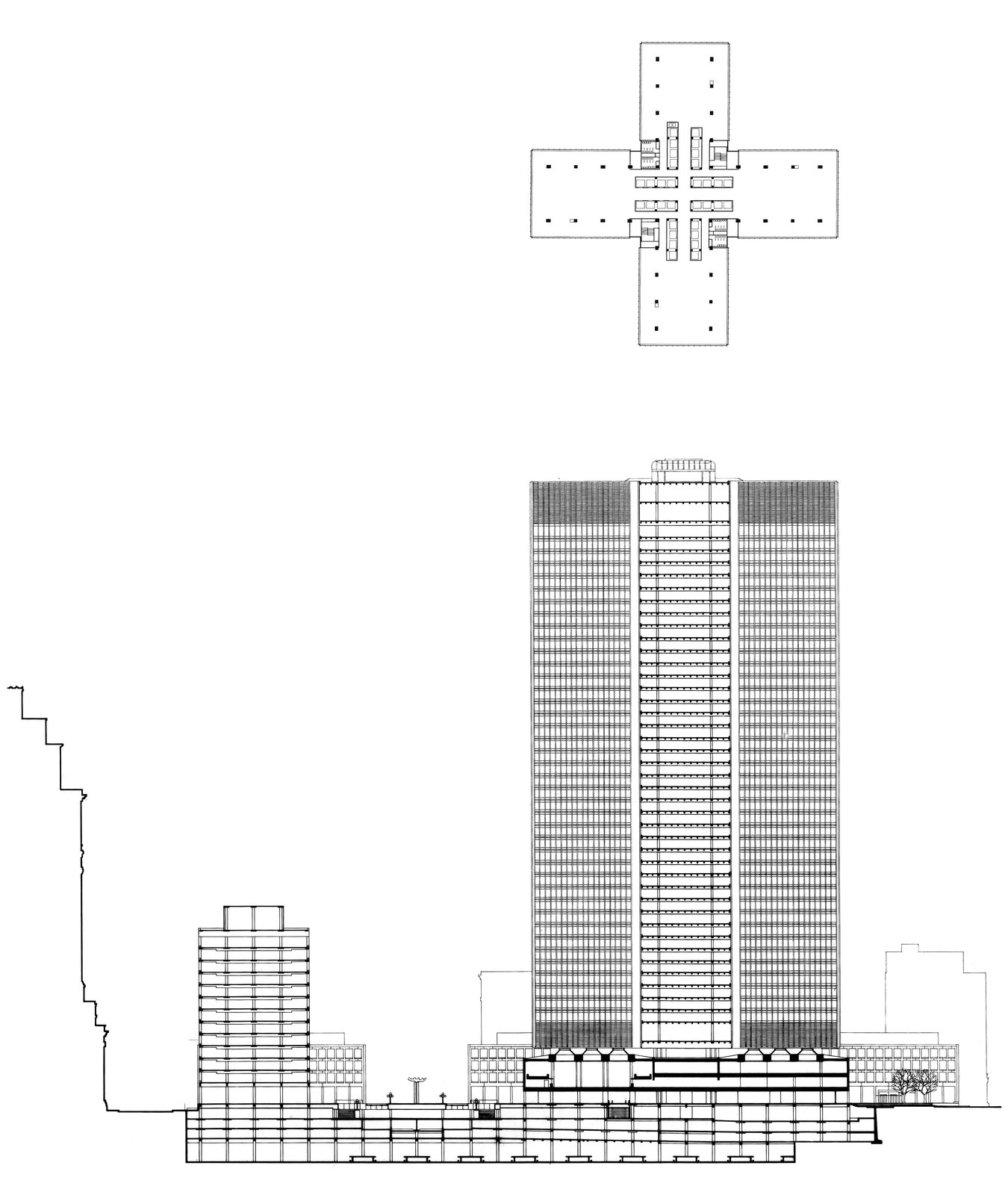
611 Place in L.A. and Place Ville Marie, Montreal

https://upload.wikimedia.org/wikipedia/commons/f/fe/611Place_LosAngeles.jpg , 
https://calisphere.org/item/c808aa829349df0b62b97853207d216f

https://en.wikipedia.org/wiki/611_Place Its a 42-story, 189 m (620 ft) skyscraper at 611 West 6th Street in Downtown Los Angeles. It was completed in 1969, some 7 years after PVM in Montreal. 611 Place is a few feet higher or a meter taller, but PVM is much wider building. It would take until the early 21st century before strict Vancouver would permit a building to rival their height.


PVM:

https://mtltimes.ca/business/have-a-look-at-the-changes-on-the-45th-and-46th-floor-of-place-ville-marie The building is equvalent to a 51_story tower, but the main widowed floors stop at 46. Some of the floors and of course the roof, have no windows, as they are mechanical or building plant operation levels.

Although it's not quite the tallest in Montreal, PVM is the tallest wide building in Quebec. It really should have been in the 55-60 story range, but Montreal wasn't ready for a big, bulky NYC office tower on the scale of 28_Liberty_Street or the MetLife_Building. Montreal has some view corridor restrictions, which prevent it to rival the tallest buildings in Austin Texas. However, Montreal is still allowed to have taller buildings than stumpy Vancouver.

https://upload.wikimedia.org/wikipedia/commons/1/14/Boulevard_Ren%C3%A9-L%C3%A9vesque.JPG Unlike narrowminded Vancover, Montreal has allowed for some tall wide buildings and even some wide streets or boulevards. Wide streets can allow for better accomodation of bus & bike lanes. The Vancouver approach is to try to cram everything into 4 lanes.

"This widening to 8 lanes was requested by the real estate developer planning the construction of Place Ville-Marie . This urban gesture allowed the arrival of several tall buildings, especially in the city center. It is without a doubt the boulevard of skyscrapers since it is on this artery that the largest buildings in Montreal and Quebec are located."
https://fr.wikipedia.org/wiki/Boulevard_Ren%C3%A9-L%C3%A9vesque_(Montr%C3%A9al)#Historique

 https://montrealjemesouviens.blogspot.com/2012/07/place-ville-marie.html

https://www.voirvert.ca/projets/projet-etude/ecologisation-place-ville-marie

https://www.pcf-p.com/projects/place-ville-marie PVM opened in 1962 & 6 years later, 777-Hornby a stump building in Vancouver with a similar shape, wasn't even allowed to have half as many floors as PVM. However, it would be an impressive building compared to what's in Victoria-Prince+George-Kamloops, but not most real cities.

https://pcfandtypecodewebstuff.s3.amazonaws.com/images/2.lin.PCF.5503_plan-section.max-1600x1600.jpg

https://skyscraperpage.com/cities/?buildingID=937 43, 46 or 50F. 188m/617' https://skyscraperpage.com/diagrams/?searchID=107855813&offset=75

https://maps.googleapis.com/maps/api/staticmap?size=375x375&zoom=18&center=45.501488%2C-73.568466&maptype=satellite&key=AIzaSyCNedHKUJhos7_OH_zp9Xtyw-eV8ylf-78 The Montreal tower.

https://maps.googleapis.com/maps/api/staticmap?size=375x375&zoom=18&center=49.282982%2C-123.121780&maptype=satellite&key=AIzaSyCNedHKUJhos7_OH_zp9Xtyw-eV8ylf-78 The watered down Vancouver version is just a stump by comparison.

777 Hornby Street
Vancouver BC Canada 
https://skyscraperpage.com/cities/?buildingID=4904 20F 72m/237' https://skyscraperpage.com/diagrams/?searchID=107855260&offset=25 It opened in 1968.

https://www.cityfeet.com/cont/listing/777-hornby-st-vancouver-bc-v6z-1s4/cs4415499

"777 Hornby is a 20 storey office, retail and parking complex strategically located at the corner of Hornby Street and Robson Street within walking distance of Vancouver's many amenities and top restaurants." https://www.777hornby.com


The former World_Trade_Center_in_New_Orleans was converted to a 34 story hotel. The building was first completed in 1967 as a 33 story, 407 feet (124 m) structure.

https://en.wikipedia.org/wiki/Four_Seasons_Hotel_and_Private_Residences_New_Orleans

https://upload.wikimedia.org/wikipedia/commons/b/be/(former)_World_Trade_Center_in_New_Orleans.jpg


https://jfdatalinks.blogspot.com/search?q=611+Place

Wednesday, January 14, 2026

Mild Victoria, BC

Victoria has been a provincial backwater for most of its history. Despite being in a mild winter setting, it's so small when compared to Edmonton, Winnipeg, Quebec City and Halifax. 

https://victoria.citified.ca/news/35-storey-one-victoria-place-mixed-use-tower-unveiled-blanshard-st-pandora-ave

https://www.onevictoriaplace.ca 

https://skyscraperpage.com/diagrams/?cityID=37&status=15  

While Edmonton was eventually allowed to have a tall building, even by Toronto, Calgary and Montreal standards, Victoria was always supposed to have shorter buildings than Winnipeg, Quebec City and Halifax. That's part of the KEEP THINGS SMALL mentality on V. Island. 

Victoria should have had its first LRT line by now, but that might improve urban mobility. Eventually, Victoria and Nanaimo will merge into one linear urban area. Eventually, the Comox_Valley_Regional_District will have over 100,000 people, the Regional_District_of_Nanaimo will have over 200,000 people, the Cowichan_Valley_Regional_District will exceed 100,000 people and the Capital_Regional_District will have over 450,000 people. 

Of course there doesn't seem to be any big regional scale planning from Sooke to Courtenay. Perhaps the island's urban planners will wait until there is 800,000 and over a million residents on the island.

https://en.wikipedia.org/wiki/Vancouver_Island#Demographics 

https://en.wikipedia.org/wiki/Island_Rail_Corridor#Vancouver_Island_Transportation_Corridor_Coalition

So, as more people discover that Victoria and Vancouver are the mildest winter cities in Canada, more people just might want to move there. Especially, when Canadian Snowbirds don't feel as comfortable with Florida, Texas & California.  


https://jfdatalinks.blogspot.com/search?q=population+growth

Tuesday, October 14, 2025

B.C. set to open Western Canada's first new medical school in decades

 https://www.cbc.ca/news/canada/british-columbia/sfu-new-medical-school-9.6938486 

Unfortunatly, for most of the history of backwater BC, there was a strong British Colonist antigrowth and anti-non-white immigration.

https://vancouver.citynews.ca/2025/10/14/sfus-new-medical-school-no-blanket-solution-healthcare-crisis/ 

Ontario and Quebec were able to build more infrastructure and other stuff, and then eventually also Alberta. Primarily as a result of having more economic wealth.

https://www.ctvnews.ca/vancouver/article/bc-set-to-open-western-canadas-first-new-medical-school-in-decades/

A new big medical school in BC would be nice, but so would be more hospital expansion.

https://www.sfu.ca/medicine.html