Showing posts sorted by relevance for query transit bridges. Sort by date Show all posts

Friday, September 19, 2025

The Best fix for North Shore traffic is to upgrade or replace both bridges

 https://www.nsnews.com/opinion/letter-best-fix-for-north-shore-traffic-is-to-upgrade-or-replace-both-bridges-11233455 

When there is a refusal to build bigger and better bridges, there still should be a regional network of bus and train bridges. However, the gridloc planning agenda keeps winning out.

Unfortunatly, after decades of inept transportation planning and then so much money wasted down a $HIT-PIPE, the North Shore keeps getting hit hard from the $HIT-BOX planning mentality. 

The Tilikum+Crossing in Portland is a fantastic example of modern infrastructure planning and development. It allows for the MAX-LRT, the streetcar, the bus, bikes and pedestrians to conveniently get across. The nice thing about the TC is that no lanes had to be removed or repurposed on the other Portland bridges. Perhaps that's why something like the TC isn't allowed in BC, because it could actually help to improve transportation efficiency. 

The Washington+Avenue+Bridge is another example of what's not allowed in Greater Vancouver or anywhere else in the BC part of Canada. After all this time, Greater Vancouver is still so lacking in a regional network of transit+bridges


https://jfdatalinks.blogspot.com/search?q=transit+bridges  

Tuesday, September 17, 2024

Metro Vancouver transit facing 'drastic cuts'

 https://www.vancouverisawesome.com/highlights/metro-vancouver-mayors-council-demands-action-on-transit-funding-brad-west-9533754

After decades of imposing narrow streets, roads, highways & bridges, it's still difficult for the region to have a proper express bus network. Most of the bridges in the region need to have a bus & bike bridge built right next to them. 

https://bc.ctvnews.ca/this-is-not-a-bluff-translink-mayors-council-calls-on-b-c-political-parties-to-share-plans-to-avoid-transit-cuts-1.7041435

The first 2 SkyTrain lines still only have 80m stations & the 3rd line, the C-Line, only has 50m stations. In contrast, the Montreal Metro was designed to have almost 153m long stations. Thus, a 500 foot long station can accommodate a 9 car train. Unfortunately, the first 2 SkyTrain lines can only accommodate the newer 4 car trains with a potential for a 5 car train, someday. The 3rd line or the C-Line, can only accomodate a 2 car joke of a train, but it has the potential to become a 2.5 car joke of a train.

This absurdity of congestive planning must be challenged & stopped in backward BC. Unfortunately, there are some influential people that continually like to maintain the symbolism of short trains and narrow bridges. They don't want the Greater Vancouver Region to become a proper urban area. That mentality apparently justifies the inadequate or underbuilt infrastructure in the region. 

So now with looming transit cuts, the narrow roads & bridges will become even more congested.

https://www.rtands.com/tag/translink

The $2BN Megaproject Under Vancouver https://www.youtube.com/watch?v=D4YFFtTEUQc

What Greater Vancouver Needs https://www.youtube.com/watch?v=qZavPFZ9H1E

Whether its a bridge or a tunnel, Perth and Seattle have excellent wide crossings which allow for rail rapid transit. Fortunately, the congestive Vancouver mentality never reached into those cities.

https://www.highway99tunnel.ca/tunnel-construction Unfortunatly, BC missed another opportunity to have rapid rail transit through the tunnel.

https://vancouver.citynews.ca/2024/09/17/highway-91-spun-out-richmond Even back in the 1980s, BC_Highway_91 should have been designed to be at least 4 lanes each way. 3 general lanes each way with the 4th as a bus & HOV lane. There also should have been 2 wide shoulders or emergency lanes. The Alex_Fraser_Bridge should have been designed to be at least 10 lanes wide. 3 general lanes each way & a bus-HOV lane & a truck lane each way. Plus, 2 emergency lanes & a provision for a lower rail transit deck. Unfortunatly, bottleneck or chokepoint planning won out. Plus, the symbolism for BC is to not properly plan for large, efficient infrastructure. 

How can the Greater Vancouver Region have an efficient express bus & rapid bus network, when the highways & bridges are kept narrow? Why wasn't the SkyTrain designed to eventually have 153m or 500 foot long stations like the Montreal Metro? That would be symbolic of a proper big thinking city wanting to have high capacity transportation corridors. BC is about taking the congestive planning approach instead.

Perth+and+Seattle have been able to do so much more, because they aren't under anything like the imposed Vancouver restrictions and the overall backward BC mentality.

Wednesday, July 12, 2017

The Portland intersection

Portland_OR has a lot of bridges & is such a far cry from the Vancouver, BC bottleneck planning approach.

"The Bridges of Portland There are 11 bridges crossing the Willamette River in the Portland area with a total of 54 lanes. These bridges are: • St. Johns Bridge (4 lanes) • Fremont Bridge (8 lanes) • Broadway Bridge (4 lanes) • Steel Bridge (3 lanes with a fourth used by light rail) • Burnside Bridge (5 lanes) • Morrison Bridge (6 lanes) • Hawthorne Bridge (4 lanes) • Marquam Bridge (8 lanes) • Ross Island Bridge (4 lanes) • Sellwood Bridge (2 lanes) • George Abernethy Bridge (6 lanes) There are two other bridges that also serve the Portland area. These bridges span the Columbia River and connect Oregon State to Washington State; more specifically, they connect the Vancouver, Washington area with the Portland area. These two bridges are: • Glenn L. Jackson Memorial Bridge (8 lanes) • Interstate Bridge (6 lanes). An important item to note here is the fact that the Interstate Bridge is now considered obsolete. The Oregon Department of Transportation and the Washington State Department of Transportation are currently working to replace the Interstate Bridge with a new bridge that will have five or six lanes in each direction – doubling its current capacity. An obvious comparison can be made with the project to twin the Port Mann Bridge. The Oregon-Washington bridge replacement project is called the Columbia River Crossing Project and more information can be found on the project’s website at www.columbiarivercrossing.org. The new Columbia River Crossing is being planned to address the congestion, mobility and safety problems on the Interstate Bridge and along the I-5 corridor between Vancouver, Washington and downtown Portland. It will include a lane for bus or light rail rapid transit."
http://www.getmovingbc.com/press_release/Bridges%20in%20Metro%20Portland%20vs%20Lower%20Mainland%20Report%20-%20Get%20Moving%20BC%20-%20FINAL%20-%20.pdf


Wednesday, January 15, 2025

Skybridge and The North Arm (Train) Bridge

Officially, there isn't suppose to be a backwards BC agenda. However, the Skybridge between NW & Surrey and the North_Arm_Bridge between Vancouver & Richmond, were designed too narrow. Unfortunatly, both of these SkyTrain+bridges weren't designed to have 2 bus lanes, or even HOV lanes. Key people knew that the SkyTrain wasn't going to be running 24hrs a day. Thus, there would have to be late-night busses when the trains shut down for the night. The 4 lane Pattullo+Bridge and the 4 lane Oak+Street+Bridge don't have enough space for 2 bus lanes, not even 1, let alone any HOV lanes. Therefore, if there is any traffic disruption on such narrow bridges, a bus will be blocked.

Both the Skybridge and The North Arm (Train) Bridge should have at least had a provision for 2 bike lanes & 2 sidewalks. But BC continually lacks having a proper transportation infrastructure vision. 

It's amazing that there wasn't enough interested people to make sure that the Skybridge between NW & Surrey would have at least 1 bike lane & 1 sidewalk. It has neither, because the public was expected to just take their bikes on a single sidewalk that is narrower than some people's bathtubs on the old, inept Pattullo Bridge.

https://www.alltrails.com/trail/canada/british-columbia/north-arm-bridge-bikeway There should have been a sidewalk & a bikepath on both sides of this bridge. Plus, 2 bus lanes & 2 HOV lanes, since the SkyTrain doesn't run 24 hours a day.

https://www.canadianconsultingengineer.com/features/north-arm-bridge There just doesn't seem to be a proper level of input from the public to make sure that both rapid transit bridges & others, are designed for future capacity.


https://jfdatalinks.blogspot.com/search?q=Skybridge

https://jfdatalinks.blogspot.com/search?q=The+North+Arm+Bridge

https://jfdatalinks.blogspot.com/search?q=SkyTrain+bridges

https://jfdatalinks.blogspot.com/search?q=Bike+Lanes

Friday, April 11, 2025

Metro Vancouver defers $1.1Billion in spending

 https://www.biv.com/news/economy-law-politics/metro-vancouver-defers-11b-in-spending-warns-of-tighter-water-use-10507478

So much money has be wasted over the years and a good part of it should have gone towards proper regional transportation planning & development.

https://globalnews.ca/news/11123828/metro-vancouver-cost-savings/

Crucial funds that could have gone towards a train tunnel by the LGB and the new D Island Tunnel. 

https://vancouversun.com/news/metro-vancouver-board-begins-spending-review

A regional network of bus-bridges still isn't part of any official transit plan. Apparently, its better to just funnel buses onto the existing narrow bridges in the region.

https://vancouver.citynews.ca/2025/02/21/metro-vancouver-regional-district-22m-budget-cuts

Despite most of the bridges being too narrow & inefficient for public transit, the SkyTrain was deliberately built to have stations that are much shorter than the Montreal Metro & TTC Subway stations.  

https://www.cbc.ca/news/canada/british-columbia/metro-vancouver-governance-review-provincial-government-1.7447724

BC has such a reluctant mentality towards thinking big. Thus, a chokepoint or congestive planning mentality has been firmly entrenched.

https://www.coastalfront.ca/read/metro-vancouver-freezes-staff-travel-amid-outrage-over-spending-and-tax-hike

Long trains & bridges wide enough to properly accommodate bus lanes & HOV lanes would actually help to reduce transportation congestion. 

https://www.cbc.ca/news/canada/british-columbia/metro-vancouver-public-engagement-2025-budget-nswwtp-1.7308921

Who knows where all the billions of dollars went over the past several decades, because not enough funds went towards a proper level of transportation infrastructure.

https://metrovancouver.org/about-us/budgets-and-financial-plans

Of course Greater Vancouver was one of the first urban regions to get rid of its streetcars & interurban tram-trains & it will likely be to be one of the last cities to bring them back.


https://jfdatalinks.blogspot.com/search?q=Metro+Vancouver

Saturday, September 28, 2024

Transit service cuts could lead to 200 more hours stuck in traffic a year

 https://bc.ctvnews.ca/transit-service-cuts-could-lead-to-200-more-hours-stuck-in-traffic-a-year-report-1.7052872 

This lack of funding just conveniently fits in with the multigenerational mentality or agenda to perpetually implement congestive urban planning in BC. 

In the 1950s & 60s, there just wasn't any concept in Greater Vancouver to have wide emergency lanes & a provision for future express bus lanes. Thus, all the bridges & the D. Island Tunnel were instant bottlenecks or chokepoints. 

Then in the 1970s & 80s, instead of admitting that all of the regional crossings are inadequate for providing express bus & HOV lanes, things just kept on going the wrong way. There was no incentive to build proper bus & HOV bridges to help the congested crossings. That's because such new infrastructure would actually improve the regional transportation system.

In the 1980s, the first SkyTrain line should have been designed to eventually allow for 152.5m long stations, just like the high capacity Montreal Metro stations. Instead, the first 2 SkyTrain lines were designed to only have 80m short stations. 

Then the 3rd line, the C Line or the embarrassing Canada Line, was designed to only have 50m stations. If the argument to have half size or one 3rd size trains was due to construction budget limitations, the stations could have still been designed to eventually allow for 153m long trains. However, that would go against the backward congestive BC approach to infrastructure.

Why allow for a 10 car train that could someday link YVR to both of the ferry terminals? Apparently, it was much better to just have a 2 car joke of a train between Vancouver & Richmond. Why build a bus & HOV tunnel next to the LG Bridge, when everything can just be squeezed into an inept 3 lane crossing? Why build a bus & HOV bridge next to the Oak & Knight Bridges, when they can remain as 4 lane chokepoints? 

The multigenerational symbolism of congestive planning seems to be imperative for backward BC. That's the best way to continually demonstrate a reluctance to have a proper express or rapid bus network & trains that are as long as those on the Montreal Metro & the Toronto Subway. A proper HOV network would also enable more people to get around more efficiently, but that would conflict with the narrow bridges. 

Things are so backwards & inept in BC, but building proper infrastructure means to properly plan for growth & future transportation demands. 

Saturday, January 4, 2025

The O-Train Line 2 and 4 launch

"The lines will begin a five-day service on Jan. 6 (Monday through Friday) and will continue for a minimum of two weeks. Buses through routes B2 (formerly called Line 2 buses), 99 and 97 will run parallel seven days a week in case of any issues." https://ottawa.citynews.ca/2025/01/03/heres-what-to-know-before-o-train-line-2-and-4-launch

This makes a lot of sense & not just because Ottawa is far away from Vancouver & the backwards BC mentality. Trains & people can break down causing a disruption on the tracks. Plus, there is no urban rail or commuter rail line in Canada that's running 24hrs a day. This means that its a good idea to have an express bus route that closely follows each train line 24hrs a day.

Greater Vancouver seems to always be a sleep at the wheel, or just inept with proper urban planning. Once the public was informed that the Skytrain won't be a 24hr system. Therefore, it would be a good idea to have express busses running parallel to each line 24hrs a day. 

Unfortunatly, the backward BC planning mentality never allowed for the SkyBridge_linking_NW_and_Surrey_with_SkyTrain to have enough space for 2 bus-lanes, 2 bike-lanes & 2 footpaths. https://en.wikipedia.org/wiki/Skybridge_(TransLink) The bridge has none of that, as if to conform to a BC bottleneck agenda. 

The 4 lane Pattullo_Bridge and the 4 lane Queensborough_Bridge were never designed with wide sidewalks & 2 wide emergency lanes. For if they were, then a few decades ago both bridges could have provided 3 lanes each way & have adequate space for bike lanes. A 3rd lane each way would have been great for buses, but that might improve the congestion.

While the new Pattullo_Bridge will actually have wide sidewalks on each side, no serious consideration was given to having 2 bus-lanes, despite the Skytrain not being a 24hr system. So buses, trucks, ambulances & cars will all have to be funneled into only 2 lanes each way. Having 2 bus lanes & 2 wide emergency lanes would actually go against the BC bottleneck mentality.

Even considering budget limitations, the new Pattullo-Bridge should have been designed with a provision for a future lower deck & open with 3 lanes each way & have 2 wide emergency lanes. Apparently, having the Pattullo-Bridge-Replacement with only 2 lanes each way & no emergency lanes somehow will make it easier for emergency vehicles to cross. Of course its the opposite effect, but this is backwards BC.

SurreyDelta & all of Langley, already have as many people, if not even more people than Ottawa, but the infrastructure is so lacking in BC. Thus, a new 4 lane bridge will be an instant chokepoint between NW & SurreyDelta & Langley. A 10 lane bridge & a 10 car Skytrain is what a proper urban area of over 3 million people would plan for.  

While Vancouver has less people than Ottawa, the BC Lower_Mainland has more people than Calgary, Edmonton & Winnipeg, combined. Thus, its very strange that Vancouver & BC insist on a congestive planning approach.

The 4 lane Queensborough_Bridge in NW has enough space to accommodate a parallel 4 lane bridge. While some backwater BC types might freakout with an 8 lane crossing there, they don't realise that a 4 lane bridge is very limited. Thus, by having two 4 lane bridges, there could be a bus & a truck lane each way as well as 2 general lanes each way. Not having dedicated bus & truck lanes for what is supposed to be a major port is absurd, but its OK for backward BC. 

In backwards BC its desired to not have a rail transit component on any of the current road bridges. Indeed, most of the bridges are so narrow that there isn't enough room for either bus lanes or HOV lanes.

https://en.wikipedia.org/wiki/Queensborough_Bridge

https://jfdatalinks.blogspot.com/search?q=Pattullo+Bridge

Monday, September 16, 2024

Climate change costs growing for B.C. municipalities

 https://www.vancouverisawesome.com/highlights/climate-change-costs-growing-for-bc-municipalities-9530035

This is very sad & pathetic for the largest urban part of BC. Most of the major bridges in Greater Vancouver should already have had bus & bike bridges built next to them. However, that would go against the bottleneck or chokepoint planning mentality.

The first 2 SkyTrain lines are still only running 4 car trains of the newer coaches. The 3rd line, C Line or Canada Line is still only running 2 car joke of a train. Fortunately, most real cities will at least run 6, but usually 8, 9 or 10 car trains. Again, that would go against the congestive planning approach, which BC has favoured for several generations.

So, one of the big questions is, why isn't a significant portion of climate change funds going into the BC infrastructure? Especially for longer trains and stations and express bus bridges.

https://www.vancouverisawesome.com/opinion/geoff-johnson-educators-need-to-begin-planning-for-coming-population-bump-9500192

Schools & hospitals for decades were designed not to easily be expanded. The multigenerational BC agenda is to hold things back for as long as possible. Long trains & wide bridges are symbolic of accommodating growth. Thus, congestive planning is symbolic of not putting enough funds into the infrastructure. Thus, another big question is, where has the money gone through the decades, because the infrastructure is always lagging?


"Duke Point is a major ferry terminal owned and operated by BC Ferries that provides ferry service across the Strait of Georgia to Tsawwassen. The ferry terminal is located at Duke Point in Nanaimo and is the only major terminal in the BC Ferries system without a public transit connection." https://en.wikipedia.org/wiki/Duke_Point_ferry_terminal

Thursday, October 24, 2024

Appreciative transit culture in BC, etc.

 https://dailyhive.com/vancouver/canadian-transit-shout-out-reaction

People are happy whenever public transit is working reasonably well and running at an appropriate level of capacity. Unfortunatly, that's not always the case and its not the fault of the transit operators and attendants. It's the inept planning that refuses to improve bottleneck water crossings and other chokepoints. Various BC governments providing limited construction budgets and or not providing structures with built-in higher capacity capabilities. 

Fortunately unlike in BC, most real cities around the world have longer trains & wide enough roads & bridges to accommodate proper bus & HOV lanes. 

Thursday, April 3, 2025

From the old and inadequate Fraser Street Bridge to the inadequate KSB

Somewhere in between 1950 & 1960, the old Fraser_Street_Bridge (FSB) should have been replaced with a new 4 lane bridge, with 2 very wide sidewalks for bikes & a future provision for 2 bus lanes. Vancouver needs a street and transit connection with No. 5 Rd. in Richmond. Unfortunatly, backwards Vancouver has always been a city without a proper big city transportation vision.

https://evelazarus.com/the-fraser-street-swing-span-bridge

https://en.wikipedia.org/wiki/Fraser_Street_Bridge_(1894)#Provincial_government_headache

https://www.richmond-news.com/local-news/photos-and-video-was-this-the-unluckiest-bridge-between-richmond-and-vancouver-4475444

https://search.nbca.unbc.ca/index.php/fraser-st-road-bridge-in-vancouver-bc-1 In the late 1800s, just being able to have a bridge roadway width of 2 wagon-roads in backwater BC was amazing. Then, decades & even several generations later, any BC bridge that could provide 2 wagon-roads each way was even more amazing. 

https://structurae.net/en/structures/fraser-avenue-street-bridge

As usual, Vancouver & BC lost & messed up an opportunity to have 2 great new bridges.

https://structurae.net/en/structures/knight-street-bridge (KSB)

https://evelazarus.com/the-knight-street-bridge-part-2

Once again, the lack of a proper big city vision resulted in the inadequate design for the 4 lane Knight+Street+Bridge (KSB). However, it makes sense from a bottleneck congestive planing mentality. Despite Vancouver being part of what is suppose to be a major port region and in need of proper transportation corridors, the Knight_Street_Bridge is a classic chokepoint.

https://www.richmond-news.com/local-news/work-on-knight-street-bridge-in-richmond-below-deck-as-well-7319230

Just because the Knight_Street_Bridge started out as a 4 lane joke, there immediately should have been 2 wide shoulders, which could have eventually become 2 extra bus lanes. Plus, there should have been a future provision to add 2 HOV lanes. Two wide sidewalks & 2 wide bike lanes. However, that would go against the congestive planning mentality of Vancouver & BC.

Indeed, by deliberately planning the KSB to be a 4 lane chokepoint and not building a new Fraser+Street+Bridge, there clearly was no interest to have proper dedicated bus lanes in that part of the Greater Vancouver Region. With so many inadequate, narrow bridges, there should be bus & HOV lane bridges to help improve regional transportation.

A regional express bus system or a rapid bus network requires dedicated lanes. The LGB should have 2 bus lanes & 2 HOV lanes in a tunnel near it. The Iron Bridge, OSB & KSB, all should have a 4 lane bus & HOV bridge next to them. That would allow for a rapid bus lane each way & a HOV lane each way.


https://jfdatalinks.blogspot.com/search?q=old+and+new+narrow+bridges

Thursday, November 21, 2024

How the City of Vancouver will pay for its 2026 FIFA World Cup costs

 https://dailyhive.com/vancouver/fifa-world-cup-vancouver-hotel-tax-costs

https://vancouver.ca/streets-transportation/bus-network-improvements.aspx With so many narrow streets, its difficult to have a proper network of bus-lanes, especially on the bridges.

https://visionzerovancouver.ca/2024/07/10/take-action-add-bus-lanes-to-translinks-priority-routes Unfortunatly, most of the bridges in the Greater Vancouver Region are just too narrow. There was no logic to have enough extra width for future bus-lanes and HOV lanes.

https://www.biv.com/news/transportation/vancouver-new-dedicated-bus-lanes-translink-2024-9267523

Unless there is a regional network of new bus-bridges, Greater Vancouver will remain in a bottleneck or chokepoint nightmare. Stuck with only a half-assed express or BRT attempt. I suppose that would be impressive to Kelowna-Victoria-Prince+George-Kamloops (K-V-PG-K) standards. Unfortunatly, those aren't big league cities.

Of course the 3rd line, or the YVR-Canada-Line or the Canada (embarrassment) Line, still hasn't been expanded up to a 2.5 car train, let alone having 5 car trains. Right from the start, the trains should have consisted of at least three, 20m coaches, with a provision for 6 car trains. Apparently, because of budget cuts, the station platforms weren't built to be 60-100m long in the first phase, they are only a 50m joke. 

The stations could have been roughed out to initially accomodate 3-4 car trains and eventually, 8 car trains. 8 x 20m= 160m. The Montreal Metro stations were built to accommodate a 152.5m train. Fortunately, Quebec doesn't have anything like a backward BC planning mentality to hinder it.

The YVR-Canada (embarrassment) Line doesn't have to be stuck as a symbolic example to not properly plan & build for longer trains in BC. This 3rd Metro-Vancouver rapid transit line doesn't have to be stuck with a 2.5 car train buildout. The incredibly short stations should be extended to 60m, which could accomodate a proper 3 car, walkthrough train. Then, with Selective_Door_Operation Technology, a 3 car train can become a 5 car train of 100m. Then, only the middle 3 cars would directly have access to the YVR-Canada-Line station platforms. 

Unfortunatly, due to the shortsighted planning mentality that is Vancouver & BC, the underground stations don't have enough level clearance to be lengthened to 152.5m or 500 feet, like the Montreal Metro stations, which can accomodate nine, 55 foot cars. At least a 5 car, 100m or 328 foot train is still possible in short-minded Vancouver.

For some strange reason, the YVR Canada+Line wasn't designed to eventually provide a link beyond the Vancouver_International_Airport to Waterfront_station. Indeed, a 2nd phase of the inadequate line should have connected Waterfront_station with the Park_Royal_Shopping_Centre and the Horseshoe_Bay_ferry_terminal. Then the 3rd phase to connect the YVR-Airport_station with the Tsawwassen_ferry_terminal

Like the Catheter Line, the George_Messey_Tunnel was designed to be inadequate, right from the start.

The George_Massey_Tunnel should have had at least 2 wide emergency lanes for future truck or HOV lanes. Plus, there should have been another tunnel section to accommodate a future express or rapid bus corridor & 2 tracks for a light rail train. Instead, cars, busses & trucks were all funneled into a 4 lane chokepoint. Ironically, over the past few decades, a bus & train tunnel or bridge should have been built, at least.

Express Bus lanes or Rapid Bus lanes vs. HOV & Truck lanes. Any bus lane has the potential to move many more people than any HOV lane. Any major port city & metropolitan area should have a truck lane as well as a bus lane. Thus any HOV lane would be more efficient in bussing people & trucking payloads.

Of course the new George_Massey_Tunnel still won't have a provision for a train section. No emergency lanes, but 2 bus lanes in addition to only 3 general lanes each way. Once again, backward BC gets its wrong. Greater Vancouver is suppose to be a major seaport. Unfortunatly, the new tunnel will only have 4 lanes each way & no HOV or emergency lanes, of course.  

Even if there are only 3 general lanes each way, there should have been a provision for a truck lane in addition to a bus lane each way. That would be at least 5 lanes each way, but no emergency lanes & still no provision for 2 train tracks either. 

Thus, the new tunnel will eventually have to have a bus & train bridge or tunnel next to it. That would allow the tunnel to have 3 general lanes each way & 1 HOV lane each way. A rapid bus & rail corridor would ensure 24 hour high capacity transit, even when the YVR-Canada-Line is shutdown overnight. 

Unfortunatly, none of the 80m & 50m SkyTrain stations were designed to have 4 tracks. That would have allowed for a proper express & local train system. The BC mentality seems to be about keeping the trains as well as the roads inadequate to meet future high transportation demands.

The LG Bridge in Vancouver should have had bus, HOV & train tunnels near it decades ago. Surrey_and_Richmond also should have had proper bus, HOV & train tunnels, decades ago.

Why have 3 sets of tracks like the O'Hare_station in Chicago? Or, have at least have 2 tracks like at the SeaTac/Airport_station. The small-scale YVR-Airport_station just has a single track to make congestion more likely. The Vancouver_International_Airport should have had at least 4 long runways by now.

The multigenerational backwater BC mentality is a combination of overlapping restrictions and a, keep it small or backwards agenda. Why plan and build like a big city, when Vancouver can mostly do things that are only impressive to smaller places like, Kelowna-Victoria-Prince+George-and-Kamloops?

Short trains, mostly stumpy buildings and mostly narrow bridges, provides powerful symbolism for the  antigrowth agenda. Building up proper size infrastructure is the opposite. 


https://jfdatalinks.blogspot.com/search?q=Canada+Line

https://jfdatalinks.blogspot.com/search?q=C+Line

Wednesday, July 31, 2024

LRT, Semi-metro and Heavy Rail Rapid Transit...

https://en.wikipedia.org/wiki/Light_rail , https://en.wikipedia.org/wiki/Light_rail#Types , 

https://en.wikipedia.org/wiki/Light_rail#Comparison_to_other_rail_transit_modes


 https://en.wikipedia.org/wiki/Premetro 

https://en.wikipedia.org/wiki/Semi-metro 

https://en.wikipedia.org/wiki/Rapid_transit 


Of course when Vancouver & the greater urban region became obsessed with keeping the roads & bridges narrow, it was as if there wasn't a proper concept of having express bus lanes & dedicated rapid bus lanes.

https://dailyhive.com/vancouver/translink-funding-issues-impacts-traffic-congestion


The 1959 George_Massey_Tunnel should have opened with 3 lanes each way. Plus, 2 wide emergency lanes. Then over the course of its first 2 decades, it could have become a 6 lane crossing with 2 bus & HOV lanes. 

By the 1980s, the inept 4 lane George_Massey_Tunnel should have had a parallel higher & wider bus & HOV tunnel consisting of at least another 4 lanes & at least 2 emergency lanes. Thus making it more capable as an eventual replacement to the old tunnel. Then by around 2000, there should have been a bike, truck & train bridge or tunnel as well. 

George_Massey_Tunnel#Replacement by 2030? The first phase of this really should have been started by the 1980s. Of course the new tunnel with 8 lanes & 2 bike lanes, won't have 2 truck lanes & there won't be 2 HOV lanes. Plus, in accordance with a perpetual congestive planning mentality, there is no provision for an extension of the Canada Line to Delta.

The new tunnel should not only have had 3 general lanes each way & 1 bus lane each way, there should be 1 truck lane each way as well. Plus, 2 wide emergency lanes which could eventually be repurpose for a north & southbound rapid bus transit corridor. That's because, even if there is ever a YVR-Canada-Line to the ferry terminal, it won't be open 24 hours.

Someday the YVR-Canada-Line should not only have 2.5 car trains, but an actual 5 car train consisting of five, 20m coaches. Selective_door_operation technology would make this possible. Of course it would have simply been much better to have designed all the stations to already be at least 100m, instead of the inept 50m. Unfortunately, backward BC thinking keeps getting in the way.

https://www.richmond-news.com/local-news/province-considering-filling-george-massey-tunnel-with-sand-8777369 Despite the old tunnels height restrictions, a slightly smaller version of the Road_Train could have been ideal for it. https://en.wikipedia.org/wiki/Road_train#Trailer_arrangements

Keeping the old tunnel as a freight corridor between Delta & Richmond would be of tremendous benefit. Delta has the Roberts_Bank_Superport & the Tsawwassen_ferry_terminal.

Richmond has the Vancouver_International_Airport & the inept Canada_Line

Despite budget limits at the time, the Canada_Line should have been designed to eventually have 5 car trains & ultimately, 10 car trains. It should have been envisioned as a high capacity rail link between downtown Vancouver, YVR, Richmond & Delta. With an ultimate connection between the Tsawwassen_ferry_terminal and the Horseshoe_Bay_ferry_terminal

For some reason Vancouver & BC never seemed to really take off in the 1980s like Calgary, Seattle & Perth. Indeed, while Vancouver seemed to continue on its sleepwalking path after Expo_86, Brisbane really started to boom after its World_Expo_88

Unlike SW BC, the Brisbane Airport & seaport are much closer to each other. 

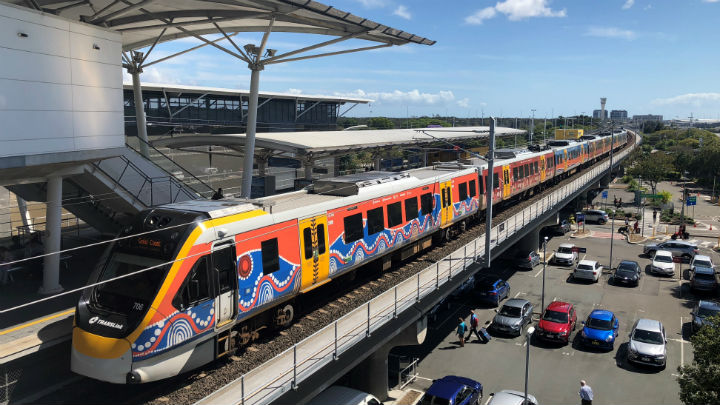
https://upload.wikimedia.org If you are from Brisbane & visiting Vancouver, you will be shocked to see such a short airport train. Being from Vancouver, its difficult to grasp how Brisbane was able to build such nice long trains. This is something to be very proud of, as it can move a lot of people in both directions. https://en.wikipedia.org/wiki/International_Airport_railway_station,_Brisbane This opened in 2001 & Vancouver's inept version had to be ready by 2010 with just 2 car trains. Yet, Brisbane designed their train to be high capacity capable as soon as it open for service. From a backwards BC perspective, it's amazing how Queensland is able to think & function on such a grand scale & to properly allocate the necessary funds. Who knows where so much of the funds went in BC? That's because not enough of it seems to have gone into the infrastructure. 

https:://en.wikipedia.org/wiki/Vancouver_International_Airport#Rapid_transit_(SkyTrain) 

Unfortunately, this is an embarrassment line because, that's not a 4 car train, its only two, 2 car trains on a single track. How can Vancouver ever rank as a proper city & metropolitan area, when the trains are so short & most of the bridges are so narrow?
https://en.wikipedia.org/wiki/YVR-Airport_station Why have a double track station allowing for at least 155m - 200m long trains? Do it the backwards BC way with only a single track & a 50m station. This isn't just an example of extreme cost-cutting. Its not properly designing crucial transportation infrastructure for eventual high capacity. Fortunately, most proper big urban areas are able to think & build big right from the start. Case in point is Queensland.

https://www.google.com/maps/place/Sir+Leo+Hielscher+Bridges,+Queensland,+Australia

https://upload.wikimedia.org/wikipedia/Gateway_Bridge This 6 lane & then a 12 lane crossing was possible, because Queensland isn't under anything like the backwater BC restrictions. 

https://en.wikipedia.org/wiki/Sir_Leo_Hielscher_Bridges This has the potential to still have 4 lanes each way. Plus, 1 bus lane & 1 HOV lane each way.

https://en.wikipedia.org/wiki/Port_of_Brisbane , https://www.portbris.com.au , 

https://www.portbris.com.au/portbris-2060

Unlike backwater BC, Queensland is able to properly think, plan, invest & build for the future. Queensland just isn't hindered by anything like the BC Mind Virus (BCMV).


https://jfdatalinks.blogspot.com/search?q=old+and+new+narrow+bridges 

https://jfdatalinks.blogspot.com/search?q=Brisbane+Airport+Railway+Line

Monday, December 18, 2023

Washington Avenue Bridge and the Tilikum Crossing vs...

 https://en.wikipedia.org/wiki/Washington_Avenue_Bridge_(Minneapolis) 2 lanes & 2 tram-train tracks, bike & walkways.

https://en.wikipedia.org/wiki/Tilikum_Crossing 2 tram train tracks & 2 for streetcars & buses. It's just so far beyond what's allowed in BC, especially in Greater Vancouver.


Both of these bridges should have been designed to have 2 bus & 2 bike lanes each, but that actually might help to relieve some of the congestion.

https://en.wikipedia.org/wiki/Skybridge_(TransLink) In spite of the regional congestion, no bus & bike lanes became part of the design. It's a fine example of inept planning in BC.

https://en.wikipedia.org/wiki/North_Arm_Bridge No bus lanes & only 1 bike lane. 


https://jfdatalinks.blogspot.com/search?q=Portland

https://jfdatalinks.blogspot.com/search?q=Tilikum+Crossing

https://therabbitportal.blogspot.com/search?q=Portland

https://therabbitportal.blogspot.com/search?q=transit+bridges 

https://jfdatalinks.blogspot.com/search?q=Bike+Lanes

Tuesday, December 19, 2023

Canada's passenger trains on shared tracks with freight trains

 https://dailyhive.com/vancouver/canada-federal-bill-passenger-train-prioritization

By now, Canada should have had all of its major cities connected by new passenger lines so that there would be no conflict with freight trains. All the major urban areas should already have had transit+bridges wherever there was a reluctance to expand road or highway bridges.

Monday, August 12, 2024

Several Vancouver narrow bridge issues

 https://dailyhive.com/vancouver/metro-vancouver-bridge-cyclist-wire-allegations

Someone might have been very angry with bike people and not with car, bus & truck people. The real problem is that so much of the older BC infrastructure just wasn't designed to be more of a multi-modal crossing. The+Lion+Bridge+and+The+Iron+Bridge have no rail rapid transit crossings to help them.

The Ironworkers-Bridge is so narrow for a highway bridge in that location & wasn't designed for substantial future capacity. When it was initially designed in the 1950s, there was no concept to have 2 bus lanes, 2 HOV lanes, 2 truck lanes & 2 emergency lanes for a port city. Plus, at least 2 general traffic lanes each way & a provision for 2 train tracks. Thus, the 6 lane bridge is so overwhelmed, because it just can't do the job of an 8-10 lane wide bridge. While the Iron Bridge has 2 improved bike+lanes, they are part of the sidewalks.  

The former 8 lane Granville+Street will have 6 lanes, while the  & Oak+Street only has 4 lanes. The inadequate Oak+Street+Bridge (OSB) should have opened with at least 8 lanes, instead of only 4. Plus, 2 wide emergency lanes & 2 wide sidewalks. There still should be a new southbound OS Bridge, but the city would be against it. A narrow 4 lane bridge just doesn't have the space & capacity for 2 express bus lanes, 2 HOV & 2 truck lanes. Apparently, it's better to just funnel everything into only 2 lanes each way.  

The OSB should be twinned or replace with something like the Samuel-De_Champlain_Bridge in Montreal. The largest city in Quebec is allowed to have a nice wide bridge & long metro trains, because Quebec isn't bound by anything like the backwards BC mentality. 

https://www.theglobeandmail.com/canada/article-montreals-new-44-billion-champlain-bridge-opens-to-traffic-for Fortunatly, the Vancouver mentality wasn't able to ever reach back to Montreal & prevent such a nice modern bridge from being built there. https://www.flatironcorp.com/project/champlain-bridge If you are from Montreal & have visited Vancouver, you will be surprise to see how much shorter an underground Vancouver train station is than what is allowed underground in Montreal, Toronto, Edmonton, Seattle, SF & LA...

https://vancouver.ca/streets-transportation/granville-bridge-connector.aspx A bike & foot bridge should have been built next to it decades ago. Then the Granville Bridge could have 3 general lanes each way, plus a bus & HOV lane each way. Instead, if 2 bus & HOV lanes are designated, there will only be 2 general lanes each way in the downtown core.

The Burrard Bridge should have had a bike & foot bride next to it. Instead, it was reduced from a 6 lane crossing to a 4 lane bridge.

The very narrow Oak+Street+Bridge & the Knight Street Bridge, should have had bus+and+bike+bridges built next to them decades ago. 

Most bridges in Vancouver & the metropolitan region just weren't designed with that much future capacity in mind, especially for buses & HOV lanes. Thus, it's a travesty that by now, almost every crossing should have had bus & bike bridges built next to them. 

https://vancouver.ca/streets-transportation/walk-bike-and-transit.aspx Unfortunatly, provisions for bus & bike lanes just weren't the thing to do several decades ago in BC.  

A truck lane is just as important as a bus & HOV lane. That's because freight should be efficiently & easily be transported in any major urban region.

https://vancouver.ca/streets-transportation/trucks-commercial-and-oversize-vehicles.aspx

https://jfdatalinks.blogspot.com/search?q=Oak+Street+and+Granville+Street

https://jfdatalinks.blogspot.com/search?q=Iron+Bridge 

https://jfdatalinks.blogspot.com/search?q=Lion+Bridge

Friday, March 28, 2025

Maple Ridge planning transit-oriented development around future Bus Rapid Transit line

 https://dailyhive.com/vancouver/lougheed-transit-corridor-area-plan-maple-ridge-translink-brt

The Golden_Ears_Bridge should have been built with 2 wide shoulders, which could have eventually become 2 bus lanes. https://en.wikipedia.org/wiki/Golden_Ears_Bridge

The Pitt_River_Bridge also should have had 2 wide shoulders, so that they easily could have become bus lanes.

https://en.wikipedia.org/wiki/Pitt_River_Bridge

Most of the existing bridges are too narrow, so there needs to be a regional framework of bus-bridges.

Wednesday, February 19, 2025

The South Bow River Bridge in Calgary

https://www.alberta.ca/south-bow-river-bridge Being from backwards Vancouver, its difficult to grasp how Calgary was able to twin the South-Bow-River-Bridge. Not only are there 8 lanes, but at least 2 emergency lanes. 

https://en.wikipedia.org/wiki/Stoney_Trail#Lane_count In BC, it was tough enough just to have 2 waggon roads side by side. Then to eventually have a bridge the width of 4 waggon roads or 4 carriageways, was amazing. Fortunately, Calgary has progressed so far beyond the 1800s & the early 20th century.

https://www.alberta.ca/calgary-ring-road , https://www.youtube.com/watch?v=5dhrataYz5E

https://majorprojects.alberta.ca/details/Stoney-Trail-SE-Bow-River-Bridge-Widening-Pedestrian-Bridge/4312 There have been a lot of complaints as to why it took so long to compleate this project. While backwater BC notoriously takes longer to get things done than Alberta usually does, there might have been an issue with the river. Still, after any environmental assessment, the construction project should have gone faster.

https://www.on-sitemag.com/bridges/alberta-to-spend-70m-to-replace-south-bow-river-bridge-in-calgary/1003970064/

https://www.renewcanada.net/south-bow-river-bridge-project-receives-70-million/

https://www.on-sitemag.com/construction/alberta-awards-contract-for-final-277m-segment-of-calgary-ring-road/1003968938/

https://westringroad.ca/bow-river-bridge , https://calgaryringroad.com/tag/alberta-highway-201

A fantastic foot and bike bridge is close by and unlike in Vancouver, lanes were added, not removed. Indeed, the Calgary footbridge and The+Helix+Bridge in Singapore were never used as an excuse to remove any lanes from other bridges. The same for the Jubilee+Bridge.

https://www.highway99tunnel.ca/frt-current-work The environmental assessments while necessary, have pushed this BC infrastructure project to at least 2030. https://www.highway99tunnel.ca/project-overview-frt Several decades ago, another tunnel or bus & bike bridge should have already been built. https://www.highway99tunnel.ca/transit-cycling Unfortunatly, when the first tunnel was built, there was no concept to have 2 bus & 2 bike lanes with 2 protected walkways. No need to have 2 wide emergency lanes with a future clearance to allow for 2 truck lanes, given that this is supposed to be a major seaport region. Just funnel everything into 2 lanes each way, whenever possible.


https://jfdatalinks.blogspot.com/search?q=Calgary  

https://jfdatalinks.blogspot.com/search?q=bike+and+pedestrian+bridges

Monday, April 15, 2024

Much more home construction and infrastructure in Metro Vancouver is urgently needed

 https://dailyhive.com/vancouver/metro-vancouver-housing-starts-construction-statistics-2023

After Vancouver & the metropolitan region kept imposing so many restrictions for decades, BC is compelled to upgrade & build more infrastructure. 

https://dailyhive.com/vancouver/metro-vancouver-pre-sales-april-2024

The KEEP THEM OUT symbolism has been perpetuated for well over a lifetime. Especially with short trains & narrow bridges & only a half-assed bus lane network. The Cushing+Bridge in Calgary is a fine example of a new bus-bridge next to a narrow Vancouver type of bridge. The+Tilikum+Crossing+in+Portland is also a great example of the type of transit bridge that should be built next to almost all  of the narrow bridges in Metro Vancouver. Fortunately, the backward BC type of planning mentality never caught on in Calgary, Edmonton, Portland, Seattle & Montreal.

https://dailyhive.com/vancouver/vancouver-development-permits-changes-2024 Speeding up the permits & rate of construction is a good slap in the face towards the KEEP THEM OUT agenda. It was hoped so many decades ago, that by gradually imposing so much municipal red tape & BC B$, that would help to stunt BC growth. It also helped the old colonial mentality to see less non-white people moving into BC. 

It's not that BC isn't multicultural, it's just that by slowing down the growth of the 10 largest BC municipalities, that becomes a perpetual excuse to not keep up with building more infrastructure.

The area of Switzerland or the Netherlands could fit into BC 23 times. Yet, BC doesn't even have half the population of the Netherlands. Indeed, BC doesn't even have the population of one Switzerland

If Metro Vancouver, Victoria, Kelowna & BC in general, would ever allow a proper scale of infrastructure, things would gradually improve. 


https://jfdatalinks.blogspot.com/search?q=Switzerland

https://jfdatalinks.blogspot.com/search?q=old+and+new+narrow+bridges

Thursday, September 28, 2023

TransLink ridership recovery reaches 90% of pre-pandemic volumes

 https://dailyhive.com/vancouver/translink-ridership-recovery-vancouver-public-transit-september-2023

While the recovery is great, the Skytrain network should have been designed to have 152m stations like Montreal & Toronto, but that would mean big city thinking. So the 50m to 80m stations provide a constant reminder of the refusal to think big.

https://dailyhive.com/vancouver/bc-transit-ridership-recovery-record

Just like the region should have a proper big city train, there should have also been a proper express bus & HOV system by now. However, with such a refusal to have wider bridges or parallel crossings, it's almost impossible to have a proper rapid bus network.

https://dailyhive.com/vancouver/ironworkers-memorial-bridge-replacement There should be a couple of HOV lanes, as well as 2 bus lanes. Thus, any replacement for the Ironworkers+Memorial+Bridge should have 10 lanes. 

However, congestive planning always wins out & who know where all the money has gone over the past several decades?

https://dailyhive.com/vancouver/skytrain-vancouver-demand-extensions

https://dailyhive.com/vancouver/commercial-broadway-station-broadway-grandview-woodland-plan-skytrain Brentwood Station, no problem. However, allowing such a crossroads station at a similar scale is too upsetting for the backwater Vancouver mentality.

https://dailyhive.com/vancouver/city-of-vancouver-car-vehicle-traffic-reductions-broadway Another fine example of the conjestive mentality. Since the train isn't allowed to run 24/7, it's a good idea to still have a wide street for express buses & 24hr traffic, which is common for most major cities.

https://dailyhive.com/vancouver/skytrain-metro-vancouver-expansion

https://dailyhive.com/vancouver/canada-public-transit-system-comparison