https://www.youtube.com/watch?v=vMwKgT4ZUvQ It is utterly foolish to not have enough space for a commuter train to run above, or in the middle or underneath the widest highways.
https://kinder.rice.edu/urbanedge/houstons-15-year-growth-three-charts Simply building wide roads like in Houston, L.A. and Toronto is just as bad as having mostly narrow bridges in Greater Vancouver.
Whether its 10 lanes or 20 lanes wide, there should always be 2 dedicated bus lanes and 2 HOV lanes. While the highway will get clogged up during the day, at least the buses and trains can still get through quickly.
The Pattullo+Bridge+replacement is only 2 lanes each way with narrow shoulders. It should have opened with enough space for 2 bus lanes and 2 HOV lanes, but that would go against the congestive urban planning mentality of BC.
The Samuel-De+Champlain+Bridge in Montreal is just as good as similar wide highway and train bridges in Seattle+and+Perth. All were possible, simply because they aren't limited by anything like the Vancouver and BC Mind Virus.
The narrow-minded Vancouver and BC approach is to try to funnel everything into just 2 or 3 lanes each way. Then there just isn't enough space to have 2 bus lanes and 2 HOV lanes. Greater Vancouver has certainly gone in the extreme opposite direction of Houston, L.A. and Toronto...
A wide Greater Houston highway has lots of space, but without 2 bus lanes and 2 HOV lanes, everything gets plugged up. In contrast, Greater Vancouver has most of its bridges and highways so damn narrow, there isn't enough space to accommodate a proper express bus and HOV network.
This deliberate backwards BC bottleneck-chokepoint planning approach is totally absurd.
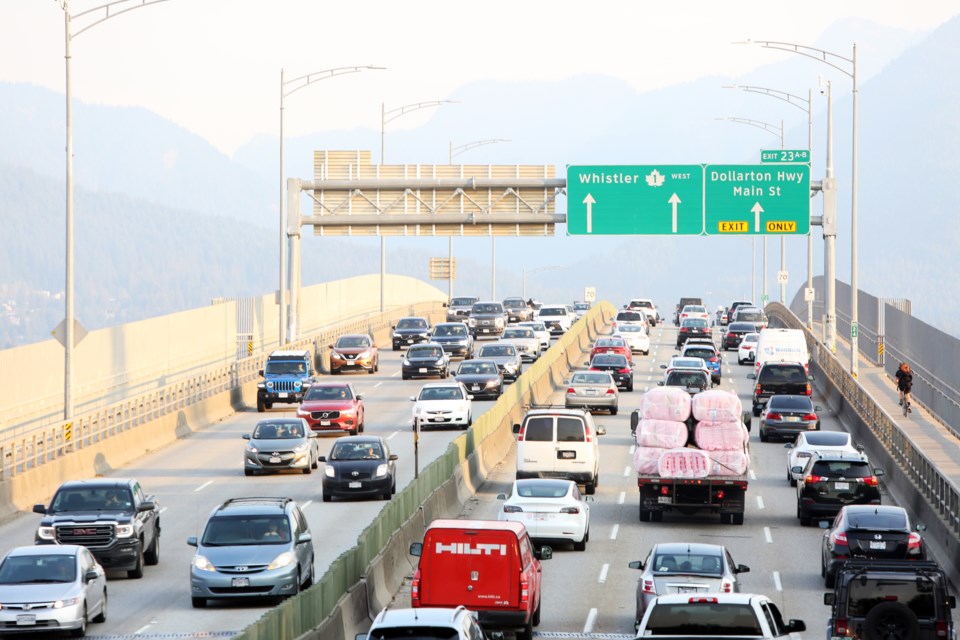
There is no commuter train tunnel near the Lions+Gate+Bridge or even for the Massey+Tunnel+replacement. Thus, they are the best examples of BC choke-point urban planning. Despite having twice the lanes as the inept 3 lane LGB, the newer Iron+Bridge never had any emergency lanes. A bus and HOV bridge was never built next to it. Plus, no commuter train bridge. It's another fine example of BC choke-point, bottleneck planning.
A north and south Boundary+Road bridge system would provide direct access between the North+Shore, Richmond+and+Delta, but that's what a proper big city would do. Backwards BC has quite a problem with thinking and building big. The 2 car Canada+Line is another example. Don't build it to at least have a 5 car train, just design it to only have 2.5 car trains, someday.
https://en.wikipedia.org/wiki/Greater_Houston#Transportation
https://en.wikipedia.org/wiki/Interstate_610_(Texas)#Lane_configurations There is a point when simply adding more lanes won't provide long-term improvement. However, when combined with dedicated bus and HOV lanes, other options become available. Especially, if there is rail rapid transit and commuter rail as well.
https://en.wikipedia.org/wiki/METRORail While not as extensive as DART_rail, it still works like a tram-train.
Of course longer streetcars or tram-trains are still slow on the actual surface street segments.
https://en.wikipedia.org/wiki/Trams_in_Melbourne#System_upgrades
https://en.wikipedia.org/wiki/Toronto_streetcar_system
https://en.wikipedia.org/wiki/Muni_Metro SF
In the case of backwards BC, the new Richmond-Delta+Tunnel should have been designed to have 8 lanes for the first phase. Then a 2nd phase should have had a 2 lane BRT tunnel, a 2 lane truck tunnel and a provision for 2 LRT tracks. Then the first phase of the new tunnel could be 3 lanes each way, with the 4th being a HOV lane.
Had this new tunnel or bridge been built decades ago, it would have cost half as much. Unfortunately, its like a choice was made for the new tunnel. Two bus lanes, but no HOV lanes and certainly no separate section for BRT and LRT. Apparently, an LRT line between YVR and the Tsawwassen Ferry terminal would have made too much sense.