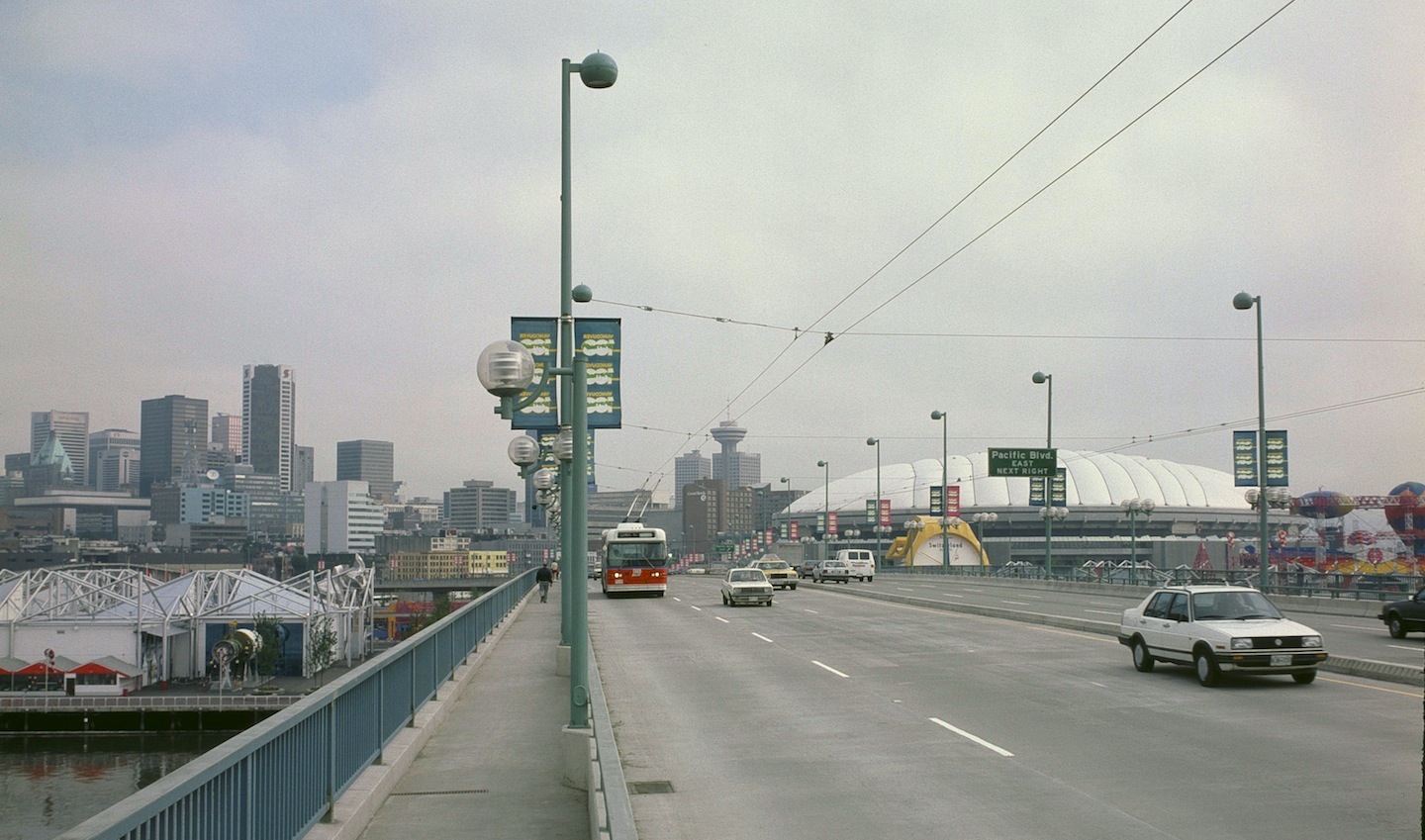
Burrard_Street and the Burrard St._Bridge (BSB) were originally designed to be 6 lanes wide, but then the VMV got ahold and changed that.
Fortunately, the VMV hasn't reduced the 6 lanes of Oak St. and 6 lanes of Granville St. Thus, when combined, they still form a 12 lane, north-south corridor.
https://en.wikipedia.org/wiki/Oak_Street_(Vancouver) , https://www.youtube.com/watch?v=kXbUb7TMj6k
Since the Oak+Street-Granville+Street+Corridor are still both 6 lanes wide for most of their lengths, this is essentially a 12 lane street corridor and is much less disruptive than if a 10-12 lane freeway had been pushed through in the 1950s or 60s.
https://en.wikipedia.org/wiki/Granville_Street , https://storeys.com/vancouver-granville-street-entertainment-district-history-renewal-planning-program
The yellow line is set for 3 lanes each way. However, if it was moved over 2 lanes, or just removed, then there could be 5 or 6 main lanes one way & 1 or no lanes the other way. Having 6 lanes each way would be best, because then 1 lane on Oak & 1 lane on Granville would always be just for busses. Then, there could also be an HOV lane on northbound Oak and on southbound Granville. This would still allow 4 north and 4 southbound general traffic lanes.
A 1950s or 60s freeway would have been so disruptive. Its always better to make surface streets more efficient than to rip up neighborhoods.
The Oak+Street+Bridge+and+Granville+Street+Bridge (OSB-GSB) are still part of an incomplete corridor for what is supposed to be a major port city and region.
An improved 8 lane Granville+Street+Bridge with double-width sidewalks could have still worked, if there had also been a wide bike & foot bridge built next to it. Then, a roughly new parallel bridge next to the 4 lane Oak+Street+Bridge, or a new 8 lane crossing altogether. Either way, that could have allowed for an 8 lane crossing there. Four lanes of Granville_Street southbound over the Fraser River and 4 lanes of Oak_Street northbound. A separate BRT bridge could run parallel. Unfortunately, such improvements go against the congestive transportation planning agenda.
2 lanes were removed from the Burrard+Street+Bridge (BSB), 2 lanes removed from the Granville+Street+Bridge (GSB) and 1 lane from the Cambie+Street+Bridge (CSB). That didn't have to happen if a bike bridge was built next to the BSB and the GSB. While the east side of the Cambie-Street-Bridge has a nice, wide sidewalk, there wasn't enough foresight to also have a wide sidewalk on its west side. However, that narrow sidewalk could still be built out to be nice & wide so that the CSB can be restored to 6 lanes.
When a city & metropolitan region mostly has narrow bridges, removing lanes or not having enough is utterly foolish! Case in point... https://www.pattullobridgereplacement.ca Instead of extra width for 2 bus & 2 HOV lanes, everything will be initially funneled into just 2 lanes each way. https://www.pattullobridgereplacement.ca/about/projectoverview Two nice sidewalks & 2 nice bike lanes, but no emergency lanes & especially, no bus lanes, right from the start. Its another classic BC bottleneck in the making. Since the SkyTrain doesn't run on a 24hr basis, 24hr bus lanes are essential, but that would go against the congestive planning methodology that is backwards BC.
Grater Vancouver isn't officially against having a proper regional express bus system and a proper BRT network. Its just without having a proper regional bus and bike bridge network, it all remains as a Half-A$$ED joke.
https://jfdatalinks.blogspot.com/search?q=Oak+Street+and+Granville+Street
https://jfdatalinks.blogspot.com/search?q=Oak+Street+Bridge OSB