Showing posts sorted by date for query urban trains. Sort by relevance Show all posts

Tuesday, May 5, 2026

The urban trifecta of backwards Vancouver

https://www.merriam-webster.com/dictionary/trifecta 

https://en.wikipedia.org/wiki/Trifecta#History 

Ideally, for some small thinking cities, the plan is to symbolically have mostly short buildings and short trains and mostly narrow bridges.

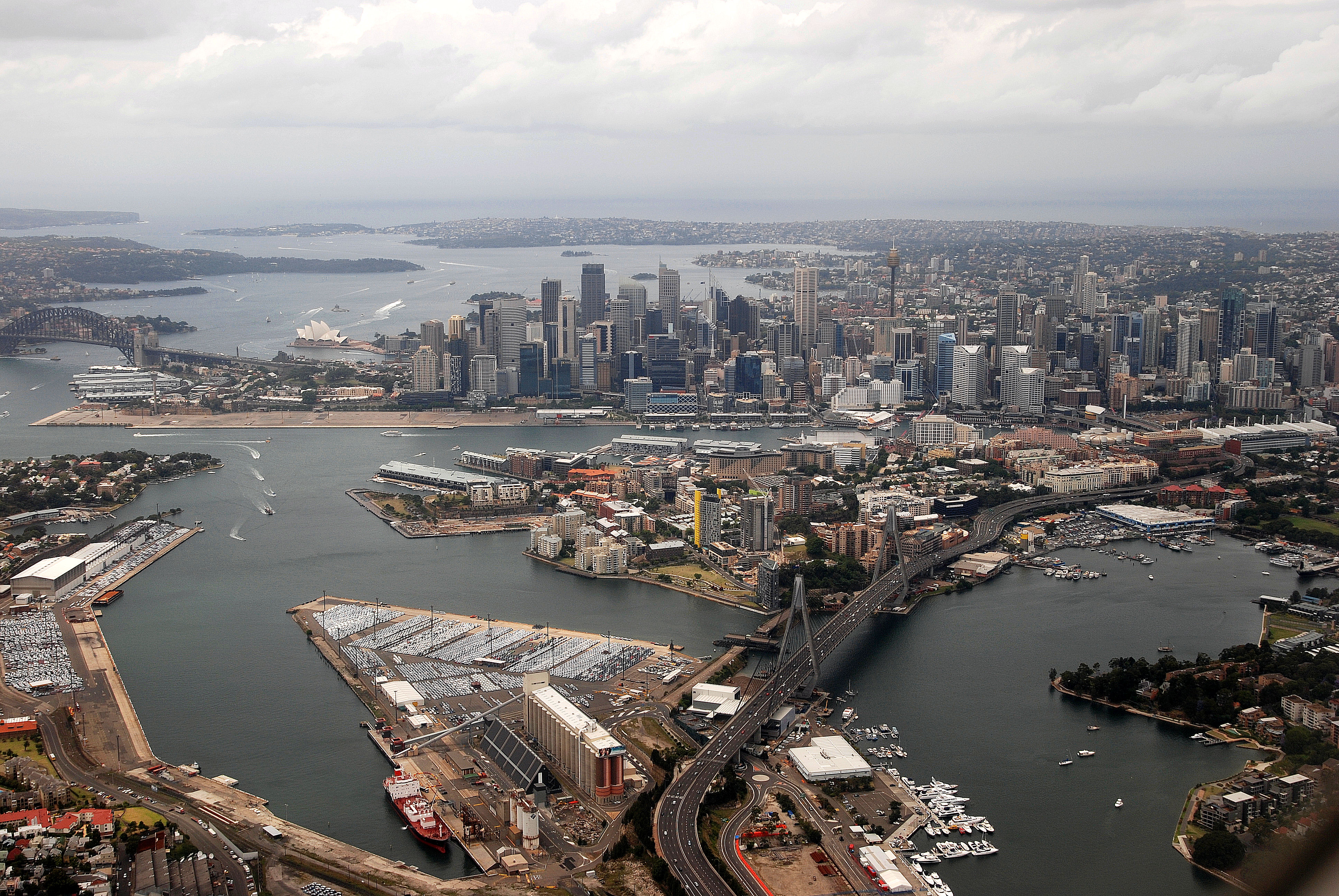
That seems to have been the goal of Vancouver over the past several decades. In contrast, Brisbane after its Expo 88, was able to really go into big city planning mode, because it doesn't have anything like the excessive Vancouver restrictions holding it back. 

The+Typical+Vancouver+Size+Stump+Building No office tower has been permitted to have a 40th floor. https://jfdatalinks.blogspot.com/search?q=The+Stumpy+Post+building+in+Vancouver Never-mind 40 or 50 stories, it wasn't even allowed to have 25 floors.

YVR-Canada+Line A 2 car joke of a train. 

Lions+Gate+Bridge A 3 lane joke of a bridge.  


https://jfdatalinks.blogspot.com/search?q=backwards+Vancouver

Monday, April 27, 2026

Old Pattullo Bridge and its Still Narrow Replacement

 https://www.youtube.com/watch?v=8_mNfn4zjcI 

Even in the 1930s there should have been some type of a big city vision, but with NW being so small and Surrey being so out of the way, this part of BC was on the urban periphery. Apparently, there was no concept of an emergency lane on the Pattullo Bridge. Still, in addition to the 2 narrow lanes each way, there should have been 2 lane for horses and wagons. Then, by the 1950s the PB could have had 3 wide lanes each way, pulse a strong traffic divider. Instead, the narrow PB was stuck with only two lanes each way, no safety divider and only 1 narrow sidewalk.

For most of its history, NW just saw it self as a provincial backwater. The lack of a big city vision in the early 1900s meant that it never bothered to absorb what would become the Tri-Cities. For most of its history, Surrey never considered that it could eventually become the largest city in BC. Of course now that has changed.

Despite being so small, NW has become a Metro Vancouver regional transit hub, because of the New_Westminster_station

Scott_Road_station is a transit hub for the South_Westminster area.

Surrey and NW really should have had a proper big city size bridge.

This is how the new road configuration could have gone for what should have been a 10 lane bridge, not another 4 lane BC joke. Even if it can eventually have 6 lanes, there is no provision for a lower deck for trains and busses.

This shows how existing key roads could have linked into a 10 lane bridge, all without having to widen the surrounding roads. Thus, no need for any major land expropriation.

2 lanes from Royal Avenue onto the new bridge and 2 lanes from the bridge onto Royal Avenue in New+Westminster.   

One lane onto and one lane off linking the bridge to the South_Fraser_Perimeter_Road in Surrey.

2 lanes onto McBride boulevard and 2 lanes onto the bridge from McBride in New+Westminster.  

From Columbia_Street_in New_Westminster, 1 lane onto the bridge, as well as 1 lane off the bridge

2 lanes from King_George_Boulevard onto the new bridge and 2 lanes from the bridge onto KGB in Surrey

2 lanes from Scott Road onto the new bridge and 2 lanes from the bridge onto Scott_Rd in Surrey.  

Things weren't properly explained to the public as to how important a wide big city bridge could have been possible and without having to widen the roads connecting to it.

Unfortunately, all of this is being funneled into just 2 lanes each way. Its as if someone symbolically wanted the new bridge to open without any bus and HOV lanes. That's how BC bottleneck and chokepoint planning works. 


https://en.wikipedia.org/wiki/Metro_Vancouver_Regional_District  

https://en.wikipedia.org/wiki/Fraser_Valley

Some day, the BC Lower_Mainland should be planned and developed to function more like a proper big urban area. 


https://jfdatalinks.blogspot.com/search?q=Pattullo+Bridge+replacement

Sunday, April 5, 2026

40 years after Expo 86

 https://bcanuntoldhistory.knowledge.ca/1980/expo-86 

Unlike Brisbane, Vancouver doubled down on its various restrictions. Ideally, any tall building in Vancouver had to be shorter than what Brisbane allows. The bridges kepet narrow and unduplicated than what Brisbane allows. The trains are to be shorter than what Brisbane and most cities allow. 

It was almost as if since Vancouver couldn't build a wall around the city to keep people out, a strong level of symbolism was imposed instead. This urban symbolism was all about keeping things small & backwards whenever possible.

Burnaby, Coquitlam and Surrey have all started the process to allow for taller buildings than what Vancouver permits. That's because they are bound by the same restrictions that Vancouver imposes.

Sunday, March 29, 2026

YVR-Canada Line and REM Train

 https://www.youtube.com/watch?v=a1ouk0VifwM&t=42s Even if the YVR-Canada Line had to initially be built as a symbolically small city train, urban transportation infrastructure can be designed in ways that can double or even triple capacity to meet future demand. Unfortunately, its very difficult to build anything in BC with significant future capacity in mind.

Ultimately, the YVR-Canada Line should have had level station clearances to eventually be able to accommodate 10 car trains. Unfortunately, in typical backwards BC planning the stations weren't even designed with enough level clearance to accommodate 5 car trains. The joke that is the Canada Line only has a level station clearance of 50m to eventually accommodate just a 2.5 car train. 

Most other cities actually build long stations to accommodate long trains right in the first place. Or, at least allow for enough level clearance so that the stations can eventually be doubled or tripled in length. 

The YVR-Canada Line should have started with the Vancouver & Richmond segment, then the Vancouver and Horseshoe+Bay+ferry+terminal segment. Then finally, the YVR to Delta and the Tsawwassen+ferry+terminal

The SkyTrain Stations in Greater Vancouver https://www.youtube.com/watch?v=6Qg78Bmf1fk

Unfortunately, proper big city transportation planning is very difficult to achieve in backwards BC. So much is watered down in Vancouver.


Montreal’s Biggest REM Expansion Yet https://www.youtube.com/watch?v=4G1oeIAfxDU&t=106s 

The Montreal REM https://www.youtube.com/watch?v=g9O6RzsXIqQ 

While the REM was designed to help the Metro, it should have the capability to be gradually expanded. Eventually, REM trains should be lengthened from 4 car trains to 6 and even 8 car trains. 

In contrast, every Skytrain line should have been designed with enough level future station clearance to eventually accommodate a train as long as a 152.5 (500 ft.) long Montreal Metro train. The first 2 Skytrain lines have 80m stations and the joke that is the Canada Line only has 50m stations. 

While the first 2 lines can accommodate 5 car trains, the C Line wasn't designed to accommodate 5 car trains. Just 2.5 car trains, someday. 

Despite there being such a symbolic push for Vancouver to keep having short trains, narrow bridges and stumpy buildings, things are gradually changing in backwards BC. The Vancouver or BC Mind Virus should have been challenged decades ago, but too many loud people wanted to perpetuate the, KEEP THINGS SMALL AND INDEQUATE agenda.

Given how most of the bridges in Greater Vancouver are so narrow, there isn't enough room for proper bus and HOV lanes, or even wide emergency lanes. One would think that at least the trains & stations would have been designed to eventually be doubled or tripled in length. But that would go against the mutigenerational congestive planning agenda. That's why there still is only a 3 lane LGB when there should have been at least a parallel bus, HOV and train tunnel. The Pattullo+Bridge replacement didn't open with 2 bus and 2 HOV lanes, not even wide shoulders or emergency lanes. NW really likes the congestive planning approach. Of course the new tunnel between Richmond and Delta won't have an additional provision for a train tube. This will also help to perpetuate the congestive transportation mandate. 

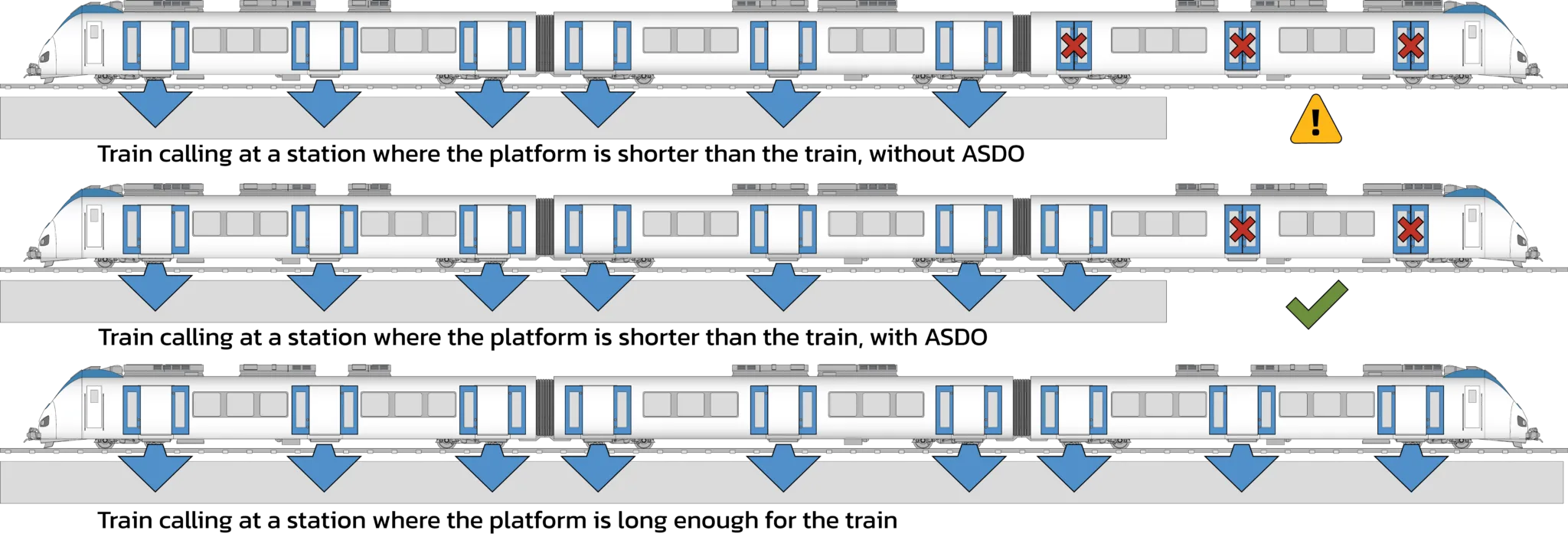
Fortunately, Selective_door_operation technology can eventually allow more sensible transportation planners to enable longer trains. 

https://en.wikipedia.org/wiki/Selective_door_operation#International_variations , https://www.youtube.com/watch?v=YdH5d1ZthmM 

This means that a 5 car Skytrain (85m) could eventually become a 7 car train, despite the 80m stations. 

https://en.wikipedia.org/wiki/SkyTrain_(Vancouver)_rolling_stock#Alstom_Mark_V Thus, an 80m train can become a 117m train.

A two car and 2.5 car (50m) train on the multibillion dollar Canada Line is so absurd and inept! With some slight station modifications, there could be a potential to eventually accommodate three, 20m cars at such short platforms. Then, once 3 car trains could become possible, its just a matter of having an extra 20m car at both ends of each train. A 5 car train of 100m is so much better than a 50m joke of a train. 

https://en.wikipedia.org/wiki/SkyTrain_(Vancouver)#Alstom_Mark_V_fleet 


https://jfdatalinks.blogspot.com/search?q=SkyTrain-Canada+Line

https://jfdatalinks.blogspot.com/search?q=REM

Monday, March 9, 2026

The narrow Pattullo Bridge Replacement

https://www.pattullobridgereplacement.ca/construction/current-works Its a nice 4 lane bottleneck choakpoint. There should have been a provision for a lower deck for bus lanes, HOV lanes and LRT, but that would help to alleviate some transportation congestion.

It wasn't designed with that much future capacity in mind, just like the absurd Canada+Line. The SkyTrain-Canada+Line is still only running 2 car trains. The New stal̕əw̓asəm Bridge is only 2 lanes each way. This is congestive urban planning in BC at its best. Narrow bridges and short trains are some of the best ways to symbolically demonstrate a reluctance to accommodate future growth capacity. 

People aren't suppose to wonder where all the money went over the past several generations, because it seems that not enough funds have gone towards proper big city infrastructure.


Thursday, March 5, 2026

Why the Widest Freeway on Earth still Made Traffic Worse in Houston

 https://www.youtube.com/watch?v=vMwKgT4ZUvQ It is utterly foolish to not have enough space for a commuter train to run above, or in the middle or underneath the widest highways. 

https://kinder.rice.edu/urbanedge/houstons-15-year-growth-three-charts Simply building wide roads like in Houston, L.A. and Toronto is just as bad as having mostly narrow bridges in Greater Vancouver.  

Whether its 10 lanes or 20 lanes wide, there should always be 2 dedicated bus lanes and 2 HOV lanes. While the highway will get clogged up during the day, at least the buses and trains can still get through quickly. 

The Pattullo+Bridge+replacement is only 2 lanes each way with narrow shoulders. It should have opened with enough space for 2 bus lanes and 2 HOV lanes, but that would go against the congestive urban planning mentality of BC.

The Samuel-De+Champlain+Bridge in Montreal is just as good as similar wide highway and train bridges in Seattle+and+Perth. All were possible, simply because they aren't limited by anything like the Vancouver and BC Mind Virus.

The narrow-minded Vancouver and BC approach is to try to funnel everything into just 2 or 3 lanes each way. Then there just isn't enough space to have 2 bus lanes and 2 HOV lanes. Greater Vancouver has certainly gone in the extreme opposite direction of Houston, L.A. and Toronto...

A wide Greater Houston highway has lots of space, but without 2 bus lanes and 2 HOV lanes, everything gets plugged up. In contrast, Greater Vancouver has most of its bridges and highways so damn narrow, there isn't enough space to accomodate a proper express bus and HOV network. 

This deliberate backwards BC bottleneck-chokepoint planning approach is totally absurd. 

There is no commuter train tunnel near the Lions+Gate+Bridge or even for the Massey+Tunnel+replacement. Thus, they are the best examples of BC choke-point urban planning. Despite having twice the lanes as the inept 3 lane LGB, the newer Iron+Bridge never had any emergency lanes. A bus and HOV bridge was never built next to it. Plus, no commuter train bridge. It's another fine example of BC choke-point, bottleneck planning. 

A north and south Boundary+Road bridge system would provide direct access between the North+ShoreRichmond+and+Delta, but that's what a proper big city would do. Backwards BC has quite a problem with thinking and building big. The 2 car Canada+Line is another example. Don't build it to at least have a 5 car train, just design it to only have 2.5 car trains, someday.

https://en.wikipedia.org/wiki/Greater_Houston#Transportation

https://en.wikipedia.org/wiki/Interstate_610_(Texas)#Lane_configurations There is a point when simply adding more lanes won't provide long-term improvement. However, when combined with dedicated bus and HOV lanes, other options become available. Especially, if there is rail rapid transit and commuter rail as well. 

https://en.wikipedia.org/wiki/METRORail While not as extentise as DART_rail, it still works like a tram-train. 

Of course longer streetcars or tram-trains are still slow on the actual surface street segments.

https://en.wikipedia.org/wiki/Trams_in_Melbourne#System_upgrades 

https://en.wikipedia.org/wiki/Toronto_streetcar_system

https://en.wikipedia.org/wiki/Muni_Metro SF

Saturday, January 31, 2026

Why Greater Toronto Has Several Skylines

 https://www.youtube.com/watch?v=eI9WJa9Q8dA 

Of course many large urban areas around the world have more than 1 or 2 skylines or tower clusters. 

For the longest time, no building in Vancouver or BC, was allowed to be as tall as the 1930s CIBC tower, which is now a stump.

https://www.blogto.com/city/2017/05/toronto-lost-observation-deck-commerce-court-north/

https://www.torontojourney416.com/canadian-bank-of-commerce-building/ 

https://www.25king.ca/the-history 

It wasn't until the early 1970s when stumpy, Vancouver allowed a building to be taller than the L.A. City Hall, or the Smith Tower in Seattle. 

The 1930s CIBC tower, the L.A. City Hall and the Smith Tower, would still be prominent towers in Vancouver, but stumps in their own cities. 

Despite Vancouver being divided by an inlet and a river, the city wasn't able to build a huge wall along Boundary Road. Thus, the KEEP THEM OUT agenda was a little thwarted. The various White city councils tried to do the next best thing. That was to symbolically impose various restrictions as a reluctance to think, plan and build on a BIG city scale. The time especially from 1960 to 2000 had predominantly White City Hall and its councils continually impose several overlapping restrictions. 

Since Vancouver can't control immigration or the movements of non-white people, keeping things small and backwards, means that less people will move there than to Toronto, Montreal, Calgary and Edmonton. However, with a mild winter climate, more and more people want to move to backwards BC, especially small-minded Vancouver and provincial Victoria. 

In spite of immigration and Multiculturalism, Vancouver was to perpetually promote its small scale agenda. 

While the first Skytrain line can finally run 5 car trains, the stations weren't designed to become long enough to eventually accomodate 9 car trains like the big city Montreal Metro has. 

The 2nd and 3rd Skytrain lines are still only running 2 car joke trains. Running 8-10 car trains is what a proper big city would do, but not backwards Vancouver. 

Narrow bridges provides strong symbolism of the cities narrow-mindedness. When bridges are too narrow, its difficult to have a proper express or rapid bus system. The reluctance to build parallel bus and HOV bridges helps to maintain the congestive planning approach that is vancouver and the Greater Region. 

Vancouver's refusal to build parallel bike bridges has meant that 2 lanes were removed from the Burrard Bridge, 1 lane from the Cambie Bridge and 2 lanes from the Granville Bridge. 

Keeping buildings symbolically short when compared to what scenic Sydney, Auckland, SF and Seattle allow, also helps to maintain Vancouver's reluctance to enter the big and tall urban scale. In fact, the scenic setting that Vancouver is in has been used as the main excuse to continually scale the city down. Yet, several scenic cities around the world are either able to have wider bridges, wider roads, longer trains or taller buildings. 

The world is mostly composed of non-white people. Canada has less than 1% of the world's population and stubborn Vancouver symbolically remains as a small provincial backwater on the Pacific Rim. 

https://centralparktower.com.au Unlike Perth, Vancouver forbids 50 story office towers and Brisbane, Sydney and Melbourne size residential towers. 

https://en.wikipedia.org/wiki/108_St_Georges_Terrace In fact, no office building in Vancouver has been permitted to have a 40th floor. However, since Burnaby and Surrey aren't under the restrictive controls of Vancouver, they will eventually allow office towers over 40 stories. 

Despite Australia having less people than Canada, Perth is allowed to have taller buildings, wider bridges and longer trains than Vancouver. Taller buildings, wider bridges and longer trains are even less likely in Halifax than whats in Brisbane or Queensland.

https://en.wikipedia.org/wiki/Q1_(building) To see buildings on a similar scale of what Brisbane allows, one has to get to Greater Toronto. Brisbane is allowed to have some buildings that would even be impressive in Melbourne and Sydney. 

While Montreal is allowed to have taller buildings than Vancouver, Montreal isn't allowed to have Sydney size towers. Especially not on the scale of what Melbourne and Toronto permit. 

Saturday, January 17, 2026

The Great SkyTrain upgrade (potential)

 https://www.youtube.com/watch?v=_D2CXdZ_4Ro 

Unfortunatly, the first 2 Skytrain lines were designed to only have 80m stations and trains. The 3rd line to YVR and Richmond was only designed to have 50m stations. In contrast, the Montreal Metro has stations long enough to accomodate 152.4m long trains. Thus, the greatest mistake was to not enable the Skytrain to eventually become a very high capacity train system. Combine that with mostly narrow bridges and roads in Greater Vancouver and you have the epitome of congestive urban planning. 

At least by late 2025 some of the new 5 car trains were out, along with some of the old 6 car little box trains on the 1st line. The 2nd and 3rd lines are still running 2 car joke trains, but that symbolically fits right in with the, KEEP BC SMALL AND BACKWARDS mentality. 

A proper big city long-term plan would have been to allow for 10 car trains, with at least 5-6 car trains at the start when each line opened.

Wednesday, November 26, 2025

Pattullo to partially close for three nights as 4 lane replacement bridge opening draws near

 https://dailyhive.com/vancouver/pattullo-bridge-closures-replacement-opening 

No matter how much NW wants to be one of the smallest cities in backwards BC, it can't stop Surrey from eventually being the biggest city in what should be bustling BC. The SkyBridge was deliberately designed to not have any HOV or truck lanes. The narrow SkyBridge wasn't even designed to eventually become a bus and bike bridge. Just a train bridge without even any sidewalks. It really should have been given an award for one of the worlds best examples of inept urban infrastructure. 

It's like the SkyBridge (1990) was designed to be the first part of the new inadequate crossings between NW and Surry.

Indeed, just like its 1937 predecessor, the Pattullo_Bridge_replacement will open with only for lanes, but at least it will have 2 bike lanes and 2 sidewalks. The Pattullo_Bridge_replacement should have opened with 6 lanes and 2 wide shoulders or emergency lanes, but that would go against funneling everything into just 2 lanes each way. No emergency lanes or wide shoulders helps to reduce emergency vehicle inefficiency. No bus & HOV lanes helps to increase transportation congestion. Despite being a seaport region, there aren't any truck lanes. Perhaps the best feature of all is than the bridge wasn't designed to eventually have a lower deck for trains and trucks. 

Multibillion dollar bridges can be designed with future widening capabilities, or at least having a provision for a lower deck. Unfortunatly, it's very difficult for BC to design prober big city size transportation infrastructure. 

Tuesday, November 18, 2025

City of Vancouver exploring Olympic Line streetcar test revival after the 2026 FIFA World Cup

 https://dailyhive.com/vancouver/vancouver-olympic-line-streetcar-demonstration-revival-proposal 

The city and greater urban region should have never gotten rid of the streetcars and interurban tram-trains. Now, its extremely difficult to bring them back. Fortunately, backwards Vancouver was unable to get Toronto, Melbourne and SF to get rid of their street railways. Those cities and many others just never had anything like a Vancouver Mind Virus or BCMV to thwart them. 

Of course Seattle & Portland would bring back some of their streetcar lines long before slow-moving Vancouver can.

Sunday, November 16, 2025

Burnaby apologizes for decades of discrimination against people of Chinese descent

 https://globalnews.ca/news/11528001/burnaby-apology-discrimination-against-chinese-community 

Asia is the most populated part of the world and until recently, China had the biggest population. Thus, people from China or people who are of Chinese descent, live all over the world. There was a strong, KEEP CANADA WHITE agenda, right into the mid 20th century. Of course this mentality wasn't just directed towards Asians, but towards anyone who was nonwhite. 

https://en.wikipedia.org/wiki/Chinese_head_tax 

https://www2.gov.bc.ca/gov/content/governments/multiculturalism-anti-racism/chinese-legacy-bc/history/discrimination

It took until the 1970s for Multiculturalism to challenge the, KEEP CANADA AS A WHITE MAN'S PARADISE. 

https://pier21.ca/research/immigration-history/canadian-multiculturalism-policy-1971

https://lop.parl.ca/sites/PublicWebsite/default/en_CA/ResearchPublications/200920E#:~:text=In%201969%2C%20the%20Royal%20Commission,Its%20key%20objectives%20were%20these: 

https://publications.gc.ca/Collection-R/LoPBdP/CIR/936-e.htm#:~:text=A%20Ministry%20of%20Multiculturalism%20was,fully%20participate%20in%20Canadian%20society. 1973 

https://thecanadianencyclopedia.ca/en/article/multiculturalism

While Canada hardly has that much of a Pacific Coast, when compared to the US and Australia, the BC part of Canada should have had at least one major city on the scale of Montreal or Seattle, Brisbane or SF. Unfortunatly, Vancouver has retained several of its overlapping restrictions, which prevent it from being on a scale similar to that of Montreal, Seattle, Calgary, Brisbane & SF... 

Despite Burnaby & Grater Vancouver being multicultural for several decades, so much of the restrictive BC mentality remains like an old disruptive computer program that hasn't been deleted. Unfortunatly, after the WW2 era, Greater Vancouver and BC continued with a backwater mentality. Just look at how much bigger things are allowed to be in Australia's 4 largest cities. Look at the scale of Seattle & Calgary & see how much of Greater Vancouver is still held back. Look at how big Edmonton as a capital is, while Victoria remains as a small provincial backwater. 

Unlike Melbourne, SF and Toronto, backwards Vancouver made sure that it was one of the first cities to get rid if its streetcar and tram-train (interurban) network before the 1960s. To make matters worse, the Greater Vancouver Region had and still does, have a system of mostly narrow bridges. 

There was such a push to have a tracks to tires agenda, no one seemed to realize that all the bridges should be wide enough to accomodate 2 bus lanes, or at least build a bus bridge or tunnel next to an existing bridge. 

Just because Multiculturalism in Canada started to officially get going in the 1970s, the city & municipal councils and planning departments were still predominantly managed by people of European descent. For most of the Colonial and postcolonial history of BC, the main municipalities were Vancouver, Burnaby, NW & Victoria. It was that way right into the 1970s. 

Since the predominantly White civic structure was firmly in place well into the 1980s, there was plenty of time to implement and maintain a social engineering agenda. An unofficial (White) Urban Livability Plan was cleverly devised by scaling almost everything down. Since BC can't control non-white immigration, "Livability" had to be symbolically quite visible. Livability was an ingenious way to impose various overlapping restrictions throughout the decades. How does the Livability agenda work? Suppose that there was a mostly subconscious mentality to refuse building up proper big city infrastructure for non-white people. Thus, by symbolically constructing inadequate transportation infrastructure, it becomes a way demonstrating that you are not properly building for the future, despite most of the world being non-white. Now, Burnaby & the Greater Vancouver region are so far behind now, its difficult to catch up to other proper metropolitan areas around the world.  

Despite Canada being the 2nd largest country in overall size, it has such a small area on the Pacific_Rim and Asia is the most populated part of the world. By keeping most of the bridges narrow and the trains short compared to most cities, that fits right in with the symbolism of antigrowth towards a predominantly non-white world. Canada is nowhere near close to having 1% of the worlds population, but most of the world is non-white. Its been that way since the beginning.  


https://jfdatalinks.blogspot.com/search?q=Burnaby+apologizes

Wednesday, October 22, 2025

'Insufficient evidence' to conclude city building inspectors taking bribes in Vancouver

 https://www.biv.com/news/entertainment-media-sports/vpd-insufficient-evidence-to-conclude-city-building-inspectors-taking-bribes-vancouver-11383302 

Allegations remain as allegations. 

However, in an unrelated matter, there was a case of total $HIT-BOX mismanagement and excrement.  Billions of dollars wasted in a $HIT-PIPE DREAM. https://www.cbc.ca/news/canada/british-columbia/metro-vancouver-board-votes-to-pause-nswwtp-review-until-legal-dispute-settled-1.7594512 

https://www.nsnews.com/local-news/metro-vancouver-halts-view-into-wastewater-plant-boondoggle-10994469

Then there is the case as to why the Canada+Line+is+so+under-built. Apparently, as a rushed and inept cost saving measure, the Canada+Line wouldn't have 152.4m long stations like the Montreal Metro or even the Edmonton LRT stations, which range from 125m to 130m. Despite its 2 billion dollar cost the Canada-Line wasn't designed with that much future capacity in mind. The ridiculously short 50m stations should have been roughed out or level for at least 100m, if not even 160m. That would have allowed for future 5-8 car trains. 

Ultimately, as a long-term, high capacity link between YVR and the 2 main ferry terminals, the stations should have had a 200m level clearance. That would have allowed for ten, 20m car trains. Unfortunatly, no provision for a 10 car train, not even a 5 car train, just an absurd 2.5 car short train, someday. 

$HIT-BOX mismanagement and opting for short trains is such careless urban infrastructure planning. 

https://www.nsnews.com/local-news/metro-vancouvers-pledge-for-reforms-insufficient-district-of-north-van-councillor-says-10716480

https://www.biv.com/news/economy-law-politics/metro-vancouver-slashes-sewage-plant-cost-by-39b-but-risks-long-term-bill-11303969

The BC Mind Virus is such a horrible thing, but it officially doesn't exist. Yet, the crappy approach to things endures.

Monday, October 13, 2025

Majority polled in Calgary and Edmonton are unhappy with the pace of population growth

 https://www.cbc.ca/news/canada/calgary/too-much-too-fast-majority-polled-in-calgary-edmonton-unhappy-with-pace-of-population-growth-9.6935121 

If you are visiting Vancouver or Victoria from Calgary or Edmonton, you will be shocked as to how narrow most of the bridges are in Greater Vancouver and Victoria. Edmonton was wise in the 1970s to have 125 m long underground LRT stations. Foolish Vancouver opted to only have 80 m stations on its first 2 lines and an absurd 50 m for the 3rd line. 

https://en.wikipedia.org/wiki/Green_Line_(Calgary) , https://www.calgary.ca/green-line.html 

https://www.calgarytransit.com/plans---projects/lrt/green-line.html

https://engage.calgary.ca/greenline/UndergroundStations Fortunatly, any underground stations in Calgary will be closer in length to that of the Edmonton LRT and not backwards Vancouver.

https://www.railjournal.com/regions/north-america/tunnel-preferred-for-calgary-lrt-green-line/

https://www.tunnelsandtunnelling.com/news/calgary-city-council-approves-green-line-lrt-construction/?cf-view

https://www.calgary.ca/green-line/stations.html

https://www.tunnelsandtunnelling.com/news/calgary-city-council-approves-green-line-lrt-construction/?cf-view 

The main roads and bridges in urban parts of Alberta are allowed to be wider than their counterparts in backwards BC. So while people in the urban parts of Alberta are concerned or even angry about rapid growth, at least Alberta can easily build more urban infrastructure. That's because Albertal isn't affect by the (unofficial) BC Mind Virus (BCMV). 

A timely example is a new bridge between Surrey & NW. Despite Surrey being expected to become the largest city in BC, the new bridge will only open with 4 lanes. No 3rd or 4th lane each way for busses, HOVs and trucks. Thus, all the road traffic at either end is funneled into just 2 lanes each way. Plus, there are no breakdown or emergency lane, just like the old bridge.   

While this new bridge can eventually be widened to 6 lanes, there is no provision for a lower deck for LRT, busses and trucks. Despite SW BC being a seaport area, trucks are funneled onto mostly narrow bridges. There has been a lack of interest to build bus bridges next to almost all of the bridges in Greater Vancouver. Yet, there is a Half-A$$ED attempt to have a better regional express bus network. This regional Rapid Bus attempt will always be a joke, unless a series of bus bridges are built. The Half-A$$ED approach is to try to have bus lanes on 4 to 6 lane bridges. Designating 2 bus lanes would reduce the narrow bridges to only 1 or 2 lanes each way for general traffic in what is suppose to be a major seaport and urban area.   

Most of the worlds population is non-white and for a big part of the history of BC, there has been a refusal to build up bigtime infrastructure for everyone. While some Albertains might wish that there was a wall built around their province or a force-field like out of Star Trek, BC is almost pretending like there is. Thus, the keep things small and backwards mentality. 

Several decades ago, BC implemented a symbolic slow-growth approach. Despite BC not having any control over immigration, or trying to establish an internal passport & checkpoint system, to KEEP PEOPLE OUT, it opted for the next best thing. Stunt or scale back the urban infrastructure to project a strong symbolic reluctance to growth and thinking big. 

When you realize how much larger things are allowed to be in Alberta, Washington State and even Western Australia & compare them to watered down BC, you see quite a difference. Despite BC & Canada in general, being multicultural, BCs cities keep finding ways to water the scale of things down. Canada has yet to have even 1% of the world's population, despite its size.  

While there are good arguments to occasionally slowdown immigration, that can eventually become problematic, just like too much immigration. Even in the 2020s, some people in the former White colonial parts of the world still wish that Canada & Australia, etc., could be a White Man's paradise. However, that seems so impractical on a planet that mostly has a non white population. 

https://humanrights.ca/story/chinese-head-tax-and-chinese-exclusion-act

https://thecanadianencyclopedia.ca/en/article/chinese-head-tax-in-canada 

https://royalalbertamuseum.ca/blog/chinese-head-tax-george-yees-story 

https://www.musee-mccord-stewart.ca/en/blog/chinese-exclusion-act/

https://parks.canada.ca/culture/designation/evenement-event/exclusion-chinois-chinese

https://www.canada.ca/en/canadian-heritage/campaigns/asian-heritage-month/important-events.html

https://stanleyparkvan.com/stanley-park-van-monument-komagata-maru.html

https://vancouver.citynews.ca/2022/10/05/vancouver-komagata-maru-memorial

https://vancouver.citynews.ca/2023/01/30/vancouver-komagata-maru-memorial-vandalism/

Even if Alberta were to eventually become its own country, it would be extremely unlikely that it could ever impose a White Man's Paradise Agenda. The same could be stated for backwards BC. However, something very peculiar has been happening in BC for several generations. 

Several BC cities and municipalities play off each other with various slow-growth agendas. Vancouver being one of the most restrictive & backwards on the the planet. Somehow the legitimate anti freeway fears of the 1960s & 70s didn't get the city & region to still build a series of bus & HOV bridges. Plus, a long-term, high capacity urban rail system.

While Montreal planned for 152.4 m stations to accomodate 9 car trains, backwards Vancouver only built 80 m Skytrain stations for the first 2 lines. Then to top that, was a plan to build a line to Richmond with only enough level clearance for 50 m stations. The 1st line only started to run 5 car trains in 2025. Eventually, the 2nd line will also have 5 car trains. However, the line to the airport was deliberately designed not to have 5 car trains. Just a Half-A$$ED 2.5 car train, someday. WTH?

For Greater Vancouver to mostly have narrow bridges, one would think the all the stations could ultimately be at least as long as a Montreal Metro train station. Indeed, Greater Vancouver should have built for 10 car trains, but will only have 5 car trains on the 1st  two lines & a 2.5 car joke of a train on the 3rd line. As of 2025, the 2nd & 3rd lines are still only running 2 car trains. Such a great way to symbolically show the resistance to eventually link YVR to both of the main BC ferry terminals. 

The inadequate 3 lane Lion Bridge still has no bus & HOV tunnels near it. Urban parts of Australia never seemed to have a similar reluctance to build tunnels as does backwards Vancouver. Tunnels for Montreal & Seattle aren't a problem either. At least BC is slated to have a new and improved tunnel by 2030, that's only a couple of generations late.   

Oh, if only people would stop moving to BC, especially Vancouver & Victoria. Well, that's not the case, its just that various BC cities want to only build urban infrastructure that is inadequate. Despite the frustrations that some people have in Alberta, at lest wider bridges, longer trains & taller buildings are allowed there. This watering things down in BC approach is symbolically indicative to refuse to properly build for a growing population. 

Surrey should have already had at least 1 hospital the size of VGH. At least Surrey like Burnaby, can build up taller in what is still mostly a mountain wilderness province. 

BC is a long way from New England & Southern Quebec. The restrictive urban planning measures in Greater Vancouver keep preventing it from becoming a proper big metropolitan area like Greater Boston and Montreal. 

Calgary and Edmonton each should have hand an airport+line by now.

https://en.wikipedia.org/wiki/Green_Line_(MBTA) Calgary will have its own version of a Green Line, eventually. https://jfdatalinks.blogspot.com/search?q=Calgary+Green+Line

Monday, September 29, 2025

SF and Sydney...

 https://publish.reddit.com/embed?url=https://www.reddit.com/r/skyscrapers/comments/1ntjh3p/san_francisco_usa 

https://upload.wikimedia.org/wikipedia/commons/f/f9/San_Francisco_Downtown_Aerial%2C_August_2025.jpg
https://upload.wikimedia.org/wikipedia/commons/b/bc/San_Francisco_skyline_from_Marin_Headlands.jpg
https://upload.wikimedia.org/wikipedia/commons/thumb/7/73/San_Francisco_and_SFO_Aerial_2018.jpg/960px-San_Francisco_and_SFO_Aerial_2018.jpg , 
https://en.wikipedia.org/wiki/Geography_of_Sydney
https://upload.wikimedia.org/wikipedia/commons/d/d4/Sydney%28from_air%29_V2.jpg   
https://upload.wikimedia.org/wikipedia/commons/d/de/Portjackson.jpg

https://upload.wikimedia.org/wikipedia/commons/1/16/Sydney_02_11_2008.JPG


SF is just as scenic as Sydney. They allow taller buildings, longer trains and wider bridges than backwater Vancouver. Unfortunatly, backwards Vancouver keeps going in the opposite direction, despite more people wanting to move to SW BC. 

The longstanding argument is that since Vancouver is in a scenic setting, every excuse should be used to scale back or water down the urban prescience. 

https://upload.wikimedia.org/wikipedia/commons/f/fd/False_Creek%2C_Vancouver_%282025%29.jpg 

Fortunately, this watered down approach hasn't made it to Sydney, Melbourne, Auckland, SF, LA and Seattle. Thus, all of them are able to have taller buildings, longer trains and wider bridges. The Vancouver Mind Virus (VMV) or the Backwards Vancouver Mentality (BVM) is an intertwined horrible concept. 

https://upload.wikimedia.org/wikipedia/commons/5/59/Vancouver_Skyline_and_Mountains.jpg

https://en.wikipedia.org/wiki/North_Shore_Mountains Even the San_Gabriel_Mountains are allowed to be taller than the ones near Vancouver.

https://upload.wikimedia.org/wikipedia/commons/6/69/Los_Angeles_with_Mount_Baldy.jpg 

https://en.wikipedia.org/wiki/Mount_San_Antonio 10,064 ft (3,068 m)   

https://en.wikipedia.org/wiki/The_Lions_(peaks)

https://en.wikipedia.org/wiki/Crown_Mountain_(North_Shore_Mountains)

https://en.wikipedia.org/wiki/Mount_Seymour  

https://en.wikipedia.org/wiki/Unnecessary_Mountain

Friday, August 29, 2025

Modular school additions a Band-Aid for classroom crunch in Surrey, BC

 https://globalnews.ca/news/11355992/modular-school-additions-no-solution-classroom-crunch-surrey-parent-leader/

Despite Surrey eventually becoming the most populated city in BC, it's still been scaled back for most of its history. It sure would have been nice if the SkyTrain between Vancouver & Surrey had 10 car trains. It's been tough enough just to finally start having some 5 car trains.

https://www.translink.ca/plans-and-projects/strategies-plans-and-guidelines/area-transport-planning/burrard-peninsula 

Unfortunatly, transportation connections between the Burrard_Peninsula and Surrey are too few and that's by design.

Fortunately, the BC mentality of limiting infrastructure hasn't been adopted in PortlandSeattleCalgaryEdmonton & Winnipeg. Thus, they are all able to have a lot more bridges. One can clearly see that a lot more funding has been properly applied in several cities. However, Greater Vancouver has a lot less bridges than many other urban areas. Short trains are expected or forced to do the job of a proper big city, long train. Most of the regional bridges are so narrow, there isn't enough space for 2 bus lanes & 2 HOV lanes. 

Then, there is a multi-generational refusal to build a regional network of bus & HOV bridges. Even the (2030) tunnel wasn't designed to have 2 HOV lanes & especially a double track train tunnel component. At lest the (2030) tunnel will have 2 bus lanes & 3 general lanes each way.   

https://www.peacearchnews.com/local-news/surrey-mayor-looks-to-repair-lack-of-healthcare-services-in-this-city-7975235  

Of course the Surrey+Memorial+Hospital wasn't designed with a series of 5-10 story buildings with a capability to eventually add another 10-15 floors.

https://www.surreynowleader.com/local-news/surrey-mayor-aghast-at-citys-dearth-of-hospital-beds-compared-to-vancouver-7873315

"Despite having a population of similar size to the City of Vancouver, Surrey has 671 hospital beds compared to Vancouver’s 2,572. Even with 168 beds slated for the new Cloverdale hospital that is under construction, Vancouver will still have triple the number of hospital beds for a population of similar size..." https://www.surrey.ca/news-events/news/surrey-mayor-proposes-health-care-administrator-address-inequity  

https://globalnews.ca/news/10342083/surrey-healthcare-crisis-hospital-capacity/ 

https://www.cbc.ca/news/canada/british-columbia/surrey-memorial-hospital-emergency-department-crisis-doctors-letter-1.7325687

Friday, July 11, 2025

How Bike Lanes have affected Vancouver's urban infrastructure

https://www.youtube.com/watch?v=LvkifuIjq9I The BSB was a 6 lane crossing that even had a provision for a lower deck intended for streetcars. Eventually, 2 lanes were removed & the lower deck was never completed. However, Vancouver was unable to prevent Seattle & Portland from reviving some of their streetcar routes.

The problem isn't bike lanes, it's the lack of interest to build a proper regional network of bus & bike bridges. Thus, if a proper bike bridge was built next to the Burrard+Street+Bridge, then 2 of its 6 lanes could have been for buses or at least HOV lanes. The lower deck could have still been for streetcars or tram-trains going between Vancouver & Richmond. The irony of backwards Vancouver is that it was one of the first cities to get rid of its streetcars & will likely be one of the last to bring them back.

The Fraser River Tunnel Project https://www.youtube.com/watch?v=NWhHJWKa6CQ Unfortunatly, this will still be a chokepoint or congested crossing.

Of course the new Richmond-Delta+Tunnel wasn't designed to be part of a rail link between the airport and the ferry terminal. There should have been 2 HOV lanes, as well as 2 bus lanes, but that would be a big-city 10 lane crossing. Instead, just an 8 lane tunnel with no train component. Eventually, a train and HOV bridge or tunnel will have to be built next to it. 

At least the first SkyTrain line can now have 5 car trains. However, the 2 car joke of a train still exists between Vancouver & Coquitlam, as well as between Vancouver & Richmond. The Montreal Metro can have 9 car trains and BART in SF can have 10 car trains. Such things are possible because they don't have a congestive BC panning mentality.


https://jfdatalinks.blogspot.com/search?q=Bike+Lanes

Sunday, July 6, 2025

SkyTrain's Rupert and Renfrew stations

 https://vancouversun.com/news/local-news/vancouver-neighbourhood-next-broadway-plan-treatment

Most of BC is wilderness and there are only a handful of potential big urban areas in BC.

https://dailyhive.com/vancouver/rupert-and-renfrew-station-area-plan-vancouver-final

The Greater Vancouver Region has been held back for several decades. Of course affordable housing should be part of the overall growth plan. All of  BC still has less people than just the Greater Toronto Area & Canada has yet to have even just 1% of the world's population.

The 3 lane Lions+Gate+Bridge and the 2 car joke that is the Canada+Line are fine BC examples of the reluctance to build proper big city size infrastructure. There should have been at least 2 bus tunnels & 2 HOV tunnels near the LGB. If the C Line couldn't have 10 car trains, the stations should have at least been designed to accomodate 5 car trains, not an eventual 2.5 car joke of a train. There also should have been a train tunnel near the LGB by now, but that's what a proper big city would have done.

Friday, May 23, 2025

Metro Vancouver Regional District to pursue major governance reforms

 https://dailyhive.com/vancouver/metro-vancouver-regional-district-governance-reform-deloitte-report

Why put an adequate amount of funds towards the regional transportation infrastructure, when it can be wasted on other things? That's what inept regional planning is suppose to do. Fortunately, most urban areas around the world try to avoid such a foolish approach.

https://www.ctvnews.ca/vancouver/article/metro-vancouvers-damning-deloitte-report-prompts-differing-opinions/

There should be a 40-60 year audit to determine why Metro Vancouver doesn't have long, high capacity trains that real proper cities have.

https://globalnews.ca/news/11194788/metro-vancouver-board-changes-report/

There would also have to be an audit of the mismanagement over the past several decades to determine why Metro Vancouver doesn't have a regional network of bus & HOV bridges.

https://vancouver.citynews.ca/2025/05/23/metro-vancouver-slashes-some-pay-perks-boosts-oversight-after-scathing-report/

https://vancouversun.com/news/metro-vancouver-vows-change-consultants-report

https://www.nsnews.com/opinion/editorial-metro-vancouver-is-more-than-the-wastewater-boondoggle-10176971 So much extra money went towards a shit-box & a shit-pipe, that should have gone towards an express bus & high capacity train tunnel between Vancouver & Park Royal & the ferry terminal.

https://vancouversun.com/news/local-news/consultant-releases-damning-report-on-metro-vancouver-governance This is shit-box planning & funding at its best. Apparently, all this regional B$ was to just keep going on until enough people started to realize that something is wrong in Vancouver & BC.


https://jfdatalinks.blogspot.com/search?q=SHIT-BOX 

https://jfdatalinks.blogspot.com/search?q=$HIT-PIPE